
NEW
Font size
S
M
L
XL
 Worksheets
Parts of Atom/Atomic Theory
Total questions: 30
Worksheet time: 33mins
Name
Class
Date
1.
The positive particles of an atom are
a)
electrons
b)
positrons
c)
neutrons
d)
protons
2.
the central region of an atom where its neutrons and protons are is its
a)
nucleus
b)
electron cloud
c)
core
d)
center
3.
Particles in an atom that are neutral and have no charge are
a)
negatrons
b)
electrons
c)
neutrons
d)
protons
4.
True or False? Neutrons have a negative charge
a)
True
b)
False
5.
A particle that moves around the nucleus is a(n)...
a)
Proton
b)
Neutron
c)
Electron
d)
Quark
6.

What does the 1.00794 stand for?
a)
Hydrogen
b)
atomic number
c)
atomic mass
d)
melting point
7.
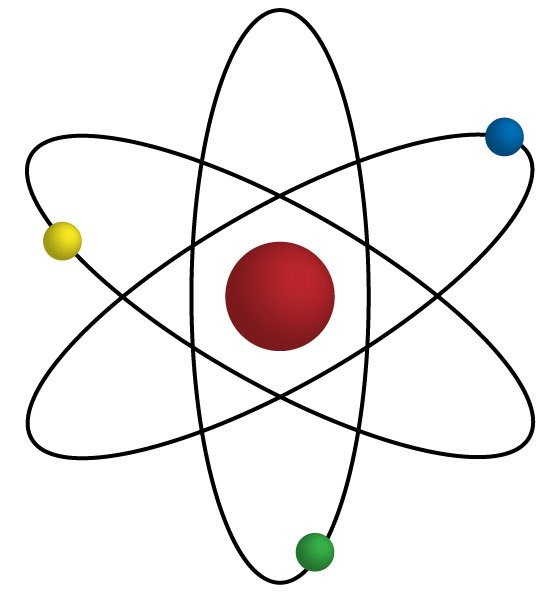
What are the 3 particles that make-up the atom?
a)
protons, neutrons, and isotopes
b)
neutrons, isotopes, and electrons
c)
positives, negatives, and electrons
d)
protons, neutrons, and electrons
8.
Atoms are mostly filled with?
a)
electrons
b)
empty space
c)
protons
d)
energy
9.
Electrons are found?
a)
Outside the nucleus
b)
Inside the nucleus
c)
Both inside and outside the nucleus
d)
It is unknown where electrons are found.
10.
Electrons:
a)
Have a negative charge
b)
Have a positive charge
c)
Have no charge
d)
The charge is unknown
11.
What is a subatomic unit has a positive charge?
a)
Proton
b)
Neutron
c)
Electron
d)
Nucleus
12.
What are the negatively charged particles found outside the nucleus?
a)
Electron
b)
Proton
c)
Neutron
d)
Nucleus
13.
What is the part of the nucleus with no electrical charge?
a)
Neutron
b)
Electron
c)
Proton
d)
Nucleus
14.
Who wrote the atomic theory?
a)
John Dalton
b)
Democritus
c)
J.J. Thompson
d)
Aristotle
15.
The first person to ever talk about an atom was
a)
Democritus
b)
Rutherford
c)
Dalton
d)
Thompson
16.
How did Rutherford discover the proton?
a)
Cathode tube ray experiment
b)
Gold Foil Experiment
c)
Planetary Model
d)
Plum Pudding Model
17.

What scientist is best known for his "Plum Pudding" model of the atom?
a)
J.J. Thompson
b)
Ernest Rutherford
c)
John Dalton
d)
Matthew Martin
18.

What contribution did John Dalton make to atomic theory?
a)
He discovered that every atom was positively charged.
b)
He discovered that every element consisted of one type of atom.
c)
He discovered that atoms had nuclei.
d)
He discovered that atoms could be divided into smaller parts.
19.

Place the following scientists in order, from earliest to latest:
A) Ernest Rutherford
B) J.J. Thomson
C) John Dalton
A) Ernest Rutherford
B) J.J. Thomson
C) John Dalton
a)
B,C,A
b)
C,A,B
c)
A,C,B
d)
C,B,A
20.

J.J. Thomson provided evidence that an atom...
a)
is the smallest particle of matter
b)
contains negatively charged particles
c)
has an overall negative charge
d)
has an overall positive charge
21.
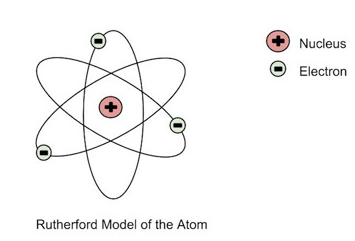
Rutherford's gold foil experiment provided evidence that...
a)
negative and positive charges are spread evenly throughout the atom.
b)
alpha particles have a positive charge.
c)
gold is not a dense as previously thought.
d)
there is a dense positively charged nucleus at the center of an atom.
22.
An atom's overall charge is ________.
a)
positive
b)
depends
c)
neutral
d)
negative
23.
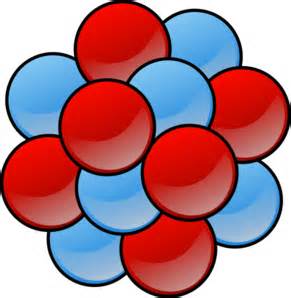
What does the nucleus of an atom contain?
a)
Electrons and neutrons
b)
Protons and neutrons
c)
Neutrinos and positrons
d)
DNA and RN
24.

Who came up with this model of an atom?
a)
J.J. Thompson
b)
Ernest Rutherford
c)
Neils Bohr
d)
James Chadwick
25.
The word atom comes from a Greek word "atomos" that means
a)
Invisible
b)
Indivisible
c)
Undivided
d)
Indestructable
26.
What is the atomic number of Zinc?
a)
65
b)
66
c)
30
d)
31
27.
What is the atomic mass of Calcium?
a)
20
b)
21
c)
39
d)
40
28.
What element has the atomic number of 52?
a)
Tellurium
b)
Chromium
c)
Antimony
d)
Iodine
29.
What element has the atomic mass of 127?
a)
Iodine
b)
Oganesson
c)
Astatine
d)
Xenon
30.
Atomic number tells you how many __________ are in the nucleus of an atom and the atomic mass tells you number of __________ and ___________ in the nucleus of an atom.
a)
electrons; protons and electrons
b)
protons; protons and electrons
c)
protons; electrons and neutrons
d)
protons; protons and neutrons
Reset

