
Font size
S
M
L
XL
 Worksheets
PSH Post Test Review
Total questions: 82
Worksheet time: 1hrs 2mins
Name
Class
Date
1.

Can your displacement ever be greater than your distance?
a)
Yes
b)
No
2.

Describe the motion of the graph.
a)
the slope is zero
b)
the speed is zero
c)
the velocity is zero
d)
all the above
3.

What information does the slope of a line tell you?
a)
distance
b)
displacement
c)
speed
d)
velocity
4.

Why don't the runners in the 400m dash start at the same line?
a)
so their distance is the same
b)
so their displacement is the same
c)
so their speed is the same
d)
so their velocity is the same
5.

Which turtle won the race?
a)
Bill
b)
Myrtle
c)
Zed
6.

If a sprinter runs 200m W and 100m E, what is his displacment?
a)
300m
b)
300m W
c)
100m
d)
100m W
7.

Acceleration is the rate of change of
a)
position
b)
time
c)
speed
d)
velocity
8.

A horizontal line on a graph shows
a)
positive acceleration
b)
negative acceleration
c)
change
d)
zero acceleration
9.

Which is an example of a car NOT accelerating?
a)
moving at 80km/h on a flat, straight highway
b)
slowing down to round a corner
c)
speeding up to win the race
d)
crossing the finish line and pulling into the pit
10.

Which describes how velocity changes over time?
a)
acceleration
b)
average speed
c)
velocity
d)
instantaneous speed
11.

If you want to calculate the acceleration, you ________ the change in speed by the time
a)
add
b)
subtract
c)
divide
d)
multiply
12.

The slope of a speed/time graph shows
a)
direction
b)
acceleration
c)
velocity
d)
speed
13.

How could a jogger accelerate?
a)
run uphill then downhill
b)
run 10 miles N then run 10 miles back
c)
jog, stop, rest, start again
d)
speed up, slow down, turn corners
14.

How can acceleration be zero?
a)
a car runs out of gas and slowly rolls to a stop
b)
a car decreases speed at a constant rate until it comes to rest
c)
car has constant speed and is traveling on a straight path
d)
the car travels round trip and is back at the starting point
15.

The feather falls slower because
a)
friction
b)
gravity
c)
tension
d)
air resistance
16.

When unbalanced forces act
a)
the motion does not change
b)
object accelerates
c)
the inertia increases
d)
the mass decreases
17.

The teacher walks 2m E, 2m S, 2m W and 2mN, What is her distance?
a)
8m
b)
16m
c)
0m
d)
2m
18.
The teacher walks 2m E, 2m S, 2m W and 2mN, What is her displacment?
a)
8m
b)
16m
c)
0m
d)
2m
19.

A magician pulls a tablecloth out from under dishes and glasses on a table without disturbing them.
a)
Newton's 1st Law
b)
Newton's 2nd Law
c)
Newton's 3rd Law
20.

Rockets are launched into space using jet propulsion where exhaust accelerates out from the rocket and the rocket accelerates in an opposite direction.
a)
The Law of Inertia
b)
The Law of Acceleration
c)
The Law of Conservation of Momentum
21.

A person not paying attention while skateboarding hits a rock. The skateboard stops...they don't.
a)
The Law of Inertia
b)
The Law of Acceleration
c)
The Law of Conservation of Momentum
22.

Pushing a child on a swing is easier than pushing an adult on the same swing, because the adult has more inertia.
a)
Newton's 1st Law
b)
Newton's 2nd Law
c)
Newton's 3rd Law
23.

A soccer ball accelerates more than a bowling ball when thrown with the same force.
a)
Law of Inertia
b)
Law of Acceleration
c)
Law of Conservation of Momentum
24.

A student leaves a pencil on a desk and the pencil stays in the same spot until another student picks it up.
a)
Law of Inertia
b)
Law of Acceleration
c)
Law of Conservation of Momentum
25.

This person bought coffee and put it on the seat next to them. If they stopped quickly and the coffee spilled which law would that represent?
a)
Newton's 1st Law
b)
Newton's 2nd Law
c)
Newton's 3rd Law
26.
The momentum of an object depends upon the object's ___________&_____________.
a)
size and shape
b)
mass and speed
c)
mass and veloctiy
d)
mass and energy
27.
The equation to calculate momentum is
a)
p=mv
b)
p=1/2mv2
c)
p=mgh
d)
p=mg
28.
When the speed of an object is doubled, its momentum
a)
remains unchanged in accord with the conservation of momentum.
b)
doubles
c)
quadruples
d)
decreases
29.

A runner has a momentum of 670 kg m/s and is traveling at a velocity of 9 m/s. What is his mass?
a)
74.4 kg
b)
6030 kg
c)
0.0134 kg
d)
80 kg
30.
A 2 kg cart has a momentum of 16 kg m/s. What is its velocity?
a)
8 m/s
b)
32 m/s
c)
0.125 m/s
d)
18 m/s
31.
What are the units of Force?
a)
kg m/sec
b)
kg m
c)
N
d)
N sec
32.
Both mass and velocity are _______________ proportional to momentum.
a)
Directly
b)
Inversely
33.
The total momentum before a collision is _________ the total momentum after a collision.
a)
equal to
b)
less than
c)
more than
d)
It depends on the type of collision
34.
Which of the following has the least amount of momentum?
a)
An ant walking along the ground
b)
An ant at rest
c)
An elephant walking
d)
An elephant running
35.
If two objects have the same mass, then the faster moving object has ____________ momentum.
a)
more
b)
less
c)
the same
36.
What is the unit for momentum?
a)
m/sec
b)
kg/sec
c)
kg/m
d)
kg m/sec
37.
What is the unit for velocity?
a)
m/sec
b)
kg/sec
c)
kg/m
d)
kg m/sec
38.
What is the unit for mass?
a)
m/sec
b)
kg/sec
c)
kg
d)
kg m/sec
39.
In the momentum equation, how do you calculate velocity?
a)
v=d/t
b)
v=pm
c)
v=p/m
d)
v=m/p
40.
In the momentum equation, how do you calculate mass?
a)
m=vp
b)
m=pv
c)
m=v/p
d)
m=p/v
41.
How can a tennis ball and a bowling ball have the same momentum?
a)
have the same speed
b)
have different speeds
c)
one is moving backwards
d)
they can't
42.
Determine the momentum of 1000-kg car moving northward at 20 m/s.........
a)
20000 N
b)
20000 Joules
c)
20000 Kg * m/s
d)
20000 kg * m/s north
43.
An object with a mass of 2000 kg at rest has what momentum?
a)
2000 kg m/sec
b)
0 kg m/sec
c)
2000 kg
d)
2000 m/sec
44.
This variable in an experiment is the one being deliberately changed by the scientist.
a)
dependent variable
b)
independent variable
c)
data
d)
control group
45.
A possible explanation to a problem that has not yet been tested.
a)
data
b)
theory
c)
hypothesis
d)
fact
46.
In a controlled experiment, how many variables can be worked with at a time?
a)
one
b)
none
c)
two or more
d)
how ever many makes sense.
47.
Which variable depends on what is done at the beginning of an experiment?
a)
Dependent
b)
Independent
c)
Control
d)
Following
48.
An experiment is performed on plants to see how different liquids affect plant growth. Each plant in the experiment is given a different liquid; water, apple juice, or milk. Each plant has the same amount of soil, sunlight, and listens to the same music. In this investigation, what is the dependent variable?
a)
Type of plant
b)
Water, apple juice, milk
c)
Plant growth
d)
Color of the plant's leaves
49.

Squidward found new reeds to tryout for his clarinet. He used an APPLAUSOMETER to measure applause after playing Under the Sea with each reed. The results were put in the table.
What was the independent variable?
What was the independent variable?
a)
The Song
b)
The Reed
c)
The Applause
50.

Mr. Krabbs is trying a new money making scheme. On Tuesdays he is selling his crabby patties on multicolored buns. He usually averages 25 customers per day. On Tuesdays he now averages 27 customers.
What was the dependent variable?
What was the dependent variable?
a)
The customers
b)
The crabby patty
c)
The multicolored buns
d)
The number of customers
51.

A hypothesis is part of the scientific method. True or False?
a)
False
b)
True
52.
Data we get by using our senses.
a)
inferences
b)
observations
c)
hypothesis
53.
A series of steps used by scientists to solve a problem or answer a question.
a)
scientific method
b)
recipe
c)
data collection
d)
metric system
54.
Which variable do you measure?
a)
Independent
b)
Dependent
55.
Which variable do you change in an experiment?
a)
Dependent
b)
Independent
56.
Mr. S normally uses praise as a reward to train his dog. He wants to know the best way to train his dog, so he sets up an experiment to find out if there is a better way to get his dog to respond to commands. What is his independent variable?
a)
Type of reward
b)
Praise
c)
Type of dog
d)
Amount of time the dog follows commands
57.
Mr. S normally uses praise as a reward to train his dog. He wants to know the best way to train his dog, so he sets up an experiment to find out if there is a better way to get his dog to respond to commands. What is his dependent variable?
a)
Type of reward
b)
Praise
c)
Type of dog
d)
Amount of time the dog follows commands
58.
A student wants to test the effects of type of exercise on heart rate. What is the dependent variable?
a)
heart rate
b)
type of exercise
c)
amount of exercise
d)
time of day exercise occurs
59.
How many variables can be tested in a controlled experiment?
a)
one
b)
two
c)
three
d)
as many as possible
60.
What step does every scientific experiment begin with?
a)
hypothesis
b)
question/problem
c)
procedures
d)
conclusion
61.
Why do we want to test one variable at a time?
a)
Because it is hard to setup a data table with more
b)
To know what is causing the changes
c)
It is what has always been done
d)
No one really knows
62.
How does adding cardio to one’s daily schedule affect their heart rate?
a)
independent
b)
dependent
63.
Mr. S set up an experiment to see how the mass of a ball affects the distance it rolls off a ramp. Identify the independent variable.
a)
Distance traveled by the ball
b)
Height of the ramp
c)
Mass of the ball
64.

In any collision (crash) the ______ is ALWAYS constant
a)
Total Momentum
b)
total speed
c)
total Velocity
d)
Energy
65.
Which object listed below has the greatest momentum?
a)
A 0.05 kg object rolling at 0.2 m/s.
b)
A 0.15 kg object rolling at 2 m/s.
c)
A 0.15 kg object rolling at 1 m/s
d)
A 0.4 kg object rolling at 2 m/s.
66.
What are the units of Force?
a)
kg m/sec
b)
kg m
c)
N
d)
N sec
67.
What law is best described by inertia?
a)
1st
b)
2nd
c)
3rd
68.

a)
1st
b)
2nd
c)
3rd
69.

a)
1st
b)
2nd
c)
3rd
70.

a)
1st
b)
2nd
c)
3rd
71.

a)
1st
b)
2nd
c)
3rd
72.
Object at rest stays at rest.
a)
1st
b)
2nd
c)
3rd
73.
F = MxA
a)
1st
b)
2nd
c)
3rd
74.
Equal and Opposite
a)
1st
b)
2nd
c)
3rd
75.
Action/Reaction
a)
1st
b)
2nd
c)
3rd
76.
What is MOVEMENT?
a)
Inertia
b)
Force
c)
Work
d)
Motion
77.
What is a PUSH or PULL of an object?
a)
Motion
b)
Force
c)
Friction
d)
Gravity
78.
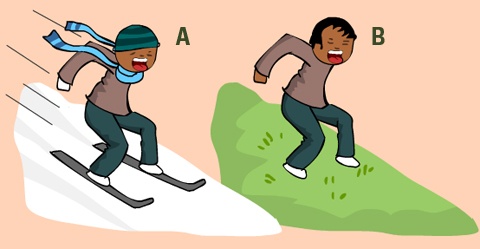
Why is it harder for the boy in Image B to get down the hill?
a)
Motion
b)
Friction
c)
Work
d)
Displacement
79.
Which force produces a change in motion?
a)
unbalanced force
b)
balanced force
c)
gravitational force
d)
frictional force
80.
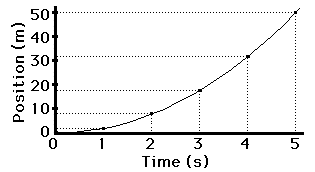
The picture of the position vs. time graph shows an object that is...
a)
accelerating/speeding up
b)
moving at a constant speed
c)
not moving
d)
accelerating/slowing down.
81.
Why does a rolling ball stop?
a)
Gravity
b)
Friction
c)
Waterfalls
d)
Sand
82.
The amount of matter in an object
a)
weight
b)
force
c)
gravity
d)
mass
Reset

