
 Worksheets
Pedigrees,punnet, traits
Total questions: 63
Worksheet time: 1hrs 22mins
Name
Class
Date
1.
Aa, DD, bB, yy are all examples of
a)
genotypes
b)
phenotypes
2.
AA and Aa always show up as
a)
dominant
b)
recessive
3.
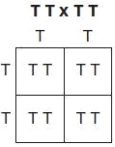
What ratio of the offspring from the cross shown will be homozygous recessive for the trait of tallness?
a)
0 in 4
b)
1 in 4
c)
2 in 4
d)
4 in 4
4.
Which of the following genotypes is homozygous dominant?
a)
A
b)
Aa
c)
AA
d)
aa
5.
Which of the following genotypes is heterozygous?
a)
Bb
b)
BB
c)
bb
d)
B
6.
In a flowering plant species, red flower color (R) is dominant over white flower color (r). What is the genotype of any red-flowering plant resulting from this species?
a)
rr
b)
R
c)
RR
d)
RR or Rr
7.
Which of the characteristics is a lion least likely to pass on to its offspring?
a)
fur color
b)
length of tail
c)
scars on leg
d)
body size
8.
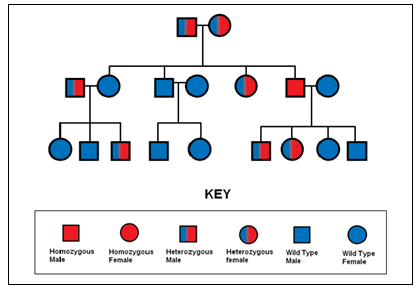
In a pedigree, what shape represents a male?
a)
circle
b)
square
c)
triangle
d)
diamond
9.
In a heterozygous genotype, the ___________ allele takes over in the phenotype.
a)
recessive
b)
dominant
c)
lower case letter
d)
both
10.
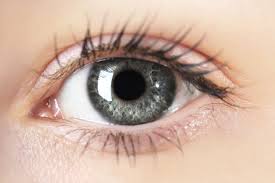
What you see, or the physical appearance.
a)
Genotype
b)
Phenotype
c)
Homozygous
d)
Heterozygous
11.
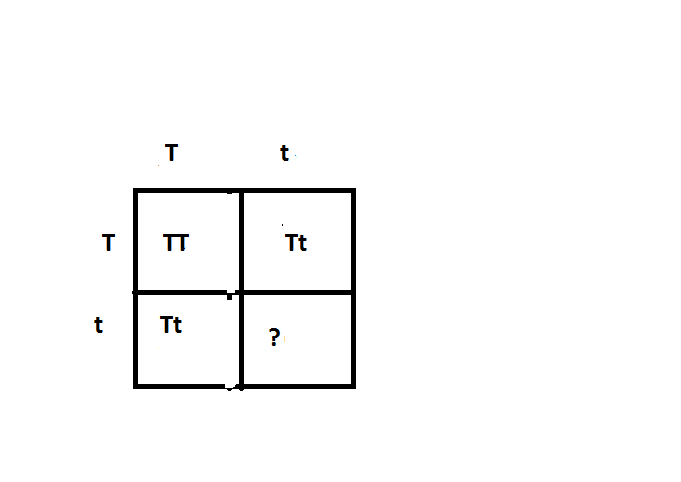
T - tall and t = short
In the punnett square below, what belongs in the missing square
In the punnett square below, what belongs in the missing square
a)
tt
b)
Tt
c)
Bb
d)
TT
12.
B = brown eyes
b = blue eyes
What is true about these two brothers that have brown eyes?
One has genotype BB the other Bb.
b = blue eyes
What is true about these two brothers that have brown eyes?
One has genotype BB the other Bb.
a)
they have same phenotype and genotype
b)
they have different genotypes and phenotypes
c)
they have same phenotype but different genotypes
d)
they have same genotype but different phenotypes
13.
aa always shows up as
a)
dominant
b)
recessive
14.
Aa is
a)
homozygous
b)
heterozygous
15.
Which of the following is a phenotype?
a)
Aa
b)
red hair
c)
heterozygous
d)
DNA
16.
Which of the following is homozygous dominant?
a)
Yy
b)
Y
c)
yy
d)
YY
17.
Which of the following is homozygous recessive?
a)
Tt
b)
tt
c)
TT
d)
T
18.
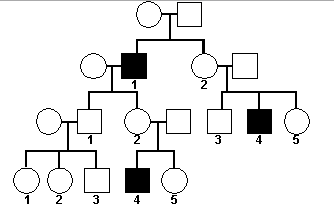
What type of heredity is shown in the pedigree?
(hint: check your notes - "modes of inheritance")
(hint: check your notes - "modes of inheritance")
a)
Sex-Linked Dominant
b)
Sex-Linked Recessive
c)
Autosomal Dominant
d)
Autosomal Recessive
19.
What gender has an X and a Y chromosome?
a)
male
b)
female
c)
transgender
d)
all of the above
20.
Complex molecule that carries genetic information that defines an organism's traits. It is stored in the nucleus.
a)
DNA
b)
protein
c)
RNA
d)
glucose nucleic acid (GNA)
21.
How many alleles (letters) do each person carry for a trait?
a)
1
b)
2
c)
3
d)
4
22.
How many alleles (letters) does a child get from each parent for each trait?
a)
1
b)
2
c)
3
d)
4
23.
Dominant alleles are represented by a:
a)
Male gene
b)
lowercase letter
c)
recessive trait
d)
capital letter
24.
W=white hair
w= non-white hair
If you cross a horse with WW and a horse with ww what fraction of the offspring would be expected to have white hair?
w= non-white hair
If you cross a horse with WW and a horse with ww what fraction of the offspring would be expected to have white hair?
a)
none
b)
3/4
c)
1/2
d)
all
25.

Examine the pedigree. The allele for the presence of a widow’s peak is dominant. Therefore, we can tell from the chart that in the couple labeled 2:
a)
the male is heterozygous and the female is homozygous.
b)
the male is homozygous and the female is heterozygous.
c)
the male is homozygous and the female is homozygous.
d)
the male is heterozygous and the female is heterozygous.
26.
What do we use pedigrees for?
a)
To look at families
b)
To make determinations about the offspring
c)
To track traits in families
d)
Nothing
27.

Give the genotype for person III-3
a)
GG
b)
Gg
c)
gg
28.

Give the genotype for person II-1
a)
GG
b)
Gg
c)
gg
29.

Freckles (F) are dominant over nonfreckles. What is the phenotype of individual #3
a)
Ff
b)
ff
c)
freckles
d)
nonfreckles
30.

What is the relationship between person I 1 and III 2?
a)
Father and Son
b)
Father and Daughter
c)
Grandfather and Granddaughter
d)
Uncle and Niece
31.

What percentage of the offspring will have this recessive disease?
a)
0%
b)
25%
c)
50%
d)
75%
32.
Hemophilia is a recessive x-linked disorder.
Which genotype represents a female who is a carrier for hemophilia?
Which genotype represents a female who is a carrier for hemophilia?
a)
XHXh
b)
XhXh
c)
XHXH
d)
XhY
33.
Hemophilia is a recessive x-linked disorder.
Which genotype represents a male with hemophilia?
Which genotype represents a male with hemophilia?
a)
XHXh
b)
XhXh
c)
XHY
d)
XhY
34.
Colorblindness is a recessive x-linked disorder.
Which genotype represents a male with normal vision?
Which genotype represents a male with normal vision?
a)
XNXN
b)
XnXn
c)
XNY
d)
XnY
35.
Colorblindness is a recessive x-linked disorder.
Which genotype represents a female who is colorblind?
Which genotype represents a female who is colorblind?
a)
XNXn
b)
XnXn
c)
XNXN
d)
XnY
36.

Which of the following genotypes belongs in the red box in the Punnett square?
a)
XBXb
b)
XbXb
c)
XbY
d)
XBY
37.

In fruit flies, red eye color (R) is a sex-linked trait that is dominant over white eye color (r).
According to the Punnett square, what percentage of offspring will have white eyes?
According to the Punnett square, what percentage of offspring will have white eyes?
a)
0%
b)
25%
c)
50%
d)
100%
38.

In fruit flies, red eye color (R) is a sex-linked trait that is dominant over white eye color (r).
According to the Punnett square, what percentage of female offspring will have red eyes?
According to the Punnett square, what percentage of female offspring will have red eyes?
a)
0%
b)
25%
c)
50%
d)
100%
39.

Which of the following genotypes belongs in the red box in the Punnett square?
a)
XBXb
b)
XbXb
c)
XBXB
d)
XbY
40.

Duchenne muscular dystrophy is a recessive x-linked disorder.
According to the Punnett square, what percentage of offspring will have the disorder?
According to the Punnett square, what percentage of offspring will have the disorder?
a)
0%
b)
25%
c)
50%
d)
100%
41.

Hemophilia is a recessive x-linked disorder. According to the Punnett square, what percentage of offspring will have the disorder?
a)
0%
b)
25%
c)
50%
d)
100%
42.

Hemophilia is a recessive x-linked disorder. According to the Punnett square, what percentage of offspring will have the disorder?
a)
0%
b)
25%
c)
50%
d)
100%
43.

Mike has type O blood. Mike can receive blood from someone who has Type A or Type B.
a)
True
b)
False
44.
What is NOT a possible genotype for someone with type B blood?
a)
BB
b)
AB
c)
BO
45.
What are the blood types of the possible children that a woman (type O) and man (type AB) can have?
a)
O and AB
b)
O and A
c)
O and B
d)
A and B
46.
Which term(s) best describes the inheritance of human blood types?
a)
incomplete dominance and multiple alleles
b)
codominance and epistasis
c)
codominance and multiple alleles
d)
incomplete dominance and codominance
47.
A man with type O blood is accused of being the father of a type B baby. The mother is type A. Could this man be the father?
a)
Yes
b)
No
48.
If a woman is a carrier for a sex linked recessive trait of hemophilia and her husband has hemophilia, which of the following is true? Make a punnett square!
a)
All sons will have hemophilia
b)
all daughters will have hemophilia
c)
50% of daughters and 50% of sons have hemophilia
d)
100% of sons have hemophilia and 100% of daughters are carriers
49.

What percentage of the offspring will have this recessive disease?
a)
0%
b)
25%
c)
50%
d)
75%
50.
In fruit flies, red eye color (R) is a sex-linked trait that is dominant over white eye color (r).
According to the Punnett square, what percentage of female offspring will have red eyes?
According to the Punnett square, what percentage of female offspring will have red eyes?
a)
0%
b)
25%
c)
50%
d)
100%
51.
In fruit flies, red eye color (R) is a sex-linked trait that is dominant over white eye color (r).
According to the Punnett square, what percentage of offspring will have white eyes?
According to the Punnett square, what percentage of offspring will have white eyes?
a)
0%
b)
25%
c)
50%
d)
100%
52.
In fruit flies, red eye color (R) is a sex-linked trait that is dominant over white eye color (r).
According to the Punnett square, what percentage of offspring will have white eyes?
According to the Punnett square, what percentage of offspring will have white eyes?
a)
0%
b)
25%
c)
50%
d)
100%
53.
Type of traits that are inherited by Boys more often than girls.
a)
Autosome Recessive
b)
Autosome Dominant
c)
Sex Linked Dominant
d)
Sex Linked Recessive
54.
Characteristics that ARE NOT carried on the X or Y chromosomes are carried on _____ chromosomes.
a)
Autosome
b)
Sex
c)
Recessive
d)
Dominant
55.

This graphic shows an example of...
a)
Sex Linked Trait
b)
Complete Dominance
c)
Co-Dominance
d)
Incomplete Dominance
56.

Circles are females. Filled in are affected by a disease. This pedigree is likely tracing a ___________ disease through a family?
a)
Autosomal Dominant
b)
Autosomal Recessive
57.

Circles are females. Filled in are affected by a disease. This pedigree is likely tracing a ___________ disease through a family?
a)
Sex Linked Recessive
b)
Autosomal Dominant
c)
Autosomal Recessive
58.

Circles are females. Filled in are affected by a disease. This pedigree is likely tracing a ___________ disease through a family?
a)
Sex Linked Recessive
b)
Sex Linked Dominant
c)
Autosomal Dominant
d)
Autosomal Recessive
59.

Circles are females. Filled in are affected by a disease. This pedigree is likely tracing a ___________ disease through a family?
a)
Sex Linked Recessive
b)
Sex Linked Dominant
c)
Autosomal Dominant
d)
Autosomal Recessive
60.

a)
Not Affected Male
b)
Not Affected Female
c)
Affected Male
d)
Affected Female
61.

a)
Not affected Female
b)
Not affected Male
c)
Affected Male
d)
Affected Female
62.

The genotype of the affected son and daughter at the bottom of this pedigree...
a)
homozygous dominant
b)
homozygous recessive
c)
heterozygous
d)
Can't tell
63.

The genotype of the affected son and daughter at the bottom of this pedigree must be:
a)
homozygous dominant
b)
homozygous recessive
c)
heterozygous
d)
Can't tell
100 %

