
 Worksheets
Matter and Measurement
Total questions: 56
Worksheet time: 2hrs 39mins
Name
Class
Date
1.
The tool used to measure the mass of a substance or object is a ______________.
a)
balance
b)
graduated cylinder
c)
ruler
d)
thermometer
2.
Jack has a rock. The rock has a mass of 14g and a volume of 2cm3. What is the density of the rock?
a)
7 mL
b)
7 g/cm3
c)
28 g/cm3
d)
1/7 g/cm3
3.

What is the volume of Object X?
a)
10.0 cm3
b)
15.0 cm3
c)
20.0 cm3
d)
25.0 cm3
4.

Which box has a higher density?
a)
Box A
b)
Box B
c)
cannot be determined
d)
they are the same
5.
What is the formula for density?
a)
density = mass x volume
b)
density = mass / volume
c)
density = mass + volume
d)
density = mass - volume
6.

Calculate the density of the cube.
a)
2 g/cm3
b)
4 g/cm3
c)
6 g/cm3
d)
8 g/cm3
7.
Which of the following would float on water? Remember, water has a density of 1.0g/cm3 .
a)
Honey 1.30 g/cm3
b)
Lamp Oil .80 g/cm3
c)
Pepsi 1.04 g/cm3
8.

In the water displacement method for finding volume
a)
You subtract the final volume from the initial volume
b)
You subtract the initial volume from the final volume
c)
You add the initial and final volumes
d)
You divide the final volume by 2
9.
Density is a characteristic property of a substance. This means that the density of water
a)
Changes depending on the volume
b)
Stays the same regardless of the volume
c)
Is greater for a greater mass of water
d)
Is less for a smaller mass of water
10.
An object should float in a liquid if it is
a)
Denser than the liquid
b)
Less dense than the liquid
c)
Lighter than metal
d)
Shaped like a ball
11.

What is the name of this instrument?
a)
Graduated Cylinder
b)
Pipet
c)
Triple Beam Balance
d)
Beaker
12.

What units should be used with the reading on this scientific tool?
a)
Milliliter
b)
Liter
c)
centimeter
d)
gram
13.

Measure to the nearest milliliter.
a)
73 mL
b)
73.0 mL
c)
76 mL
d)
76.1 mL
14.

What unit should be used when reading this scientific instrument?
a)
gram
b)
kilogram
c)
centimeter
d)
millimeter
15.

What property is a balance used to measure?
a)
Size of an object
b)
Mass of an object
c)
Flexibility of an object
d)
Weight of an object
16.

What is the length of the crayon?
a)
7.1 cm
b)
4.5 mL
c)
4.4 g
d)
3.4 cm
17.

What is the mass on this triple beam balance?
a)
272.1 g
b)
272.1 lb
c)
272.1 oz
d)
272.1 kg
18.
When a gas changes its phase and turns into a liquid it is known as
a)
condensation.
b)
sublimation.
c)
vaporization.
d)
freezing or solidification.
19.
Which of the following is a sign that a chemical reaction has occurred?
a)
change in shape
b)
melting
c)
formation of a gas
d)
dissolving
20.
Is melting butter for popcorn a chemical or physical change?
a)
chemical
b)
physical
21.

Is burning wood a chemical or physical change?
a)
chemical
b)
physical
22.
A change in the size, shape, or state of matter.
a)
chemical change
b)
physical change
c)
chemical reaction
d)
electron change
23.
Which of the following is NOT an example of a physical change?
a)
crumpled paper
b)
pencil sharpening
c)
shrunken clothing
d)
sour milk
24.
Kim puts an ice cube in a beaker and it melts. This is a good example of:
a)
a physical change.
b)
a chemical change.
c)
an experiment.
d)
an analysis.
25.
Adding baking soda and vinegar together and it fizzes and creates carbon dioxide.
a)
Chemical
b)
Physical
26.
Which of the following is NOT a physical property?
a)
breaking a window
b)
color
c)
denisty
d)
freezing point
27.
Which of the following properties is a physical property?
a)
magnetism
b)
reactivity with oxygen
c)
flammability
d)
non-reactive
28.
Which is a chemical change?
a)
freezing fruit juice
b)
slicing a potato
c)
boiling water
d)
copper metal turning green
29.
what is the definition of chemical change?
a)
any change that results in the formation of new chemical substances.
b)
changing clothes
c)
matter cannot be created or destroyed, only change form
d)
changes affecting the form of a chemical substance, but not its chemical composition.
30.
which one is the definition of chemical property?
a)
a property or characteristic of a substance that is observed during a reaction where the chemical composition of a substance is changed
b)
any change that results in the formation of new chemical substances
c)
combustibility
31.
what is the definition of physical change?
a)
any change that results in the formation of new chemical substances.
b)
rusting
c)
changes affecting the form of a chemical substance, but not its chemical composition.
d)
any property that is measurable, whose value describes a state of a physical system
32.
What is the definition of chemical reaction?
a)
The input which reacts chemically to create product
b)
a system where none of the reactants or products are allowed to escape
c)
occurs when the atoms and molecules of two or more substances rearrange to form new substances
d)
the output, or result of a chemical reaction
33.
What is a reactant in a chemical equation?
a)
The input which reacts chemically to create product
b)
the output, or result of a chemical reaction
c)
a small molecule that makes up one part of a polymer
d)
compounds made of thousands of repeating smaller molecules
34.
What is a closed system?
a)
a system where none of the reactants or products are allowed to escape
b)
compounds made of thousands of repeating smaller molecules
c)
the output, or result of a chemical reaction
d)
occurs when the atoms and molecules of two or more substances rearrange to form new substances
35.
Fill in the blank:
The law of conservation of mass states that matter cannot be created nor __________________.
The law of conservation of mass states that matter cannot be created nor __________________.
a)
destroyed
b)
rearranged
c)
transferred
d)
changed
36.
In a chemical reaction, the mass of the reactants was 15g. The mass of the products was 12g. Did this chemical reaction follow the law of conservation of mass?
a)
Yes
b)
No
c)
You can't tell with the given infomation
37.
In a closed system, a chemical reaction takes place. The mass of the reactants in the beginning of the reaction is 25g. What does the mass have to be in the end of the reaction in order to follow the law of conservation of mass?
a)
25g
b)
You can't tell with the given information.
c)
30g
d)
15g
38.
The following chemical reaction occurs:
2S + 3O2 -> 2SO3
How many atoms of oxygen are there in the reactant?
2S + 3O2 -> 2SO3
How many atoms of oxygen are there in the reactant?
a)
2 atoms of oxygen
b)
3 atoms of oxygen
c)
6 atoms of oxygen
d)
1 atom of oxygen
39.
All living things are made of:
a)
water
b)
mass
c)
space
d)
matter
40.
Matter has :
a)
air and water
b)
mass and takes up space
c)
mass and energy that leak out
d)
compounds only
41.
Compounds are made up of :
a)
2 or more atoms that are the same type
b)
2 or more atoms of different types
c)
3 or more carbon atoms
d)
2 or more oxygen atoms
42.
A pure substance that cannot be broken down into simpler substance by chemical reactions is called a(n)
a)
compound
b)
atom
c)
element
d)
acid
43.
Two or more atoms joined together is called a(n)
a)
compound
b)
molecule
c)
atom
d)
element
44.

In this picture, which represents atoms?
a)
A
b)
B
c)
C
45.

In this picture, which one represents a compound?
a)
A
b)
B
c)
C
46.
What type of substance is always made up of a single type of atom?
a)
compound
b)
mixture
c)
molecule
d)
element
47.
How could you break down the compound calcium carbonate into the elements that make it up?
a)
by melting
b)
by crushing
c)
with a filter
d)
with chemical changes
48.

This diagram represents a _____.
a)
pure substance that is a compound
b)
mixture of elements and compounds
c)
pure substance that is an element
d)
mixture of compounds
49.

This diagram represents a _____.
a)
pure substance that is a compound
b)
mixture of elements
c)
pure substance that is an element
d)
mixture of compounds
50.

This diagram represents a _____.
a)
pure substance that is a compound
b)
mixture of elements
c)
pure substance that is an element
d)
mixture of compounds
51.
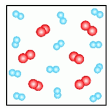
This diagram represents a _____.
a)
pure substance that is a compound
b)
mixture of elements
c)
pure substance that is an element
d)
mixture of compounds
52.
Solubility is defined as
a)
the ability to catch on fire
b)
the ability to be dissolved
c)
the ability to fly.
d)
the ability to get on Mrs. D's nerves.
53.
The approximate number of elements we know about today is .......
a)
18
b)
48
c)
118
d)
1018
54.
Which of these is a property of metals?
a)
It's malleable
b)
It can't conduct electricity
c)
They are used in food
d)
It's very brittle
55.

Is flammability a physical or chemical property?
a)
Physical
b)
Chemical
56.

Is color a physical or chemical property?
a)
Physical
b)
Chemical
100 %

