
 Worksheets
Biology Unit 2 Practice Test
Total questions: 59
Worksheet time: 48mins
Name
Class
Date
1.
I am way bigger in plant cells than I am in animal cells. What am I?
a)
Golgi Apparatus
b)
Nucleus
c)
Vacuole
d)
Ribosomes
2.
surrounds the cell; regulates what enters/leaves cell; maintains homeostasis
a)
vacuole
b)
cell wall
c)
cell membrane
d)
lysosome
3.
Which statement is NOT part of the Cell Theory?
a)
Only animals are made of cells.
b)
Cells are the basic unit of structure and function in all living things.
c)
All living things are made of cells.
d)
New cells come from existing cells.
4.
Ribosomes are the cell organelle that
a)
Break down food to produce energy for the cell.
b)
Produce proteins for the cell.
c)
Break down broken cell parts.
d)
Make food for the cell using the sun's energy.
5.

Using this image, what organelle is A?
a)
Cell Wall
b)
Large Central Vacuole
c)
Mitochondria
d)
Chloroplast
6.
A group of cells that have similar functions? Examples are nervous, epithelial, muscle and connective
a)
cells
b)
tissues
c)
organs
d)
atoms
7.
surrounds the cell; controls what enters/leaves cell; maintains homeostasis
a)
vacuole
b)
cell wall
c)
cell membrane
d)
lysosome
8.
Which has membrane bound organelles
a)
Prokaryote
b)
Eukaryote
c)
Virus
d)
All of the above
9.

Which organisms lack a cell membrane
a)
Bacteria/Virus
b)
Plant/Animal
c)
Fungus
d)
All cells have a membrane
10.

This organelle acts like a big water balloon in a plant to help give it structure
a)
Chloroplast
b)
Cell wall
c)
Lysosome
d)
Vacuole
11.
Which statement about prokaryotic and eukaryotic cells is true?
a)
Pro contain a nucleus, while euk do not.
b)
Pro are larger than euk.
c)
Euk contain DNA inside a nucleus, whereas pro do not have a nucleus.
d)
Euk have been around longer than pro.
12.
I make proteins for the cell.
a)
ribosome
b)
chloroplast
c)
cell wall
d)
lysosome
13.
What is the major difference between prokaryotic and eukaryotic?
a)
prokaryotic has a nucleus; eukaryotic does not
b)
eukaryotic has a nucleus; prokaryotic does not
c)
prokaryotic has DNA; eukaryotic does not
d)
eukaryotic has a cell wall; prokaryotic does not
14.
What is the total magnification of a microscope when one lens has a magnification of 10x, and the other lens has a magnification of 30x?
a)
15x
b)
30x
c)
40x
d)
300x
15.

Which of the following is NOT a characteristic of a prokaryotic cell?
a)
no organelles
b)
simple
c)
DNA in cytoplasm
d)
nucleus
16.
What is the difference between a plant cell's vacuole and an animal cell's vacuole?
a)
Animal cells do not have vacuoles
b)
The vacuoles in an animal cell are outside of the cell membrane
c)
A plant cells vacuole is larger than an animal cells
d)
A plant cell's vacuole is smaller than an animal cells
17.
The movement of water from an area of high concentration to an area of lower concentration is called
a)
facilitated diffusion
b)
active transport
c)
osmosis
d)
dialysis
18.

Iodine turns dark purple when in contact with starch. After an hour, the solution in the dialysis tubing turned dark purple. Why?
a)
The starch in the tubing diffused out.
b)
The iodine and water diffused in.
c)
The iodine changed into starch.
d)
The starch changed into iodine
19.

Movement of solute through the cell membrane from high to low concentration.
a)
diffusion
b)
active transport
c)
facilitated diffusion
d)
osmosis
20.

what type of solution causes the blood cells to swell and burst.
a)
hypotonic solution
b)
hypertonic solution
c)
isotonic solution
d)
active transport
21.
Active Transport is different from passive transport in that active transport requires energy and . . .
a)
moves molecules from low to high concentration
b)
moves molecules from high to low concentration
c)
keeps things at equlibrium
d)
does not involve the cell membrane
22.

Which of the following items was unable to cross the dialysis tubing and why (from the Osmosis Diffusion Experiment)?
a)
Water because it was too small.
b)
KI because it was too large.
c)
Starch because it was too large.
d)
Water because it is very polar and forms hydrogen bonds.
23.
Diffusion occurs when a substance moves from where it is _________ to where it is _______ concentrated.
a)
more....less
b)
less.....more
24.
Which of the following requires energy in order to transport substances across the membrane?
a)
facilitated diffusion
b)
diffusion
c)
osmosis
d)
active transport
25.
Iodine turns dark purple when in contact with starch. After an hour, the solution in the dialysis tubing turned dark purple. Why?
a)
The starch in the tubing diffused out.
b)
The iodine and water diffused in.
c)
The iodine changed into starch.
d)
The starch changed into iodine
26.

These red blood cells were most likely in a
a)
hypertonic solution
b)
hypotonic solution
c)
isotonic solution
27.

What type of solution is this cell in?
a)
hypertonic
b)
endotonic
c)
isotonic
d)
hypotonic
28.
In multicellular organisms, the cells are
a)
smaller than unicellular organisms
b)
simpler than unicellular organisms
c)
specialized for different functions
d)
all identical and do the same functions
29.
This cell organelle helps organisms maintain homeostasis by controlling what substances may enter or leave cells.
a)
vacuole
b)
nucleus
c)
cell membrane
d)
cell wall
30.
what are two types of passive transport?
a)
endo and exocytosis
b)
cookies and milk
c)
Sodium-Potassium Pumps
d)
Osmosis and diffusion
31.
What might happen to a freshwater plant that is placed into saltwater?
a)
Cells will swell
b)
Plasmolysis
c)
Cytolysis
d)
There will be no change
32.
A cell with a 10% salt solution is placed into a beaker with a 40% salt solution. How will water move?
a)
It will leave the cell
b)
It will enter the cell
c)
It will move in and out equally
d)
There will be no movement
33.
Where are proteins made?
a)
Golgi body
b)
Mitoichondrion
c)
Chromosomes
d)
Ribosomes
34.
Find total magnification for:
Eyepiece = 20X
Objective lens = 20X
Eyepiece = 20X
Objective lens = 20X
a)
20x
b)
40x
c)
200x
d)
400x
35.
What structures distinguish a plant cell from an animal cell?
a)
Plant cells have cell walls and ribosomes.
b)
Plant cells have cell walls and chloroplasts.
c)
Plant cells have chloroplasts and ribosomes.
d)
Plant cells have chloroplasts and mitochondria.
36.
Which of the following is NOT a cell theory.
a)
All non-living things are made of cells
b)
All cells come from pre-existing cells
c)
Cells are the basic unit of structure and function of all living things
37.
What a cell needs to transport particles by active transport?
a)
Sun
b)
Wind
c)
Energy
d)
Channels
38.
Which of the following items was unable to cross the dialysis tubing and why (from the Osmosis Diffusion Experiment)?
a)
Water because it was too small.
b)
KI because it was too large.
c)
Starch because it was too large.
d)
Water because it is very polar and forms hydrogen bonds.
39.
Passive transport requires no
a)
concentration gradients
b)
osmosis
c)
motion
d)
energy
40.
During osmosis
a)
water moves from high to low concentration
b)
large or oddly shaped molecules move across a cell membrane
c)
water moves when energy is used
d)
proteins are built
41.
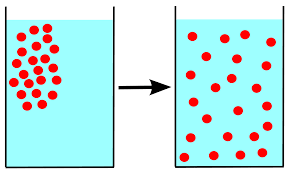
The picture below is an example of _________________.
a)
osmosis
b)
isotonic
c)
diffusion
d)
active transport
42.
Which is NOT a form of active transport?
a)
Endocytosis
b)
Osmosis
c)
Exocytosis
d)
Pinocytosis
43.
Which does NOT require energy to occur?
a)
Passive Transport
b)
Active Transport
c)
Endocytosis
d)
Exocytosis
44.
What is the difference between active and passive transport?
a)
Active does not need energy and passive uses ATP (energy)
b)
Active uses ATP (energy) and passive does not need energy
c)
Active stores transport proteins and passive releases
d)
Active uses hormones and passive does not
45.
Which organelle belongs in plant cells only?
a)
Cell Membrane
b)
Mitochondrion
c)
Chloroplast
d)
Nucleus
46.
Which organelle belongs in plant cells only?
a)
Cytoplasm
b)
Mitochondrion
c)
Cell Wall
d)
Nucleus
47.
Which organelle belongs in plant cells only?
a)
Cytoplasm
b)
Mitochondrion
c)
Large Central Vacuole
d)
Cell Membrane
48.
Which organelle belongs in both plant and animal cells?
a)
Chloroplast
b)
Cell Wall
c)
Large Central Vacuole
d)
Cell Membrane
49.
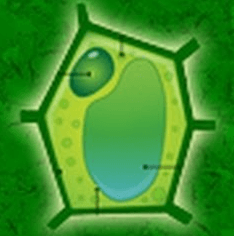
A rigid layer that lies outside the cell's membrane is...
a)
Cytoskeleton
b)
Cilia
c)
Cell Wall
d)
Flagella
50.
animals have chloroplasts
a)
false
b)
true
51.
Plants and animal cells both have a nucleus.
a)
True
b)
False
52.
Where are chloroplasts found?
a)
Plant cells only
b)
Both plant and animal cells
c)
Animal cells only
53.
Provides extra support for the plant cell and gives in shape
a)
chlorophyll
b)
chloroplast
c)
cell wall
d)
vacuole
54.
The movement of molecules against a concentration gradient
a)
simple diffusion
b)
facilitated diffusion
c)
active transport
d)
osmosis
55.
Ideally, your cells should be in a(n) _______ solution
a)
isotonic
b)
hypertonic
c)
hypotonic
d)
isometric
56.
A cell placed in a hypertonic solution will
a)
Stay the same
b)
Shrink- get smaller
c)
Swell- get bigger
57.
When both inside and outside of a cell have the same amount of water it is said that the cell has reached a state of ___________.
a)
osmosis
b)
equilibrium
c)
diffusion
d)
hypertonic
58.
If you looked at red blood cells under a microscope and saw that several of the blood cells had burst, what would you say happened?
a)
The cells were placed in a hypotonic solution.
b)
The cells were placed in a hypertonic solution.
c)
The cells were placed in an isotonic solution.
59.
If a cell is placed in a hypotonic solution, the cell will _______.
a)
stay the same
b)
swell (get bigger)
c)
shrink (get smaller)
100 %

