Wayground logo

Free Printable Worksheets

Font size

S
M
L
XL
Worksheets

PCTI Motion Unit Test Review

Total questions: 50

Worksheet time: 43mins

Name
Class
Date
1.
What is the speed this motion?
a)
constant speed
b)
not moving
c)
speed increasing
d)
speed increasing at a constant rate
2.
What happened during A to B point?
a)
not moving
b)
increasing speed at a constant rate
c)
moving at a constant speed
d)
moving at 10 m/s2 acceleration
3.
What happened during C to D point?
a)
not moving
b)
increasing speed at a constant rate
c)
moving at a constant speed
d)
moving at 0 m/s2 acceleration
4.
What happened during E to F point?
a)
not moving
b)
increasing speed at a constant rate
c)
moving at a 5 m/s
d)
moving at 5 m/s2 acceleration
5.
which line represents the constant acceleration?
a)
A
b)
B and D
c)
C
d)
A, B, and D
6.
which line shows a negative acceleration ?
a)
A
b)
B and C
c)
D
d)
A, B, and 
A, B, and D
7.
What is happening at C?
a)
Stationary
b)
Accelerating
c)
Fast steady speed; moving away from the starting position
d)
Slower steady speed; moving away from the starting position
8.
What is happening at D?
a)
Stationary
b)
Accelerating
c)
Fast steady speed; moving away from the starting position
d)
Slower steady speed; moving away from the starting position
9.
Which runner won the race?
a)
A
b)
B
c)
C
10.
Which runner had a head start?
a)
A
b)
B
c)
C
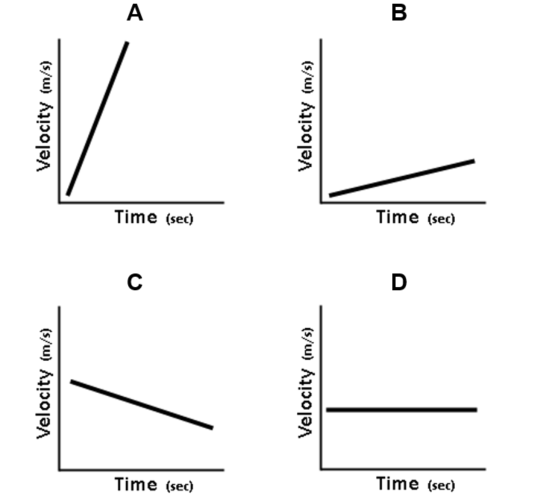
11.
Which graph represents zero acceleration (constant velocity)?
a)
A
b)
B
c)
C
d)
D
12.
Which graph shows the object standing still?
a)
A
b)
B
c)
C
d)
D
13.
What is this graph showing?
a)
Constant Speed
b)
Acceleration (speeding up)
c)
Deceleration (slowing down)
d)
No motion
14.
Velocity is different from speed in that velocity is speed in a given direction.
a)
True
b)
False
15.
A unit of velocity is the meter.
a)
True
b)
False
16.
The rate at which velocity changes with time is called acceleration.
a)
True
b)
False
17.
A unit of acceleration is meters per second.
a)
True
b)
False
18.
Even though a car is slowing down, it is still accelerating, in the most general definition of acceleration.
a)
True
b)
False
19.
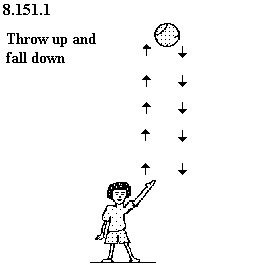
A ball is thrown into the air. At the highest point, the ball has zero velocity and zero acceleration.
a)
True
b)
False
20.
As a ball falls freely, the distance it falls each second is the same.
a)
True
b)
False
21.
Speed is
a)
A measure of how fast something is moving
b)
always measured in terms of a unit of distance divided by a unit of time
c)
the distance covered per unit time
d)
all of the above
22.
One possible unit of speed is 
a)
miles per hour
b)
light years per century
c)
kilometers per hour
d)
all of the above
23.
Acceleration is defined as the CHANGE in 
a)
time it takes to move from one place to another place.
b)
velocity of an object
c)
distance divided by the time interval
d)
velocity divided by the time interval
24.

A train travels 6 meters in the first second of travel, 6 meters again during the second second of travel, 6 meters again during the third second. It's acceleration is __ m/s2?

a)

0

b)

6

c)

12

d)

18

25.
A  car starts from rest and after  7 seconds it is moving at 42  m/s. What is the ’s average acceleration?
a)
0.17
b)
1.67
c)
6
d)
7
26.
 Jermaine runs exactly 2 laps around a 400 meter track. What is the displacement?
a)
800
b)
400
c)
0
d)
200
27.
Scott travels north 5 miles and then goes west 3 miles before coming straight back south 2 miles. What is his distance?
a)
10
b)
7
c)
8
d)
6
28.
What kind of quantity has both a magnitude and a direction?
a)
scalar
b)
vector
c)
frame of reference
d)
time
29.
Vector quantities need both a magnitude and a _____.
a)
distance
b)
displacement
c)
direction
d)
velocity
30.
Acceleration only takes place when things speed up. 
a)
True
b)
False
31.
When speed and direction remain the same throughout a motion, this is called?
a)
Accelerated motion
b)
Constant motion
c)
Changing motion
d)
Changing velocity
32.
Which of the following statements applies to the motion of a ball rising and then falling in free fall?
I. The ball has constant acceleration as it moves upward.
II. The ball has constant acceleration at the top of its path.

III. The ball has constant acceleration as it moves downward.
a)
I only
b)
III only
c)
I and III
d)
I, II, and III
33.
A baseball catcher throws a ball vertically upward and catches it in the same spot as it returns to the mitt. At what point in the ball’s path does it experience zero velocity and nonzero acceleration at the same time?
a)
midway on the way up
b)
at the top of its path
c)
the instant it leaves the catcher’s hand
d)
the instant before it arrives in the catcher’s mitt
34.
Which would hit the ground first if dropped from the same height in a vacuum—a feather or a metal bolt?
a)
the feather
b)
the metal bolt
c)
They would hit the ground at the same time.
d)
They would be suspended in a vacuum.
35.

Which would fall with greater acceleration in a vacuum (no air)—a leaf or a stone?

a)

the leaf

b)

the stone

c)

They would accelerate at the same rate.

d)

It is difficult to determine without more information.
36.
Suppose you are in a car that is going around a curve. The speedometer reads a constant 30 miles per hour. Which of the following is NOT true?
a)
You and the car are accelerating.
b)
Your acceleration is constantly changing.
c)
Your velocity is constant.
d)
Your direction is constantly changing.
37.
If a freely falling object were somehow equipped with a speedometer, its speed reading would increase each second by 
a)
about 5 m/s.
b)
about 10 m/s.
c)
about 15 m/s.
d)
a rate that depends on its initial speed.
38.
A ball is thrown upwards and caught when it comes back down. In the absence of air resistance, the speed of the ball when caught would be 
a)
less than the speed it had when thrown upwards.
b)
more than the speed it had when thrown upwards.
c)
the same as the speed it had when thrown upwards.
39.
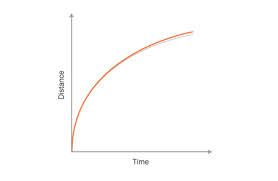
The picture of the position vs. time graph shows an object that is...
a)
accelerating/speeding up
b)
moving at a constant speed 
c)
not moving 
d)
accelerating/slowing down. 
40.
A plane flying 300 mph West toward California is an example of...
a)
Speed
b)
Velocity
c)
Acceleration
d)
Direction
41.
15m/s2 is an example of...
a)
Speed
b)
Distance
c)
Time 
d)
Acceleration
42.

Which would fall with greater acceleration in AIR—a leaf or a stone?

a)

the leaf

b)

the stone - less air resistance

c)

They would accelerate at the same rate.

d)

It is difficult to determine without more information.

43.

A car is traveling to the right with a speed of 29​​m/s when the rider slams on the accelerator to pass another car. The car passes in 110 m with constant acceleration and reaches a speed of 34m/s. We want to find the acceleration of the car as it sped up. What equation should you choose?

a)

v=vo+at

b)

d=vot+1/2at2

c)

v2=vo2+2ad

d)

d=1/2(v+vo)t

44.

Kinematic equation can only be used when you have a constant ....

a)

Position

b)

Velocity

c)

Acceleration

d)

Time

45.

The unit we use to measure acceleration is ___.

a)

m/s

b)

m

c)

s

d)

m/s2

46.

A car starts from rest and accelerates uniformly over a time of 5.21 seconds for a distance of 110 m. Determine the acceleration of the car. Choose the appropriate equation.

a)

v=vo+at

b)

d=vot+1/2at2

c)

v2=vo2+2ad

d)

d=1/2(v+vo)t

47.

Rocket-powered sleds are used to test the human response to acceleration. If a rocket-powered sled is accelerated to a speed of 444 m/s in 1.83 seconds, then what is the distance that the sled travels?

Choose the appropriate equation.

a)

v=vo+at

b)

d=vot+1/2at2

c)

v2=vo2+2ad

d)

d=1/2(v+vo)t

48.

If Michael Jordan has a vertical leap of 1.29 m, then what is his takeoff speed if his acceleration is -9.8 m/s2 and his velocity at the top of his leap i 0 m/s?

a)

v=vo+at

b)

d=vot+1/2at2

c)

v2=vo2+2ad

d)

d=1/2(v+vo)t

49.

The unit we use to measure distance is ___.

a)

m/s

b)

m

c)

s

d)

m/s2

50.

The unit we use to measure time is ___.

a)

m/s

b)

m

c)

s

d)

m/s2