
NEW
Font size
 Worksheets
Unit 2 Review Game (Plate Tectonics)
Total questions: 50
Worksheet time: 27mins

What is the cause Mt. Everest in the Himalayas increasing in elevation?
earthquakes
movement of plate tectonics
volcanoes
rocks falling


What is the cause Mt. Everest in the Himalayas moving to the northeast?
earthquakes
movement of plate tectonics
volcanoes
rocks falling

What is solid rock found everywhere on the Earth, often under sediments?
bedrock
sediments
Horizon C
humus
What is the cause Mt. Everest in the Himalayas increasing in elevation despite being eroded?
The erosion is greater than the uplift.
The uplift is greater than the erosion.
The uplift is equal to the erosion.
Mt. Everest is not on a currently active plate boundary.
As a climatologist, which of the following provided Wegener with supporting evidence for his hypothesis?
Egyptian hieroglyohics
ancient scrolls
ancient aliens
glacial deposits
What type of boundary occurs when two (2) tectonic plates come together or combine?
convergent
divergent
transform
subduction
What type of boundary occurs when two (2) tectonic plates slide past each other creating earthquakes with building up mountains?
convergent
divergent
transform
subduction
What type of boundary occurs when two (2) tectonic pull apart from each other?
convergent
divergent
transform
subduction
Above a subduction zone, what is any vent or fissure in the crust that allows hot lava, ash, and gas to escape?
island
mid ocean ridge
trench
volcano
What is a sudden shaking of the ground resulting from a release of energy in Earth's crust at convergent and transform boundaries?
islands
mid ocean ridges
earthquakes
volcanoes
What is the point on Earth's surface directly above where an earthquake has occurred?
magnetude
epicenter
earthquake depth
tsunami
What is the relationship between earthquakes and the movement and changing elevation?
There is a correlation.
There is a causation.
There is both a correlation and causation.
There is neither a correlation or causation.


Why are there volcanoes shown in the picture?
the seafloor sinks into the mantle where it melts
the plates move apart and allow magma to rise to the surface
hot spots allow magma to rise to the surface
the oceanic and continental plates cause a collision zone
What type of plate boundary occurs when oceanic crust pushes under continental crust?
transform
divergent
convergent
earthquake depth
What do the presence of earthquakes and volcanoes tell scientists about plate tectonics?
location of the plate boundaries
location of the hot spots
location of the bedrock
the type of crust (oceanic or continental)
What do the presence of the Hawaiian Islands and seamount tell scientists about plate tectonics?
location of the plate boundaries
location of the hot spots
location of the bedrock
the type of crust (oceanic or continental)

What is a slab of Earth's crust as shown in the picture (the boundary around an entire piece of solid rock between a longer fault line and another longer fault line edge)?
plate
mantle
oceanic crust
continental crust
What does the presence of marine fossils at the top of Mt. Everest tell us?
The mountains are formed from a collision of Asia and India, pushing the edges or former beaches of India high into the air.
The mountains are formed from a subduction zone where the edges or former beaches of India where pushed under Asia.
The mountains are formed from a divergent boundary where the beaches of India were pushed upward by magma.
The mountains are formed from a transform boundary where the fossils were exposed by earthquakes.


Which location is an example of a convergent plate boundary created at a subduction zone of oceanic plates pushing under continental plates?
The Andes Mountains, South America
The Ural Mountains, Russia
The Appalachian Mountains, United States
The Mid-Atlantic Ridge, Atlantic Ocean
Which location is an example of a convergent plate boundary created at a collision zone of continental plates?
East African Rift (on the eastern side of Africa,; below the Persian Gulf)
San Andreas Fault (the area where Ridgequest, California is located)
White Island (the island off the coast of New Zealand)
Which two (2) continents supported Wegener's hypothesis based on their puzzle like fit ?
South America and Africa
North America and South America
Africa and India
Asia and Australia

What igneous rock is called volcanic glass because of its smooth texture?
obsidian
granite
basalt
limestone
The igneous rock shown does not have large mineral grains. Therefore, it was formed from what substance?
lava
magma
sediments compacted together
sediments cemented together
Why is there formation of new seafloor at ridges pushing the ocean floor away from the ridge?
magma rises to the surface, where it becomes lava and freezes into a mountain or ridge
magma sinks causing a break or rift
the core erupts hot lava to the surface
hot spots allow magma to reach the surface
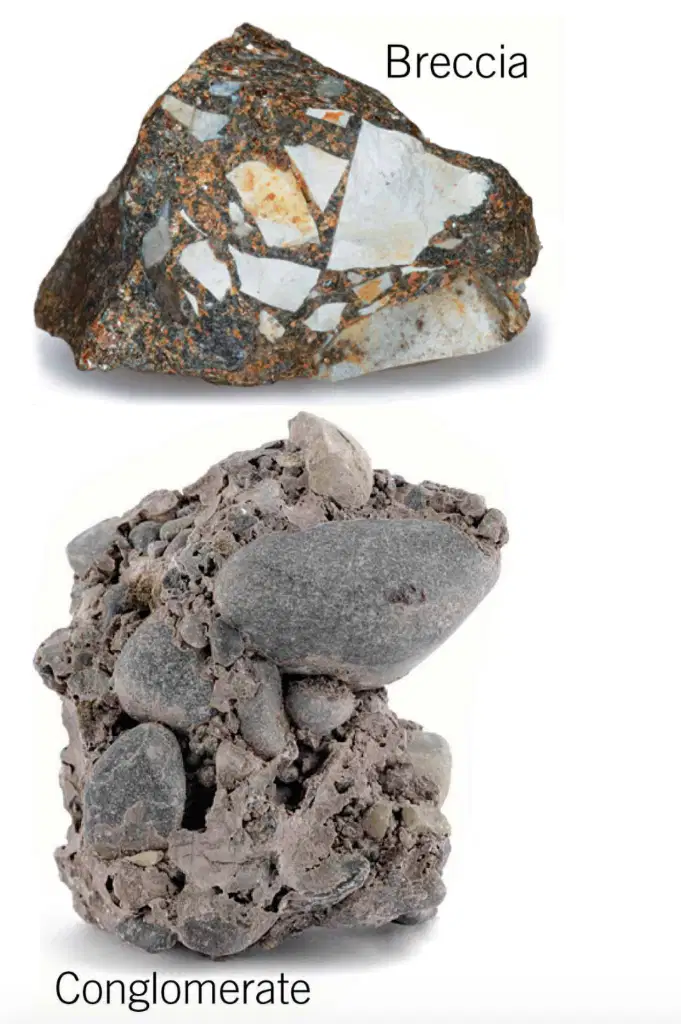
The breccia and conglomerate rocks shown have large sediments or mineral grains. Therefore, they were formed from what process?
cooling of lava
cooling of magma
sediments compacted together
sediments cemented together
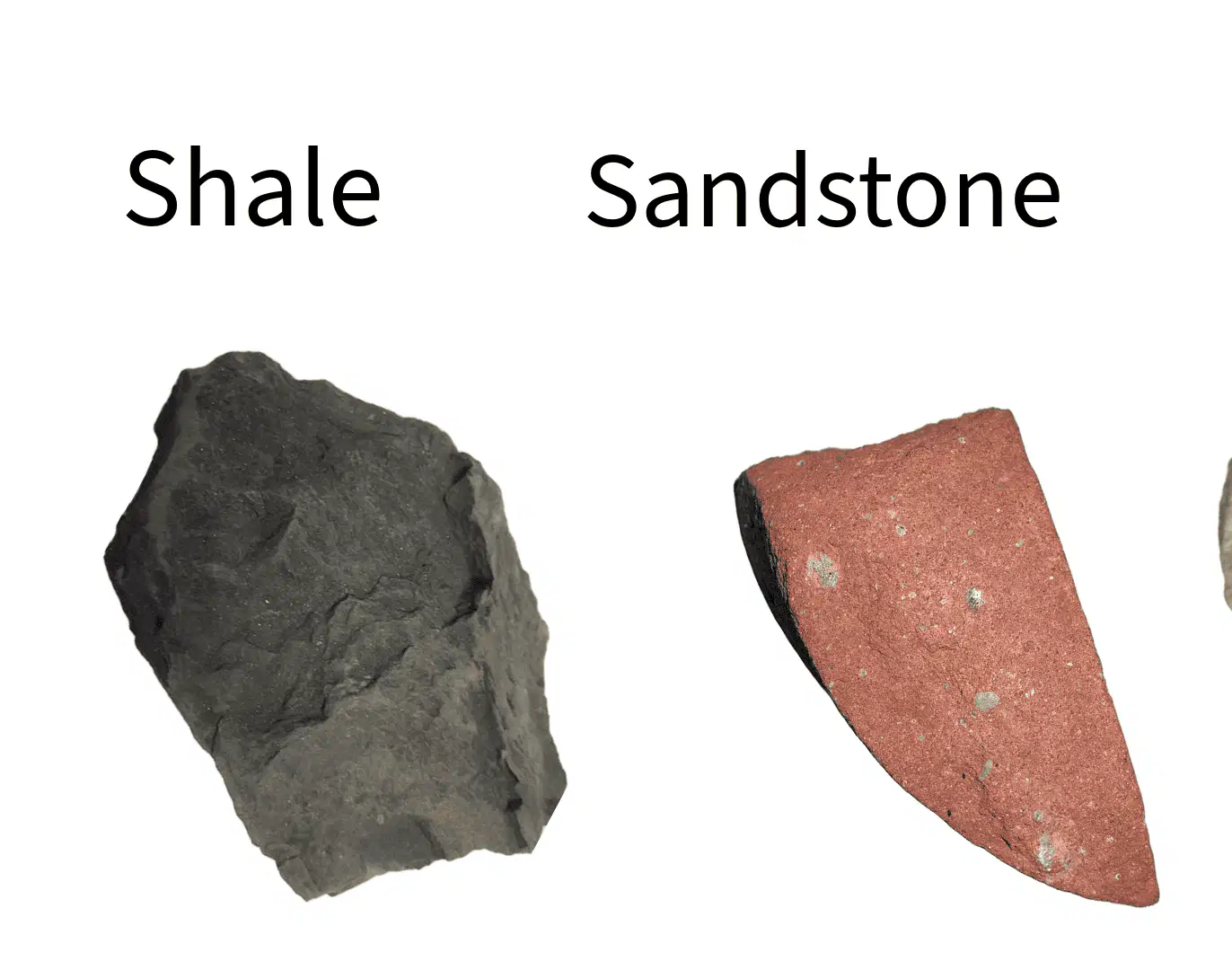
The shale and sandstone rocks shown have small sediments or mineral grains. Therefore, they were formed from what process?
cooling of lava
cooling of magma
sediments compacted together
sediments cemented together

What type of rocks are the shale and sandstone rocks shown in the picture?
igneous
sedimentary
metamorphic
boundary

What type of rocks are the breccia and conglomerate rocks shown in the picture?
igneous
sedimentary
metamorphic
boundary
What is mostly basaltic rock found at the bottom of the ocean?
thin, less dense oceanic crust
thick, less dense oceanic crust
thin, dense oceanic crust
thick, dense oceanic crust
What is the outer surface (and thinnest layer) of the Earth?
crust
mantle
inner core
outer core
What is the middle layer under the crust where hot rock moves, flows, and shifts?
crust
core
mantle
bedrock
What is the innermost layer of Earth, consisting of a inner area (solid) and outer area (liquid)?
asthenosphere
mantle
core
crust

Mt. Mitchell is part of the Appalachian Mountains. Why is this mountain not increasing in elevation?
It is located on a subduction zone.
It is located on a collision zone.
It is located on a transform boundary.
It is located in an area where there is not an active plate boundary.
What is mostly granite rock found at the under the continents?
thin, less dense continental crust
thick, less dense continental crust
thin, dense continental crust
thick, dense continental crust
What is the less dense, mostly granite bedrock found at the under the continents?
continental crust
oceanic crust
mantle
core
What is the dense, mostly basalt bedrock found at the bottom of the oceans?
continental crust
oceanic crust
mantle
core
Mt. Mitchell is part of the Appalachian Mountains. Why is this mountain decreasing in elevation?
The amount of erosion in the area is greater than the amount of uplift.
The amount of erosion in the area is less than the amount of uplift.
The amount of erosion in the area is equal to the amount of uplift.
There is more rainfall in this area than anywhere else in the world.
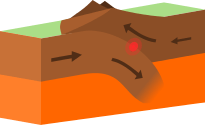
What type of plate boundary creates the mountains shown in the picture?
earthquake
divergent
convergent
transform

Earthquakes formed at an active transform boundary.
A volcano formed at an active transform boundary.
A valley formed at an active divergent boundary.
A ridge formed by an inactive convergent boundary.

Scientists think that convection currents that move the plates flow in Earth's mantle. Magma rises at mid-ocean ridges and pushes the seafloor away from the ridge. What type of plate boundary is this?
convergent
divergent
transform
subduction

