
 Worksheets
Cells
Total questions: 50
Worksheet time: 39mins
Name
Class
Date
1.
Controls what enters and leaves the cell
a)
Mitochondria
b)
Cell Membrane
c)
Cell Wall
d)
Nucleus
2.
Stores food and water for the cell.
a)
Cytoplasm
b)
Cell Wall
c)
Vacuole
d)
Nucleus
3.

What do all of these organisms have in common?
a)
They all have uniform offspring
b)
They are all made of cells
c)
They possess the same features
d)
They have the same internal and external structures
4.

According to cell theory, where did this cell come from?
a)
another living cell
b)
energy from sun
c)
a multicellular organism
d)
the nonliving environment
5.

Robert Hooke, Anton van Leeuwenhoek, Theodor Schwann, Rudolf Virchow, and Matthias Schliden were all responsible for what theory?
a)
The Theory of Gravity
b)
The Theory of Relativity
c)
The Cell Theory
d)
The Theory of Continental Drift
6.
What tool do you use to view the cells?
a)
metric ruler
b)
centrifuge
c)
microscope
d)
pipette
7.
Which of the following is NOT a cell theory.
a)
All non-living things are made of cells
b)
All cells come from pre-existing cells
c)
Cells are the basic unit of structure and function of all living things
8.
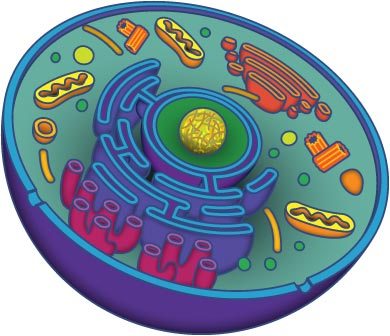
All living things are made up of...
a)
cells
b)
cell tissues
c)
organ
d)
organ systems
9.
The first part of the Cell Theory states: "What happens in Cell Theory, stay in Cell Theory."
a)
True
b)
False
c)
I don't know
d)
Ummmm
10.
All cells come from___________ cells.
a)
pregnant
b)
pre-existing
c)
paternal
d)
pin size
11.
Rocks are not living because
a)
they never move
b)
they aren't needed for humans
c)
they are not made of cells
d)
they don't break down
12.
What is the basic structural and functional unit of all living things?
a)
atom
b)
cell
c)
molecule
d)
human
13.
All cells are produced ____________.
a)
from nothing
b)
from other cells
14.
what is the control center in a cell
a)
mitochondria
b)
DNA
c)
nucleus
d)
movement
15.
also known as the "powerhouse"
a)
cell membrane
b)
storage
c)
cytoskeleton
d)
mitochondria
16.

What is the fluid inside a cell called?
a)
Endoplasimic Reticulum
b)
Orange Juice
c)
Water
d)
Cytoplasm
17.

What is known as the brain of a cell
a)
cell wall
b)
Cell membrane
c)
Nucleus
d)
Nuclues
18.

This organelle helps plants keep their rigid structure.
a)
Cell wall
b)
Cell membrane
c)
Chloroplast
d)
Nucleus
19.

Chloroplasts carry out...
a)
Phagocytocis
b)
Phylocytosis
c)
Photosynthesis
d)
Respiration
20.
This structure is a storage area for the cell. Plants usually have one large one.
a)
Lysosome
b)
Vacuole
c)
Ribosome
d)
Golgi Body
21.
Long strands of chromosomes that contain deoxyribonucleic acid (DNA) are located in the __________ of the cell.
a)
nucleus
b)
cell membrane
c)
cytoplasm
22.
A typical plant cell is rectangular in shape.
a)
True
b)
False
23.
Prokaryotic
a)
are single celled organisms that do not have a nucleus or membrane bound organelles
b)
a protective layer that covers the the cells surface and acts as a barrier
c)
is the smallest unit that can preform all he processes necessary for life
24.
These organelles capture energy from sunlight and use it to produce food for the cell.
a)
cell membrane
b)
chloroplasts
c)
cell wall
d)
ribosomes
25.
A gel-like fluid in which many different organelles are found.
a)
cell membrane
b)
nucleus
c)
organelle
d)
cytoplasm
26.
This structure is a storage area for the cell. Plants usually have one large one.
a)
Lysosome
b)
Vacuole
c)
Ribosome
d)
Golgi Body
27.
Prokaryotic
a)
are single celled organisms that do not have a nucleus or membrane bound organelles
b)
a protective layer that covers the the cells surface and acts as a barrier
c)
is the smallest unit that can preform all he processes necessary for life
28.
Which organism listed below is a prokaryote?
a)
dog
b)
human
c)
sunflower
d)
bacterial cell
29.
This structure is in plant cells but not animal cells. It is outside of the cell membrane and adds more support/structure/rigidity to the plant.
a)
Cell membrane
b)
Cell Nucleus
c)
Cell Wall
d)
Endoplasmic Reticulum
30.
Animal and plant cells are both this type of cell.
a)
Eukaryote
b)
Prokaryote
31.
This scientist discovered and named the cell.
a)
Robert Hooke
b)
Anton Van Leeuwenhoek
c)
John Dalton
d)
Mathias Schleiden
32.

What tool do you use to view the cells?
a)
metric ruler
b)
centrifuge
c)
microscope
d)
telescope
33.

What is one way in which all living things on Earth are alike?
a)
All living things have hair.
b)
All living things are made of cells and come from other cells.
c)
The cells of all living things have chloroplast.
d)
All living things can move.
34.
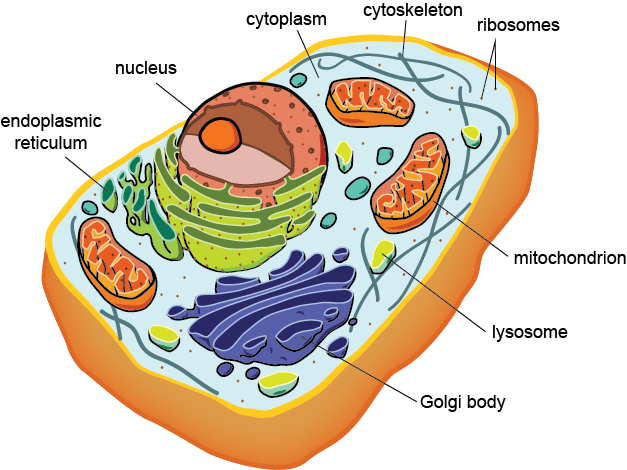
Which of the following statements is not part of the cell theory?
a)
Cells are the basic unit of structure and function in all living things.
b)
All cells are produced from other cells.
c)
Only animal cells are composed of cells.
d)
All living things are composed of cells.
35.

Which of the following scientists was the first to observe bacteria under a microscope?
a)
Anton van Leuwenhoek
b)
Matthais Schleiden
c)
Robert Hooke
d)
Theodor Schwann
36.
Which is NOT part of the Cell Theory
a)
New cells are produced from existing cells
b)
All living things are composed of cells
c)
Only eukaryotic cells have a nucleus
d)
Cells are the basic unit of structure & function in living things
37.

What kind of cell is this?
a)
animal cell
b)
bell bell
c)
plant cell
d)
vacuole
38.
The green pigment in plants is due to the presence of
a)
chlorophyll
b)
Chlorine
c)
Chlorophyta
d)
chromatophores
39.
Animals cell do or do not have cell walls?
a)
do
b)
do not
40.
Animal and plant cells have structures that are present in both.
a)
True
b)
False
41.
The cell wall lies on the inside of the cell membrane.
a)
True
b)
False
42.
Chloroplasts does not make food for the plant cells.
a)
False
b)
True
43.

What kind of cell is this? How do you know?
a)
This is an animal cell because it has a cell wall, chloroplast, and a large vacuole. Plant cells don't have a cell wall.
b)
This is a plant cell because it has cell wall, chloroplast, and a large vacuole. Animal cells don't have a cell wall.
44.
True or False: The activities of both plant and animal cells are controlled by a nucleus within the cell.
a)
True
b)
False
45.
Which one is NOT a characteristic of all living things?
a)
Made of cells
b)
Make its own food
c)
Grow and develop
d)
Obtain and use energy
46.
A cell is the smallest part of an organism that can live on its own.
a)
True
b)
False
47.

What would happen to the plant cell without the chloroplasts?
a)
There wouldn't be an organelle that performs photosynthesis
b)
There wouldn't be an organelle that serves as the resevoir for water and waste
c)
There wouldn't be an organelle that regulates what comes in and out of the cell
d)
They wouldn't be an organelle that makes necesary proteins
48.

Label C
a)
Cell membrane
b)
Nucleus
c)
Cell wall
d)
Cytoplasm
49.
a living thing made of the same tiny building blocks
a)
cytoplasm
b)
cell wall
c)
organism
d)
chloroplast
50.
oval shaped organelles that create energy
a)
endoplasmic reticulum
b)
mitochondria
c)
golgi bodies
d)
chloroplast
100 %

