
 Worksheets
Cell Division and Karyotypes
Total questions: 84
Worksheet time: 1hrs 4mins
Name
Class
Date
1.

Which of the following best describes a DNA molecule?
a)
double helix
b)
contains ribose
c)
made of amino acids
d)
contains uracil
2.
Adenine bonds with ______________.
a)
Guanine
b)
Thymine
c)
Cytosine
d)
Adenine
3.
Guanine bonds with ______________.
a)
Adenine
b)
Guanine
c)
Cytosine
d)
Thymine
4.

Which organelle is DNA usually found in?
a)
mitochondrian
b)
cell membrane
c)
chloroplast
d)
nucleus
5.

What determines the code, or information, of a DNA molecule?
a)
the shape (structure) of the nitrogen bases
b)
the order (sequence) of the nitrogen bases
c)
the color of the nitrogen bases
d)
the frequency (number) of nitrogen bases
6.

DNA codes for...
a)
bases
b)
proteins
c)
amino acids
d)
phosphates
7.
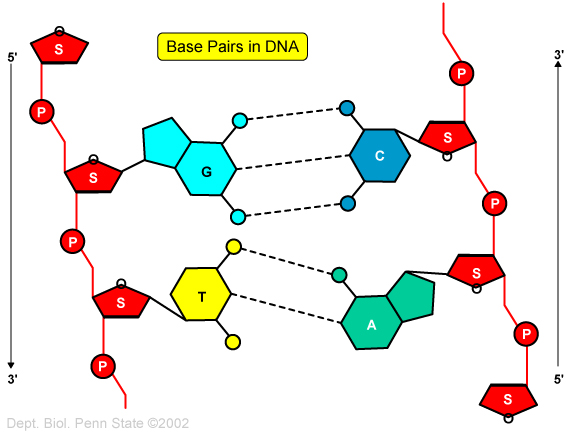
Nitrogenous bases are joined by which type of bond?
a)
polar bonds
b)
ionic bonds
c)
covalent bonds
d)
hydrogen bonds
8.
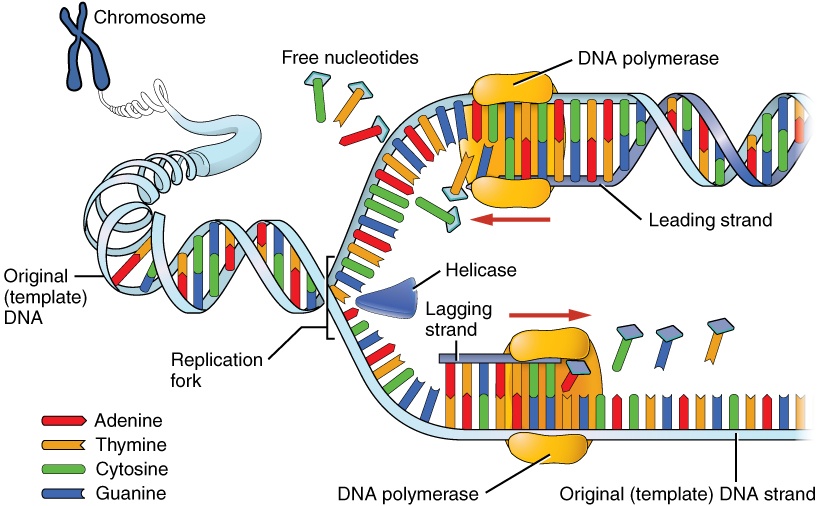
The enzyme that unzips the DNA to prepare for replication
a)
helicase
b)
replicase
c)
polymerase
d)
synthase
9.
DNA replication results in two DNA molecules,
a)
each one with two original strands
b)
each one with two new strands
c)
each one with one new strand and one original strand
d)
one with two new strands and the other with two original strands
10.
The name of the 5 carbon sugar that makes up DNA is _____
a)
phosphate
b)
deoxyribose
c)
ribose
d)
polymerase
11.

The "Double Helix Model" of DNA was proposed by:
a)
Watson & Crick
b)
Meselson & Stahl
c)
Beadle & Tatum
d)
Gosling & Watkins
12.
What is the complement to the DNA strand below:
5'-ATGCCAT-3'
5'-ATGCCAT-3'
a)
5'-TACGGTA-3'
b)
3'-TACGGTA-5'
c)
3'-ATGGCAT-5'
d)
5'-ATGGCAT-3'
13.
If there is 17% thymine in a portion of DNA, how much cytosine is there?
a)
17%
b)
33%
c)
34%
d)
66%
14.
What is DNA Replication?
a)
The synthesis of new DNA strands
b)
Making proteins from DNA
c)
Creating a new cell via mitosis
d)
Infecting cells via viral DNA
15.
During DNA replication, the enzyme _____ bonds together the new side of the DNA
a)
helicase
b)
ligase
c)
synthase
d)
polymerase
16.
In what phase of the cell cycle does DNA replication take place?
a)
G1
b)
S
c)
G2
d)
M
17.
The "steps" of the DNA "ladder" are made up of?
a)
Alternating phosphate groups and sugars
b)
Nitrogen Bases
c)
Phospholipids
d)
Protein Chains
18.
Nuclear membrane forms around chromosomes and begins to separate.
a)
Anaphase
b)
Telophase
c)
Prophase
d)
Interphase
19.

Identify the Cell Cycle Stage.
a)
Prophase
b)
Interphase
c)
Anaphase
d)
Telophase
20.

Identify the Cell Cycle Stage.
a)
Anaphase
b)
Cytokinesis
c)
Telophase
d)
Metaphase
21.

Identify the Cell Cycle Stage.
a)
Cytokinesis
b)
Interphase
c)
Anaphase
d)
Metaphase
22.

Identify the Cell Cycle Stage.
a)
Anaphase
b)
Cytonkinesis
c)
Interphase
d)
Prophase
23.

Identify the Cell Cycle Stage.
a)
Interphase
b)
Anaphase
c)
Telophase
d)
Prophase
24.
The phase in mitosis where chromosomes move away and are pulled apart by spindles to opposite sides of the cell.
a)
prophase
b)
anaphase
c)
metaphase
d)
telephase
25.

Which is Metaphase?
a)
A
b)
E
c)
C
d)
F
26.
The process by which the nuclear material is divided equally between two new cells
a)
mitosis
b)
cancer
c)
spindle
d)
centromere
27.

In mitosis, the two resulting cells are
a)
different from the starting cell and identical to each other.
b)
different from the starting cell and different from each other.
c)
identical to the starting cell and different from each other.
d)
identical to the starting cell and identical to each other.
28.
The time between cell divisions in the life cycle of the cell is called
a)
anaphase
b)
interphase
c)
prophase
d)
metaphase
29.
Where does a cell contain it's genetic material?
a)
nucleus
b)
nucleolus
c)
cytoskeleton
d)
golgi
30.
Chromatin is found during which phase?
a)
Prophase
b)
Metaphase
c)
Interphase
d)
Telophase
31.
Asexual reproduction will result in
a)
Identical offspring to the parent
b)
Twins
c)
Meiosis
d)
Non-identical offspring to the parent
32.
The nuclear membrane breaks down occurs during which stage?
a)
Interphase
b)
Metaphase
c)
Prophase
d)
Telophase
33.
The chromosomes align in the middle of the cell occurs during which stage?
a)
Anaphase
b)
Metaphase
c)
Interphase
d)
Telophase
34.
What do centrioles do?
a)
Attach 2 sister chromatids together
b)
Pull the nuclear membrane apart
c)
Pull chromosomes apart
d)
Condense during Interphase
35.
90% of the cell's life is spent during what stage?
a)
Prophase
b)
Anaphase
c)
Metaphase
d)
Interphase
36.
What stage is a cell in when cleavage is present in the cell division?
a)
Interphase
b)
Prophase
c)
Cytokinesis
d)
Metaphase
37.
When during the cell cycle are chromosomes visible?
a)
Interphase
b)
When they are being replicated
c)
During cell division
d)
During the G1 phase
38.
During which state of the cell cycle is DNA Replicated?
a)
Interphase
b)
Prophase
c)
Anaphase
d)
Cytokinesis
39.

Structure A refers to the _____.
a)
chromatid
b)
chromosome
c)
centromere
40.

Structure B is pointing to the _____.
a)
chromosome
b)
centromere
c)
DNA
d)
chromatid
41.

identical halves of a chromosome
a)
sister chromotids
b)
genes
c)
centromere
42.
The final part of the cell cycle and actually contains two separate processes: Mitosis and Cytokinesis
a)
Cell Cycle
b)
Cell Division
c)
Mitosis
d)
Cyclin
43.
This develops in the middle plane of a plant cell separating it into two daughter cells during cell division.
a)
cell wall
b)
cell plate
c)
cell membrane
d)
cytoplasm
44.
A jelly-like substance found inside a cell surrounding its organelles is
a)
cytokenisis
b)
cytoplasm
c)
mitosis
d)
epithelial
45.
These form during prophase and attach to chromosomes at the centromere to pull them apart during cell division
a)
prophase
b)
nucleus
c)
spindle fibers
d)
gene
46.
During which process is the cytoplasm divided into two new cells?
a)
Interphase
b)
Mitosis
c)
Cytokinesis
d)
DNA Replication
47.

Stage of Interphase in which the cell copies its DNA in preparation for cell division
a)
G1
b)
Synthesis
c)
G2
d)
Interphase
48.

This picture shows which process?
a)
cell cycle
b)
meiosis
c)
mitosis
d)
interphase
49.

Cell division is represented by what letter?
a)
A
b)
B
c)
C
d)
D
50.
What is the result of mitosis?
a)
2 gametes
b)
2 identical somatic cells
c)
4 gametes
d)
2 different somatic cells
51.

sequence
a)
C,D, B, A, F, E
b)
D,A,F,C,E,B
c)
B,E,C,F,A,D
d)
C,B,D,A E,F
52.

During the growth/gap 1 stage of the cell cycle, a cell
a)
splits into two new cells
b)
doubles in size and growth
c)
Duplicates its DNA
d)
divides its cytoplasm
53.
The cells produced via meiosis are called:
a)
sex cells
b)
somatic cells
c)
body cells
d)
skin cells
54.
This produces 2 identical cells.
a)
mitosis
b)
meiosis
55.
A human usually has xx amount of chromosomes.
a)
6
b)
22
c)
4
d)
46
56.

What phase is shown in the picture?
a)
anaphase 1
b)
anaphase 2
c)
metaphase 1
d)
telophase 1
57.

Meiosis makes sperm and egg cells. In humans, sperm and egg cells each have _____ chromosomes. Therefore a fertilized human egg cell (sperm and egg cell combined) would create a cell with _____ chromosomes.
a)
23, 46
b)
46, 23
c)
2, 4
d)
50, 100
58.
What causes genetic variation in meiosis?
a)
chromosomes lining up
b)
crossing over of chromosomes
c)
separation of chromosomes
d)
chromosomes pulling apart
59.
Unlike mitosis, meiosis in male mammals results in the formation of
a)
one haploid gamete
b)
three diploid gametes
c)
four diploid gametes
d)
four haploid gametes
60.

When an area of a chromatid is exchanged with the matching area on a chromatid of its homologous chromosome, _________________ occurs
a)
crossing over
b)
mutagenesis
c)
hybridization
d)
fertilization
61.
What kind of cells are made in MEIOSIS?
a)
Haploid Gametes
b)
Diploid Somatic Cells
c)
Skin Cells
d)
Liver Cells
62.
Diploid Cells are represented by
a)
2n
b)
n
c)
4n
d)
1/2 n
63.
If the Diploid number of Carrots is 18, the haploid number is
a)
18
b)
9
c)
27
d)
36
64.

Which process and type of resulting cells are represented?
a)
mitosis, gametes
b)
mitosis, body cells
c)
meiosis, gametes
d)
meiosis, body cells
65.
The process of crossing over occurs in what phase of meiosis?
a)
anaphase 1
b)
prophase 1
c)
prophase 2
d)
telophase 1
66.
Which of these cells would be produced through meiosis?
a)
skin cells
b)
liver cells
c)
brain cells
d)
sperm cells
67.
The chromosomes that pair up during meiosis, are called __________ chromosomes.
a)
homozygous
b)
asexual
c)
homologous
d)
genes
68.
When homologous chromosomes match up, they form a structure call a ___________.
a)
tetrad
b)
triad
c)
diploid
d)
gamete
69.
Crossing over helps promote
a)
male genotype
b)
genetic variation
c)
DNA replication
d)
mitosis
70.
A male shark has 40 chromosomes in each of its sex cells. How many would be present in its body cells?
a)
20
b)
40
c)
80
d)
160
71.

What phase is represented?
a)
metaphase 1
b)
metaphase 2
c)
anaphase 1
d)
anaphase 2
72.

Identify the phase.
a)
Metaphase I
b)
Metaphase II
c)
Prophase I
d)
Anaphase II
73.

What phase is represented?
a)
prophase1
b)
prophase 2
c)
telophase 1
d)
telophase 2
74.

What phase is represented?
a)
metaphase 1
b)
metaphase 2
c)
anaphase 1
d)
anaphase 2
75.

According to the chromosome theory of inheritance, what are carried from parents to their offspring on chromosomes?
a)
Genes
b)
Spindle Fibers
c)
Centrioles
d)
Cytoplasm
76.

What is one of the advantages, why is it better to reproduce sexually versus asexually?
a)
survival of the fittest
b)
overproduction
c)
genetic variation
d)
cloning
77.
What would indicate a human male?
a)
XX
b)
X
c)
XY
d)
XXY
78.
Photograph of chromosomes grouped in ordered pairs
a)
pedigree
b)
Punnett Square
c)
Venn Diagram
d)
Karyotype
79.
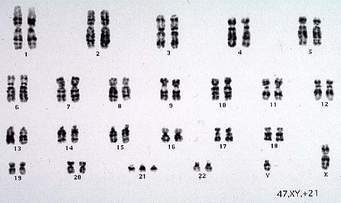
Based on the Karyotype shown, at which chromosome pair can we identify a genetic disorder?
a)
Chromosome pair 5
b)
Disorder of the sex chromosomes
c)
Chromosome pair 21
d)
There are no chromosomal disorders
80.
Which statement is NOT true about Karyotypes
a)
Chromosomes (pairs 1-22) are arranged by size
b)
Sex chromosomes are found at the end
c)
A normal karyotype has 46 chromosomes or 23 pairs
d)
Having missing or extra chromosomes does not indicate a disorder
81.

What is the gender of the individual whose karyotype is seen in the image?
a)
Male
b)
Female
82.
The doctors use karyotypes to examine the chromosomes. A karyotype is a picture of all the chromosomes in a cell.
a)
True
b)
False
83.
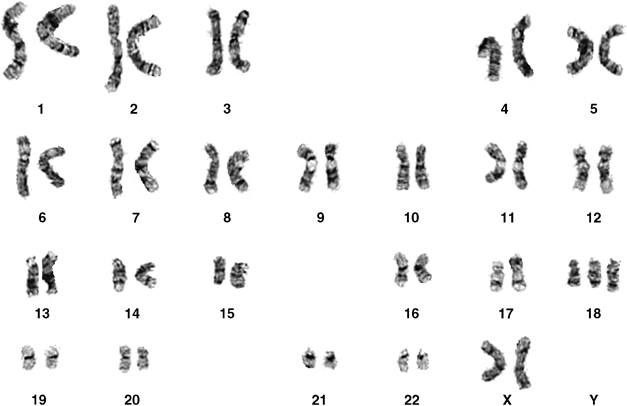
What is the chromosomal condition of the individual whose karyotype is seen in the image?
a)
Monosomy X (Turner's Syndrome)
b)
Trisomy 21 (Down's Syndrome)
c)
Trisomy 13 (Patau Syndrome)
d)
Trisomy 18 (Edwards's Syndrome)
84.

What is the chromosomal condition of the individual whose karyotype is seen in the image?
a)
Trisomy 21 (Down's Syndrome)
b)
Trisomy 13 (Patau Syndrome)
c)
Trisomy 18 (Edward's Syndrome)
d)
XXY Sex Chromosomes (Klinefelter's Syndrome)
100 %

