
 Worksheets
Earth Science Mid-term Review
Total questions: 93
Worksheet time: 2hrs 46mins
Name
Class
Date
1.

a)
Hurricane
b)
Tornado
c)
Thunderstorm
d)
Typhoon
2.

What type of air mass is the highlighted arrow?
a)
cold/dry
b)
cold/humid
c)
warm/dry
d)
warm/humid
3.
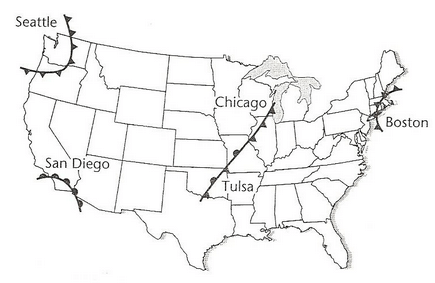
Which type of front is located near Boston?
a)
warm front
b)
cold front
c)
stationary front
d)
occluded front
4.
What is the surface current that brings warmer temperatures to Europe?
a)
Gulf Stream
b)
Red Sea
c)
Saltwater
d)
Eastern Australian Current
5.
Seasons are caused by ___________________.
a)
The Earth facing the Sun
b)
The tilt of the Earth on its axis
c)
Mother Nature
6.

Which season is shown in the northern hemisphere?
a)
winter
b)
spring
c)
summer
d)
fall
7.

Which season is shown in the southern hemisphere?
a)
winter
b)
spring
c)
summer
d)
fall
8.
Which sentence best describes the relationship between elevation and air temperatures?
a)
LOWER elevation = COLDER temperatures
b)
HIGHER elevation = COLDER temperatures
c)
HIGHER elevations = WARMER temperatures
9.
Rain, sleet, hail, and freezing rain are all...
a)
precipitation
b)
condensation
c)
evaporation
d)
perspiration
10.
Which of the following will heat the fastest?
a)
water
b)
land
c)
both heat at equal rates
11.

Which statement best describes the difference between weather and climate?
a)
Weather is the conditions when you look outside while climate is the conditions you can expect for the next 6 months.
b)
Climate is the current condition outside while weather is what you can expect for the next 6 months.
12.
The air in the troposphere has a greater density than the air in any other layer of the atmosphere,
a)
True
b)
False
13.
What is the percentage of oxygen in Earth's atmosphere?
a)
1%
b)
21%
c)
78%
d)
90%
14.
What is the percentage of nitrogen in Earth's atmosphere?
a)
1%
b)
21%
c)
78%
d)
90%
15.
What is the lowest main layer of Earth's atmosphere?
a)
Thermosphere
b)
Troposphere
c)
Stratosphere
d)
Mesosphere
16.

Where is the altitude the greatest?
a)
1
b)
2
c)
3
d)
4
17.

Where is the air pressure the greatest?
a)
1
b)
2
c)
3
d)
4
18.
Which gas in our atmosphere is most abundant?
a)
Argon
b)
Oxygen
c)
Nitrogen
d)
Carbon Dioxide
19.
The air in the troposphere has a greater density than the air in any other layer of the atmosphere,
a)
True
b)
False
20.
What percentage of our atmosphere is made up of other gases such as argon, water vapor, and carbon dioxide?
a)
1%
b)
21%
c)
78%
d)
90%
21.
What is the percentage of oxygen in Earth's atmosphere?
a)
1%
b)
21%
c)
78%
d)
90%
22.
What is the percentage of nitrogen in Earth's atmosphere?
a)
1%
b)
21%
c)
78%
d)
90%
23.
In which layer of the atmosphere does weather occur?
a)
Mesosphere
b)
Thermosphere
c)
Stratosphere
d)
Troposphere
24.
What is the lowest main layer of Earth's atmosphere?
a)
Thermosphere
b)
Troposphere
c)
Stratosphere
d)
Mesosphere
25.
Where is the air pressure the greatest?
a)
1
b)
2
c)
3
d)
4
26.
Where is the altitude the greatest?
a)
1
b)
2
c)
3
d)
4
27.
Name three (3) ways that solar radiation is sent back into space.
a)
reflection
b)
scattered
c)
Absorption
d)
All the above
28.
Which layer is the coldest?
a)
Troposphere
b)
Stratosphere
c)
Mesosphere
d)
Thermosphere
29.
This layer is the “heat sphere”.
a)
Troposphere
b)
Stratosphere
c)
Mesosphere
d)
Thermosphere
30.
Where you will find the ozone layer.
a)
stratosphere
b)
thermosphere
c)
exosphere
d)
mesosphere
31.
Where we live.
a)
stratosphere
b)
thermosphere
c)
troposphere
d)
mesosphere
32.
Considered to be a part of the thermosphere.
a)
ionosphere
b)
thermosphere
c)
troposphere
d)
mesosphere
33.
The hottest layer.
a)
troposphere
b)
thermosphere
c)
exosphere
d)
mesosphere
34.
Where satellites orbit.
a)
troposphere
b)
thermosphere
c)
exosphere
d)
mesosphere
35.
Where you will find Aurora Borealis (Northern Lights)
a)
troposphere
b)
ionsophere
c)
exosphere
d)
mesosphere
36.
Which order is correct from the earth to space?
a)
thermosphere
troposphere
exosphere
mesosphere
stratosphere
ionosphere
troposphere
exosphere
mesosphere
stratosphere
ionosphere
b)
thermosphere
troposphere
stratosphere
exosphere
mesosphere
ionosphere
troposphere
stratosphere
exosphere
mesosphere
ionosphere
c)
exosphere
ionosphere
thermosphere
mesosphere
stratosphere
troposphere
ionosphere
thermosphere
mesosphere
stratosphere
troposphere
d)
troposphere
thermosphere
troposphere
stratosphere
exosphere
mesosphere
thermosphere
troposphere
stratosphere
exosphere
mesosphere
37.
What happens to the air pressure the higher up in space you go?
a)
the air pressure increases
b)
the air pressure decreases
c)
the air pressure stays the same
d)
there is no air pressure
38.
Where I find clouds.
a)
thermosphere
b)
stratosphere
c)
troposphere
d)
ionosphere
39.
Which layer has the highest pressure?
a)
thermosphere
b)
stratosphere
c)
troposphere
d)
ionosphere
40.
Which of these layers is closest to Earth?
a)
thermosphere
b)
stratosphere
c)
mesosphere
d)
ionosphere
41.
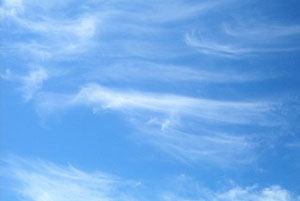
This type of cloud is thin, wispy, and made of ice crystals
a)
cumulus cloud
b)
stratus cloud
c)
cirrus cloud
d)
cumulonimbus cloud
42.
The temperature at which water vapor condenses is the
a)
relative humidity
b)
humidity
c)
freezing point
d)
dew point
43.
What are the four classes of clouds based on altitude?
a)
cirrus, nimbus, stratus, cumulus
b)
low, middle, high, vertically developed
c)
troposphere, stratosphere, mesosphere , thermosphere
d)
classes of clouds are not based on altitude
44.
They are highest clouds in the sky. They look curly, white and feathery. Usually mean good weather.
a)
Cumulus
b)
Cumulonimbus
c)
Cirrus
d)
Stratus
45.
Clouds are made up of tiny drops of ______ or ice. The moisture in the cloud affects the weather.
a)
dust
b)
water
c)
cloud particles
d)
precipitation
46.

what type of cloud is shown?
a)
cumulus
b)
cirrus
c)
stratus
47.

Cumulonimbus clouds mean ...
a)
fair weather (nice)
b)
thunderstorms
c)
rain/storms coming
d)
long periods of rain
48.

Cumulus clouds mean ...
a)
fair weather (nice)
b)
thunderstorms
c)
rain/storms coming
d)
long periods of rain
49.
Which is not a factor that affects climate?
a)
altitude
b)
latitude
c)
lakes and oceans
d)
living organisms
50.

The rain shadow is shown at ____
a)
A
b)
B
c)
C
d)
D
51.
Which season is shown in the northern hemisphere?
a)
winter
b)
spring
c)
summer
d)
fall
52.
When do equinoxes occur?
a)
mid summer and winter
b)
mid spring and fall
c)
the beginning of summer and winter
d)
the beginning of spring and fall
53.

By what amount did carbon dioxide in Earth's atmosphere increase between 1960 and 2000?
a)
40 -50 ppm
b)
60 -70 ppm
c)
110 -120 ppm
d)
360 -370 ppm
54.

In what year was the average global temperature lowest between 1880 and 2000?
a)
1880
b)
1900
c)
1940
d)
2000
55.
Which is not a source of carbon dioxide?
a)
forest fires
b)
volcanoes
c)
glaciers
d)
use of fossil fuel
56.
What are the two main factors that determine the climate of an area?
a)
precipitation and humidity
b)
temperature and air pressure
c)
wind conditions and humidity
d)
temperature and precipitation
57.
What are the surface features of an area called?
a)
latitude
b)
longitude
c)
topography
d)
elevation
58.
What are the 3 major climate zones in order from equator to the poles?
a)
polar, temperate, tropical
b)
tropical, temperate, polar
c)
temperate, polar, tropical
59.
What is the measure of distance in degrees north and south from the equator?
a)
latitude
b)
longitude
c)
elevation
d)
topography
60.
What is the height of an area above sea level?
a)
elevation
b)
topography
c)
latitude
d)
longitude
61.
a box in which symbols on a map are explained is called
a)
compass rose
b)
map scale
c)
legend/key
d)
physical map
62.
A symbol on a map that shows direction
a)
compass rose
b)
axis
c)
legend/key
d)
scale
63.
a map that shows the elevation of areas of land
a)
political map
b)
topographical map
c)
product map
d)
population map
64.
The imaginary line between the north and south poles, about which the Earth rotates
a)
hemispheres
b)
equator
c)
intermediate directions
d)
axis
65.
An imaginary, longitude line running from the North Pole to the South Pole; this runs through Greenwich, England, is set at o° and divides the earth into the "Western Hemisphere" and the "Eastern Hemisphere"
a)
equator
b)
Prime Meridian
c)
Northern Hemisphere
d)
Southern Hemisphere
66.

What is the difference in elevation between Point X and Point Y?
a)
120 m
b)
240 m
c)
360 m
d)
340 m
67.
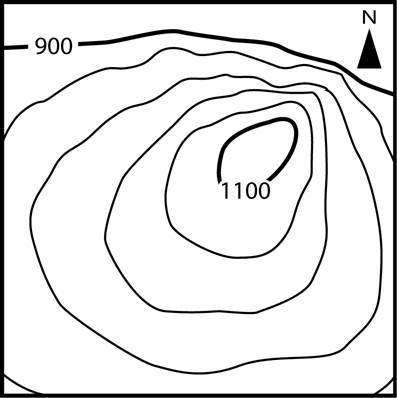
Provided is a topographic map of a hill with contour lines drawn showing elevation in meters.
The steepest slope on this hill can be found on the side that is facing which direction?
The steepest slope on this hill can be found on the side that is facing which direction?
a)
Southwest
b)
Northeast
c)
Northwest
d)
Southeast
68.

In which direction is Mill River flowing?
a)
Southeast
b)
Southwest
c)
Northeast
d)
Northwest
69.

What is the elevation of point B?
a)
800 ft
b)
850 ft
c)
900 ft
d)
1000 ft
70.

What is the elevation of Y?
a)
Between 120-140 meters
b)
Between 100-120 meters
c)
Between 140-160 meters
d)
Between 80-100 meters
71.

If we were in a plane, Path B --> C is about the same distance as path E --> N. But, which path is the easier walk?
a)
B --> C is the easier walk
b)
E --> N is the easier walk
c)
B --> C and E --> N are the same walking distance
72.
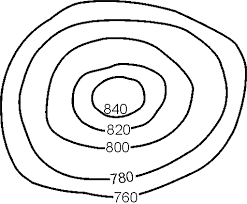
Determine the contour interval:
a)
5 m
b)
10 m
c)
15 m
d)
20 m
73.
A possible explanation to a problem that has not yet been tested.
a)
data
b)
theory
c)
hypothesis
d)
fact
74.
This variable in an experiment is the one being deliberately changed by the scientist.
a)
dependent variable
b)
independent variable
c)
data
d)
control group
75.
There are two types of data. Which type of data involves numbers that are obtained by counting or measuring?
a)
quantitative
b)
qualitative
76.
The summary at the end of an experiment that explains the results.
a)
conclusion
b)
procedures
c)
materials
d)
responding variable
77.
A series of steps used by scientists to solve a problem or answer a question.
a)
scientific method
b)
recipe
c)
data collection
d)
metric system
78.
Which is NOT a step in the scientific method?
a)
Make observation
b)
Form a theory
c)
Collect data
d)
Form a hypothesis
79.
Testing a hypothesis often involves a(n):
a)
answer
b)
experiment
c)
problem
d)
safety check
80.
What is a hypothesis?
a)
A hypothesis is the right answer to an experiment.
b)
A hypothesis is the wrong answer to an experiment.
c)
A hypothesis is an educated guess.
d)
I don't know.
81.
An experiment is performed on plants to see how different liquids affect plant growth. Each plant in the experiment is given a different liquid; water, apple juice, or milk. Each plant has the same amount of soil, sunlight, and listens to the same music. In this investigation, the independent variable is ...
a)
The type of plant
b)
The amount of sunlight
c)
The type of music
d)
The type of liquid
82.
If you increase the amount of spinach you eat, then you will increase the iron in your blood.
What's the dependent variable?
What's the dependent variable?
a)
increase the amount of iron in your blood
b)
spinach you eat
83.
What is the first step in the scientific method?
a)
Ask a question
b)
Conclusion
c)
No Horse Play
d)
Observe
84.
Scientist who study Cells is a ?
a)
Zoologist
b)
Biologist
c)
Botanist
d)
Geologist
85.
Scientist who studies Rocks is a ?
a)
Biologist
b)
Zoologist
c)
Botanist
d)
Geologist
86.
This term means anything that takes up space.
a)
Physics
b)
Chemist
c)
Matter
d)
Scientist Method
87.
A Meteorologists study what?
a)
Living Things
b)
Matter and Energy
c)
Climate and Weather
d)
Weather and Animals
88.

According to the text you read, what topic of science did Albert Einstein specialize in?
a)
Physics
b)
Chemistry
c)
Astronomy
89.
The study of energy and matter and the interactions between them. Physicists study such subjects as gravity, light, and time.
a)
Chemistry
b)
Physics
c)
Meteorology
d)
Geology
90.
The science that deals with the composition, properties, reactions, and the structure of matter.
a)
Chemistry
b)
Paleontology
c)
Oceanography
d)
Botany
91.
The study of the universe beyond the Earth's atmosphere
a)
Physics
b)
Geology
c)
Astronomy
d)
Medicine
92.
The science of the origin, history, and structure of the Earth.
a)
Chromotography
b)
Geology
c)
Oceanography
d)
Zoology
93.
The exploration and study of the ocean.
a)
Geometry
b)
Algebra
c)
Oceanography
d)
Medicine
100 %

