wayground logo

Free Printable Worksheets

Font size

S
M
L
XL
Worksheets

Geology SOL Review

Total questions: 98

Worksheet time: 1hrs 8mins

Name
Class
Date
1.
What is the correct order (starting from the surface) of Earth's layers?
a)
crust, outer core, inner core, mantle
b)
mantle, outer core, inner core, crust
c)
crust, mantle, outer core, inner core
d)
outer core, inner core, crust, mantle
2.
Earth's inner core is...
a)
a dense ball of solid iron and nickel.
b)
a layer of molten iron and nickel.
c)
a layer of hot rock.
d)
a layer of rock that forms Earth's outer skin.
3.
Which layer of Earth has the GREATEST density?
a)
crust
b)
mantle
c)
outer core
d)
inner core
4.
Heat transfer within a fluid takes place by...
a)
convection currents
b)
radiation
c)
conduction
d)
density
5.
If we compare the temperature and pressure of Earth's mantle to the core, what differences can we expect as we move downward into Earth?
a)
Both temperature and pressure increase.
b)
Both temperature and pressure decrease.
c)
Temperature decreases and pressure increases.
d)
Temperature increases and pressure decreases.
6.
What is a constructive force?
a)
an earthquake
b)
a volcanic eruption
c)
a flood 
d)
 a wind storm
7.
Where do isolated, volcanic islands, such as Hawaii form?
a)
transform boundaries
b)
divergent boundaries
c)
subduction zones
d)
hot spots
8.
A _____________ measures the size of an earthquake.
a)
barometer
b)
Doppler radar
c)
depth scale
d)
seismograph
9.
Mount St. Helens formed at 
a)
converging boundaries.
b)
diverging boundaries.
c)
transform faults.
d)
rift zones.
10.
How could an older rock layer be on top of a younger rock layer?
a)
Earthquake activity folded the rock layers.
b)
Volcanic eruptions destroyed a rock layer.
c)
Erosion removed several layers of rock.
d)
Weathering changed the layering of the rocks.
11.
What is mostly likely the cause of an earthquake?
a)
stress due to movement in Earth's crust
b)
gravitational variation due to Moon's orbit around Earth
c)
temperature variation due to Earth's orbit around the Sun
d)
rotational imbalance due to changes in Earth's poles
12.
What process would cause younger rock layers to be under older rock layers?
a)
melting and hardening
b)
cooling and heating
c)
deposition and cementing
d)
uplifting and faulting
13.
Why does Iceland have so many active volcanoes?
a)
It lays over two tectonic plates colliding.
b)
It lays over two tectonic plates moving apart.
c)
It's on a single tectonic plate, away from plate boundaries.
d)
It's on a single tectonic plate that's moving under another plate.
14.
Which type of wave arrives first during an earthquake?
a)
Primary (p-wave) waves
b)
Secondary (s-wave) waves
c)
Rayleigh Waves
d)
Love Waves
15.
An s-wave is an example of what type of wave?
a)
Longitudinal
b)
Converse
c)
Transverse
d)
Ocean
16.
A p-wave is an example of
a)
Longitudinal
b)
Transverse
c)
Converse
d)
Ocean
17.
Earthquakes release these which let us study what the Earth is made out of
a)
Tectonic Plates
b)
Seismic Waves
c)
Plateaus
d)
P Waves
18.
This is the area beneath the Earth's surface where the earthquake begins
a)
epicenter
b)
focus
c)
fault line
d)
tectonic plate
19.
This is the area above ground where the earthquake starts
a)
focus
b)
epicenter
c)
p waves
d)
plate boundary
20.
This is the name of the single digit number that means how powerful an earthquake is. It is measured on the Richter scale
a)
Force
b)
Stress
c)
Magnitude
d)
Plate Boundary
21.
Which of the following causes Earth's tectonic plates to move?
a)
Energy from the Sun
b)
Magnetic Pole Reversal
c)
Convection currents in the mantle
d)
Faults in Mountain Ranges
22.
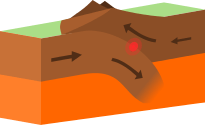
What type of plate boundary is this?
a)
Plate
b)
Divergent
c)
Convergent
d)
Transform
23.
What type of event will occur at this boundary?
a)
Earthquake
b)
Volcano Eruption
c)
Tornado
d)
Mountain Building
24.
Which of the following is NOT evidence to support the theory of plate tectonics?
a)
Fossils
b)
Mountains
c)
Glaciers
d)
Sand Erosion
25.
The theory that says Earth's continents once made up an ancient supercontinent, and have been drifting apart ever since, is called the theory of...
a)
Pangea
b)
Plate Tectonics
c)
Natural Selection
d)
Gravity
26.

Oceanic Trenches are formed by _______ plate boundaries

a)

Convergent

b)

Transform

c)

Plate

d)

Divergent

27.
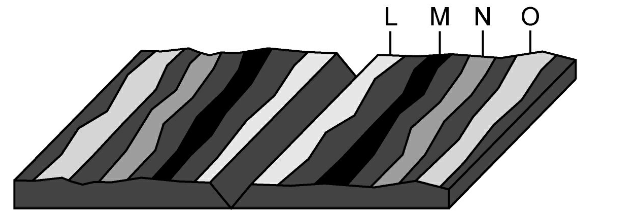
Where would the oldest rock be found?
a)
L
b)
M
c)
N
d)
O
28.
The Great Rift Valley in Africa and the Mid-Ocean Ridge were all created by this boundary
a)
Divergent
b)
Convergent
c)
Reform
d)
Transform
29.
When an oceanic plate and a continental plate collide, which one will subduct?
a)
oceanic
b)
continental
c)
neither
30.
What type of rock would you most likely find a fossil inside of?
a)
sedimentary
b)
igneous
c)
metamorphic
d)
diamond
31.
Emily was looking at a rock and saw tiny crystals.  Emily should know that all rocks are made up of _____.
a)
diamonds
b)
minerals
c)
fossils
d)
dirt
32.
What would you use to determine the hardness of a mineral?
a)
color tiles
b)
streak test
c)
Mohs Scale
d)
weight scale
33.
What are 3 properties that are used to identify minerals?
a)
luster, color and sound
b)
smell, color and hardness
c)
luster, color and hardness
d)
luster, smell and hardness
34.
A slow cooling igneous rock will have _____ crystals
a)
large
b)
small
c)
average
d)
black
35.
Metamorphism is caused by intense _____ & _____.
a)
foliation & nonfoliation
b)
texture & composition
c)
cementation & compaction
d)
temperature & pressure 
36.

Granite, Obsidian and Pumice are all examples of ________

a)

Sedimentary Rocks

b)

Igneous Rocks

c)

Metamorphic Rocks

37.

Marble, Slate and and Gneiss are all examples of ________.

a)

Metamorphic Rocks

b)

Sedimentary Rocks

c)

Igneous Rocks

38.
A lightly colored igneous rock is considered what?
a)
Mafic
b)
Felsic
39.
Is this metamorphic rock foliated or non foliated?
a)
Foliated
b)
Non foliated
40.

The basalt, shown here, is an igneous rock. We know that it cooled rapidly because it has a fine texture with no large crystals showing. What kind of rock type is this?

a)

clastic sedimentary

b)

intrusive (underground) igneous

c)

extrusive (above ground) igneous

d)

nonfoliated metamorphic

41.

Granite, the rock shown here, is what kind of rock

a)

intrusive igneous

b)

extrusive igneous

c)

foliated metamorphic

d)

nonfoliated metamorphic

42.
Look carefully at the chart.  Be aware that igneous INTRUSIVE rocks will have much bigger crystals than igneous EXTRUSIVE rocks.  Which of the rocks below should have BIGGER crystals
a)
Diorite
b)
Andesite
43.
Both of these rocks are metamorphic.  How can you tell the foliated apart from the non-foliated?
a)
the foliated rock is smooth
b)
the nonfoliated rock is shiny
c)
the foliated rock is on the left
d)
the foliated rock is stripey
44.
What type of rock has particles that bury fossils underwater and so preserves them?  (what kind of rock do fossils form in)
a)
igneous
b)
metamorphic
c)
sedimentary
45.
Limestone, shown here, is a
a)
metamorphic rock
b)
igneous rock
c)
sedimentary rock
46.
Marble comes from the sedimentary rock limestone.  When the limestone is subjected to extreme heat and pressure over a long time, the limestone turns into what metamorphic rock?
a)
limestone
b)
shale
c)
slate
d)
marble
47.
What is this glassy rock
a)
granite
b)
andesite
c)
limestone
d)
obsidian
48.
How do I know this is an organic sedimentary rock?
a)
it has large crystals
b)
it has fossils
c)
it has a glassy texture
d)
it has a grey color
49.
__________ metamorphism occurs when magma heats the surrounding rock and changes it.
a)
Regional
b)
Forced
c)
Igneotrophic
d)
Contact
50.
__________ metamorphism occurs when rock formations in the crust collide and build pressure
a)
Regional
b)
Forced
c)
Igneotrophic
d)
Contact
51.
What is the name of this Metamorphic Rock?
a)
Schist
b)
Slate
c)
Gneiss
d)
Marble
52.
What sedimentary rock is changed into quartzite during metamorphism?
a)
Shale
b)
Sandstone
c)
Limestone
d)
Conglomerate
53.
What sedimentary rock is changed into slate during metamorphism?
a)
Shale
b)
Limestone
c)
Sandstone
d)
Breccia
54.

If a layer of sandstone lies on top of a layer of limestone in which a 450-million-year-old fossil is found, and there are no unconformities, the layer of sandstone must be ____.

a)

older than 450 million years

b)

younger than 450 million years

c)

exactly 450 million years old

d)

to old to determine its age

55.

According the graph, a piece of timber containing one-fourth of the amount of carbon-14 that is found in a living tree, died about how many years ago?

a)

11,400 years

b)

22,800 years

c)

5,700 years

d)

17,100 years

56.

What type of unconformity is shown between D and C in the figure?

a)

nonconformity

b)

disconformity

c)

angular unconformity

d)

uniformatarianism

57.

Which is the best sequence of events shown in the figure, listed from oldest to youngest?

a)

FEDABC

b)

ABCFED

c)

DEFCBA

d)

FEDCBA

58.

Relative to the limestone layer (A) in the figure, the fault is...

a)

not related

b)

younger

c)

older

d)

the same age

59.

Which of the following conditions help preserve organisms as fossils- there are three answers

a)

quick burial by sediments

b)

hard parts

c)

protection from scavengers

d)

activities of microorganisms

60.

Fossils of species that lived on Earth for short periods of time, were abundant, and were widespread geographically are...

a)

absolute date

b)

original remains

c)

index fossils

d)

trace fossils

61.

The map shows some of the bedrock in Virginia. Which of these has the oldest exposed bedrock?

a)

Hightown Valley

b)

Monterey

c)

Jack Mountain

d)

Bull Pasture

62.

A sample of a radioactive element has a mass of 80 g. How much parent and daughter materials are in the sample after two half-lives?

a)

parent = 20 g; daughter = 60 g

b)

parent = 80 g; daughter = 80 g

c)

parent = 2; daughter = 1/2

d)

parent = 60 g; daughter = 20 g

63.

What appears to have occurred in the section labeled B in the figure

a)

Sediment was deposited on sloped ground.

b)

Sediment was deposited on sloped ground that later became level.

c)

Sediment was deposited on level ground that later tilted.

d)

Sediment was deposited on level ground that stayed level.

64.
In which province is Bituminous coal mined?
a)
Valley and Ridge
b)
Appalachian Plateau
c)
Blue Ridge
d)
Coastal Plain
65.
Which Virginia province is shown on the map? 
a)
Coastal Plain 
b)
Piedmont 
c)
Valley and Ridge 
d)
Blue Ridge 
66.
Which Virginia province is seen on this map? 
a)
Piedmont 
b)
Coastal Plain 
c)
Blue Ridge 
d)
Appalachian Plateau 
67.
Karst topography includes underground caverns. Where in VA would this landscape be found?
a)
Piedmont 
b)
Coastal Plain
c)
Valley and Ridge
d)
Blue Ridge
68.
Which province has the oldest rocks in VA?
a)
Coastal Plain
b)
Piedmont
c)
Blue Ridge
d)
Appalachian Plateau
69.
Most of the gravel and sand deposits in Virginia are found in which region?
a)
Coastal Plain
b)
Piedmont
c)
Valley & Ridge
d)
Blue Ridge
70.
The Fall Line is the natural border between which two regions?
a)
Appalachian Plateau & Valley & Ridge
b)
Blue Ridge & Coastal Plain
c)
Coastal Plain & Piedmont
d)
Blue Ridge & Piedmont
71.
Where would limestone be mined in VA?
a)
Appalachian Plateau
b)
Valley and Ridge
c)
Blue Ridge
d)
Piedmont
72.
The Appalachian Plateau is where coal is mined.  Coal forms in what type of rock?
a)
igneous
b)
foliated metamorphic
c)
nonfoliated metamorphic
d)
sedimentary
73.

Coal Deposits in Virginia are the result of

a)

Ancient Swamps

b)

Ancient Sandstone

c)

Ancient Desert Ecosystems

d)

Ancient Volcanic Activity

74.

Select the three mineral resources below that are mined in, and make the largest contributions to Virginia's economy

a)

Petroleum

b)

Sand

c)

Talc

d)

Coal

e)

LImestone

75.

What is the best evidence that many different geologic periods are represented in Virginia?

a)

The presence of fossils of different ages

b)

The location of the Piedmont

c)

The amount of chemical weathering

d)

The length of its rivers

76.

Trilobites,are fossils of an ocean dwelling animal related to the modern day horse shoe crab. These animals lived throughout Earth's oceans hundreds of millions of years ago. Fossils of these animals can be found in sedimentary rock layers in the mountains of Virginia. This indicates that-

a)

the mountains of Virginia were formed by massive volcanoes

b)

the mountains of Virginia were once covered by swamps

c)

the mountains of Virginia has never been covered by water

d)

the mountains of Virginia were once a marine environment

77.

Which natural resource from Virginia is used to make concrete

a)

Quartz

b)

Coal

c)

Limestone

d)

Natural Gas

78.
Put the stages of Coal development in order from MOST RECENT to oldest
a)
peat, lignite, coal
b)
coal, lignite, peat
c)
lignite, coal, peat
d)
lignite, peat, coal
79.
When rocks are broken down into smaller pieces
a)
erosion
b)
weathering
c)
sediment
80.
When water, ice and wind move particles of rock and soil from one place to another
a)
sediment
b)
weathering
c)
erosion
81.
The force that attracts objects to each other
a)
erosion
b)
gravity
c)
glacier
82.
The subsoil catches and holds the nutrients and minerals that are washed down from the
a)
Topsoil
b)
Weathered rock
c)
solid rock
83.
Erosion caused by _______________ changes beaches and lakes
a)
glaciers
b)
ice
c)
waves
84.
Soil is a mixture of
a)
weathered rock particles
b)
plant and animal remains
c)
all of the above
85.
Change over time for organisms.
a)
geologic time scale
b)
evolution
c)
era
d)
period
86.

What Eon are we currently in?

a)

Phanerozoic

b)

Hadean

c)

Archaen

d)

Proterozoic

87.

What Era are we currently in?

a)

Paleozoic

b)

Mesozoic

c)

Cenozoic

d)

Triassic

88.

Which Era was dominated by dinosaurs?

a)

Paleozoic

b)

Mesozoic

c)

Cenozoic

d)

Cambrian

89.

What is the longest unit of time?

a)

Eon

b)

Era

c)

Period

d)

Epoch

90.

What type of event usually marks the end of an Era

a)

A Mass Extinction

b)

A Quinceanera

c)

An earthquake

d)

Evolution of a species

91.

Which era began with the early invertebrates, such as trilobites and brachiopods.

a)

Paleozoic

b)

Mesozoic

c)

Cenozoic

92.

early vertebrate fish began to develop in the

a)

Paleozoic era

b)

Mesozoic era

c)

Cenozoic era

93.

the first amphibians came later in the

a)

Paleozoic era

b)

Mesozoic era

c)

Cenozoic era

94.

By the end of the era, seed plants were common.

a)

Paleozoic

b)

Mesozoic

c)

Cenozoic

95.

Small mammals and birds appeared in this era

a)

Paleozoic

b)

Mesozoic

c)

Cenozoic

96.

Flowering plants became most common.

a)

Paleozoic era

b)

Cenozoic era

c)

Mesozoic era

97.

Humans are a part of this era

a)

Paleozoic

b)

Mesozoic

c)

Cenozoic

98.

In what time period did Pangaea appear?

a)

Precambrian time

b)

Paleozoic era

c)

Mesozoic era

d)

Cenozoic era