
 Worksheets
Mr. Crowne's Quarter One Exam Review
Total questions: 84
Worksheet time: 2hrs 34mins
Name
Class
Date
1.
A possible explanation to a problem that has not yet been tested.
a)
data
b)
theory
c)
hypothesis
d)
fact
2.
This variable in an experiment is the one being deliberately changed by the scientist.
a)
dependent variable
b)
independent variable
c)
data
d)
control group
3.
Should experiments be repeated over and over to see if the results are the same each time?
a)
yes
b)
no
4.
The summary at the end of an experiment that explains the results.
a)
conclusion
b)
procedures
c)
materials
d)
responding variable
5.
A series of steps used by scientists to solve a problem or answer a question.
a)
scientific method
b)
recipe
c)
data collection
d)
metric system
6.
In a controlled experiment, how many independent variables can be worked with at a time?
a)
one
b)
none
c)
two or more
d)
how ever many makes sense.
7.
A list of the steps anyone could follow to conduct an experiment.
a)
obervations
b)
question/problem
c)
materials
d)
procedures
8.

Which statement is an inference about this picture?
a)
The van is tan.
b)
The van ran into KFC.
c)
The driver was hungry.
d)
Red and white are part of the KFC building.
9.
Mr. S. sets up an experiment to see how the mass of a ball affects the distance it rolls off a ramp. Identify the independent variable.
a)
distance traveled by the ball
b)
height of the ramp
c)
mass of the ball
d)
weight of the ball
10.
Mr. S. sets up an experiment to see how the mass of a ball affects the distance it rolls off a ramp. Identify the dependent variable.
a)
height of the ramp
b)
distance traveled by the ball
c)
mass of the ball
d)
weight of the ball
11.
A student is planning an experiment to find out how the height from which he drops a ball affects how high the ball bounces. The dependent variable is the _____.
a)
Diameter of the ball
b)
Force acting on the ball
c)
Height that the ball bounces
d)
Height from which the ball is dropped
12.
When experimenting with the growth of a plant, a scientist uses three (of the same type of) plants, two different fertilizers, equal light, and equal water. What type of variable is the fertilizer?
a)
Dependent
b)
Independent
c)
Control
d)
Compound
13.
An experiment is performed on plants to see how different liquids affect plant growth. Each plant in the experiment is given a different liquid; water, apple juice, or milk. Each plant has the same amount of soil, sunlight, and listens to the same music. In this investigation, what is the dependent variable?
a)
Type of plant
b)
Water, apple juice, milk
c)
Plant growth
d)
Color of the plant's leaves
14.
Science is a continually ongoing process.
a)
True
b)
False
15.
If I study for my scientific method quiz, then I will have a better test score. What is the dependent variable?
a)
Scientific Method
b)
Studying
c)
Independent variable
d)
Test score
16.
What is a hypothesis?
a)
A hypothesis is the right answer to an experiment.
b)
A hypothesis is the wrong answer to an experiment.
c)
A hypothesis is an educated guess.
d)
I don't know.
17.
Which is NOT a step in the scientific method?
a)
Make observation
b)
Form a theory
c)
Collect data
d)
Form a hypothesis
18.
What step does every scientific experiment begin with?
a)
hypothesis
b)
question/problem
c)
procedures
d)
conclusion
19.
This part of the experiment serves as a basis of comparison; the one variable being tested has been omitted.
a)
experimental group
b)
control group
c)
data
d)
variables
20.
Which of these contains steps in the right order?
a)
Ask a question, state your hypothesis, research, experiment, analyze, make a conclusion
b)
State your hypothesis, ask a question, research, experiment, analyze, make a conclusion
c)
Ask a question, research, state your hypothesis, experiment, analyze, make a conclusion
d)
State your hypothesis, ask a question, research, make a conclusion, experiment, analyze
21.
True or False: Your hypothesis can never be wrong.
a)
True
b)
False
22.

In this graph, what is the independent variable?
a)
Population
b)
Day
c)
Species 5
23.

In this graph, what is the dependent variable?
a)
Walla Walla Island
b)
Time
c)
Number of Deer
24.
What is an inference?
a)
Just a guess.
b)
A statement based off of your observations.
c)
The same as an observation.
d)
Examples of something.
25.

Which of the following statements is an inference of the picture?
a)
A student is roasting a marshmallow
b)
Two students are listening through cups
c)
The teacher is not in the classroom
d)
A student is setting off a rocket
26.

She is holding an umbrella
a)
observation
b)
inference
27.

It is raining outside
a)
observation
b)
inference
28.

This bullseye demonstrates...
a)
High Accuracy & High Precision
b)
High Accuracy & Low Precision
c)
Low Accuracy & High Precision
d)
Low Accuracy & Low Precision
29.
How close a measurement is to the true value is called..
a)
Accuracy
b)
Precision
c)
Significant
d)
Estimate
30.
When a measurement is repeatable and consistent it is said to have...
a)
High precision
b)
Low precision
c)
High accuracy
d)
Low accuracy
31.
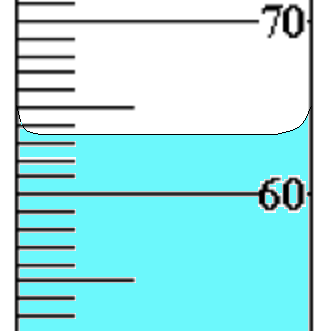
Volume?
a)
63.5 mL
b)
63 mL
c)
63.55 mL
d)
6 mL
32.
Volume?
a)
63.5 mL
b)
63 mL
c)
63.55 mL
d)
6 mL
33.

Put the liquids in order from most dense to least dense?
a)
4, 3, 2, 1
b)
1, 2, 3, 4
c)
3, 4, 2, 1,
d)
4, 3, 1, 2
34.
An empty beaker has a mass of 60 grams. When mercury is added to the graduated cylinder, it has a mass of 200 grams. What is the mass of the mercury?
a)
140 grams
b)
200 grams
c)
140 mL
d)
260 g
35.
Accuracy is defined as
a)
close repeated measurements
b)
awesome measurements
c)
really good guessing
d)
measurement near the true value
36.
Measurements that are repeated and close to each other can be defined as:
a)
accurate
b)
accurate and precise
c)
precise
d)
estimated
37.
If an object has a density of 3.6 g/mL and you put it into water, will it sink or float?
a)
sink
b)
float
38.

What is the volume of Object X?
a)
10.0 cm3
b)
15.0 cm3
c)
20.0 cm3
d)
25.0 cm3
39.

What piece of lab equipment is this?
a)
Graduated cylinder
b)
Erlenmeyer Flask
c)
Beaker
d)
Ruler
40.
When you hold a chemical at a distance and wave it towards yourself to smell it?
a)
waft
b)
wave
c)
smell
d)
sniff
41.
What is the definition of ACCURACY?
a)
how close the measurements are to the correct value
b)
how close the measurements are to each other
42.

What is the formula to calculate speed?
a)
S = t/d
b)
S = d/t
c)
S = d x t
d)
S = t x d
43.

What is speed?
a)
how far you go
b)
how much distance is covered over a period of time
c)
how fast you accelerate
d)
the change in the location of a object
44.

What is velocity?
a)
the quickness of an object
b)
the location of an object
c)
acceleration
d)
speed in a specific direction
45.

A runner races in the 100 meter dash. It takes her 10 seconds to finish. What is her average speed?
a)
10 m/s
b)
1000 m/s
c)
100 seconds
d)
10 seconds
46.

The correct equation to calculate speed is
a)
distance/time
b)
time/distance
c)
distance x time
d)
distance/time2
47.

Alan travels 100 km in 5hrs. Find his average speed in km/h
a)
5km/hr
b)
10km/hr
c)
50km/hr
d)
20km/hr
48.

What is happening at A?
a)
Stationary
b)
Accelerating
c)
Slower steady speed; moving away from the starting position
d)
Steady speed; returning to start position
49.
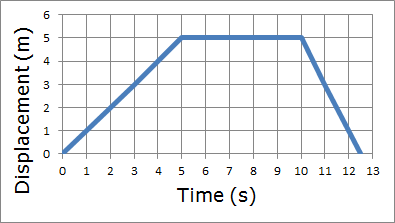
What is the person doing from 5 seconds to 10 seconds?
a)
Walking
b)
Running
c)
Standing Still
d)
Walking Fast
50.

What is the speed of an object that travels 60 meters in 4 seconds?
a)
240 m/s
b)
15 m/s
c)
0.067 m/s
d)
15 mph
51.

What does this graph represent?
a)
Constant Speed
b)
Acceleration
c)
Not moving
52.
Which of the following is a unit for acceleration?
a)
km/s
b)
m/s2
c)
mi/hr
d)
ft
53.
Acceleration of an object happens when things ________
a)
slow down
b)
go faster
c)
change direction (turn)
d)
All of the above
54.
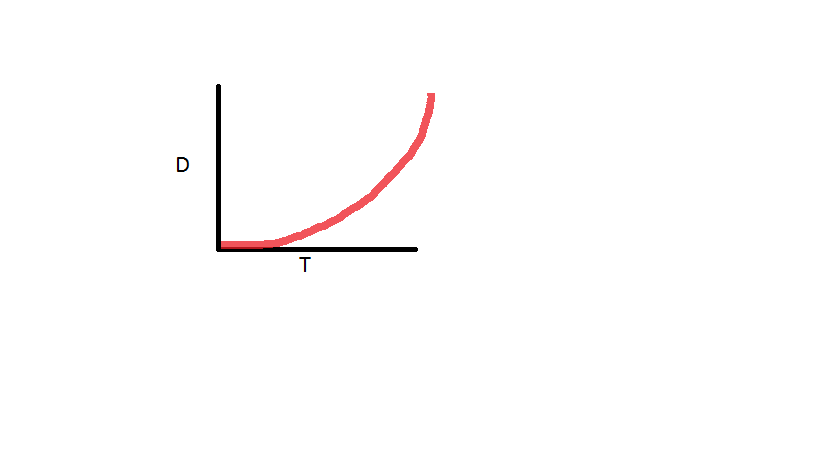
The graph below represents
a)
Speed
b)
Velocity
c)
Acceleration
d)
Deceleration
55.
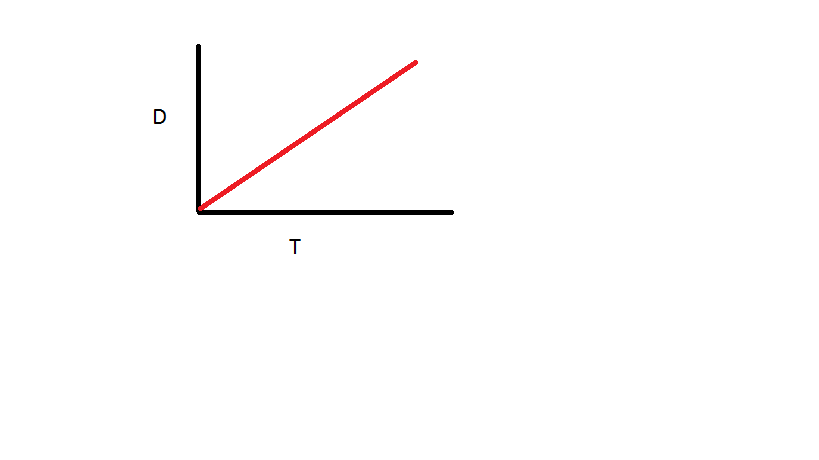
The graph represents
a)
Acceleration
b)
No motion
c)
Deceleration
d)
Constant Velocity
56.
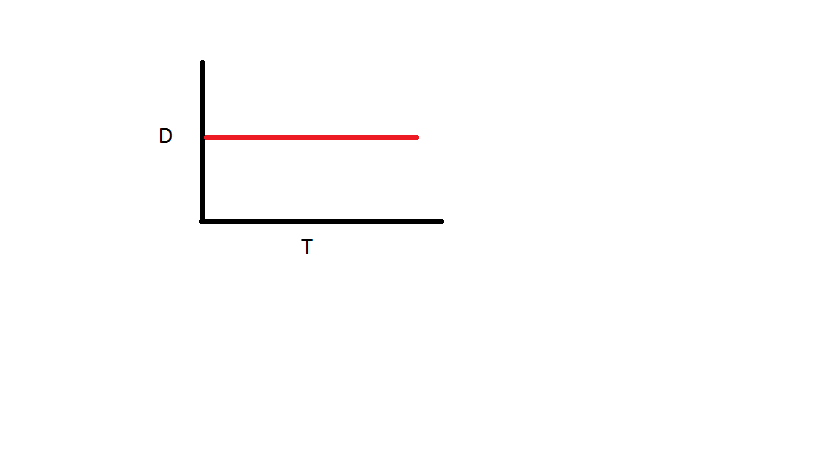
The graph represents
a)
No motion
b)
Constant velocity
c)
Acceleration
d)
Deceleration
57.

The graph respresents
a)
No motion
b)
Constant Velocity
c)
Acceleration
d)
Deceleration
58.

The graph represents
a)
no motion
b)
constant velocity
c)
acceleration
d)
negative acceleration
59.
An object is _____ if its position changes relative to another object.
a)
in motion
b)
at reset
c)
a frame of refence
d)
magical
60.

Calculate the average speed (in meter/sec) if a cheetah runs 180 meters in 10 seconds.
a)
198 m/sec
b)
170 m/sec
c)
12 m/sec
d)
18 m/sec
61.

A roller coasters accelerates from an initial velocity of 6.0 m/s to a final velocity of 70 m/s over 4 seconds. What's the acceleration?
a)
24 m/s2
b)
18 m/s2
c)
16 m/s2
d)
16 m/s
62.
When a car goes around a corner at 20 mph, why do we say it accelerates?
a)
The car is accelerating because of the velocity is constant
b)
The car accelerates because it's going 20 mph
c)
Cars always accelerate when they are in motion
d)
The car is accelerating because it's changing direction
63.
The metric system is based on multiples of:
a)
100
b)
20
c)
10
d)
1
64.
What is mass?
a)
the distance between two points
b)
the amount of matter (stuff) in an object
c)
the amount of space an object takes up
d)
the distance between three points
65.
What is volume?
a)
the distance between two points
b)
the amount of matter (stuff) in an object
c)
the amount of space an object takes up
d)
the distance between three points
66.
Which one is not in the metric system?
a)
Kilometer
b)
Yard
c)
Centimeter
d)
Meter
67.
The base unit for length is the
a)
second
b)
gram
c)
meter
d)
liter
68.
The base unit for volume is the
a)
second
b)
gram
c)
meter
d)
liter
69.
The base unit for mass is the
a)
meter
b)
gram
c)
kilogram
d)
liter
70.
What is the abbreviation for centimeter?
a)
c
b)
cm
c)
m
d)
km
71.
The metric system is based on multiples of:
a)
100
b)
20
c)
10
d)
1
72.
The Metric System is also known as the International System, SI.
a)
True
b)
False
73.
Jack has a rock. The rock has a mass of 14g and a volume of 2cm3. What is the density of the rock?
a)
7 mL
b)
7 g/cm3
c)
28 g/cm3
d)
1/7 g/cm3
74.
Which units of measurement are used for volume?
a)
grams
b)
centimeters
c)
grams/milliliter
d)
milliliter
75.
Which lab tool might you use to measure the volume of a liquid?
a)
electric scale
b)
bunsen burner
c)
test tube
d)
graduated cylinder
76.

What is the volume of Object X?
a)
10.0 cm3
b)
15.0 cm3
c)
20.0 cm3
d)
25.0 cm3
77.
True or False: The density of a specific type of material never changes.
a)
True
b)
False
78.

I have two objects with the same volume but different masses. Which object will be more dense?
a)
The object with less weight.
b)
The object with more weight.
c)
The object with more mass.
d)
The object with less mass.
79.
What is the formula for density?
a)
density = mass x volume
b)
density = mass / volume
c)
density = mass + volume
d)
density = mass - volume
80.
Frank has an eraser. It has a mass of 4g, and a volume of 2cm3. What is its density?
a)
8 g/cm3
b)
2 g/cm3
c)
1/2 g/cm3
d)
24 g/cm3
81.
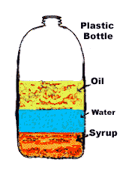
Which liquid is the least dense?
a)
oil
b)
water
c)
syrup
d)
plastic bottle
82.
What is the density of water?
a)
0 g/ml
b)
1 g/ml
c)
10 g/ml
d)
100 g/ml
83.

What do we know about the density of lamp oil, rubbing alcohol, and vegetable oil?
a)
The density is greater than 1.0 g/mL
b)
The density is less than 1.0 g/mL
c)
The density is equal to 1.0 g/mL
d)
The density can not be determined
84.
Which physical property would be the most useful for identifying an unknown liquid?
a)
Weight
b)
volume
c)
mass
d)
density
100 %

