
 Worksheets
Honors Review - Waves (SPS9abcde)
Total questions: 80
Worksheet time: 3hrs 6mins
What do waves carry from place to place?
Energy but not matter or particles
Matter or particles but not energy
Energy and matter and particles
Frequency is transferred
What is true about sound and light?
Sound has photons and light does not
Sound travels slower than light
Sound can travel through space but light cannot
Frequency and wavelength are directly related for sound and inversely related for light.
Travels the fastest through air
Light
Sound
Both
This is a longitudinal wave
Light
Sound
Both
This wave requires a medium.
Light
Sound
Both
This wave transfers energy from one place to another.
Light
Sound
Both





Which has the longest wavelength?
Gamma Rays
Visible Light
Microwaves
Radiowaves
Which has the highest frequency?
Gamma Rays
Visible Light
Microwaves
Radiowaves
Select the correct order (energy INCREASING) of waves on the EMS
Radio, Micro, Infra, Visible, Ultra, X-ray, Gamma
Gamma, X-ray, Ultra, Vis, Infra, Micro, Radio
Vis, Micro, Infra, Ultra, X-ray, Gamma, Radio
Micro, Radio, Vis, Infra, Ultra, X-ray, Gamma

What type of interference is represented in this diagram?
Constructive
Destructive
Select the correct order (wavelength INCREASING) of waves on the EMS
Radio, Micro, Infra, Visible, Ultra, X-ray, Gamma
Gamma, X-ray, Ultra, Vis, Infra, Micro, Radio
Vis, Micro, Infra, Ultra, X-ray, Gamma, Radio
Micro, Radio, Vis, Infra, Ultra, X-ray, Gamma

Which of the following describes the bending of a wave due to its change of speed.
Reflection
Diffraction
Refraction
Dispersion

When a wave front moves through a barrier which is of a width of similar wavelength is referred to as
Reflection
Refraction
Radiation
Diffraction

When waves meet and form a wave with either a largerer or smallerer amplitude
Radiation
Interference
Diffraction
Microwaves
Check all true statements about a mechanical wave.
It must have a medium (matter) to move through.
It can travel through outer space.
Their frequency and wavelength are inversely related.
They can refract, reflect, diffract and undergo interference.
They can undergo the Doppler Effect.
Check all true statements about an electromagnetic wave.
It must have a medium (matter) to move through.
It can travel through matter or a vacuum.
Their frequency and wavelength are inversely related.
They can refract, reflect, diffract and undergo interference.
They can undergo the Doppler Effect.
Which statement best defines a wave medium?
The material through which a wave travels.
A point halfway between the crest and trough.
The distance from one wave crest to the next.
The speed at which waves travel in water.

Which wave has the smallest frequency?
A Red
D Yellow
B Green
C Blue
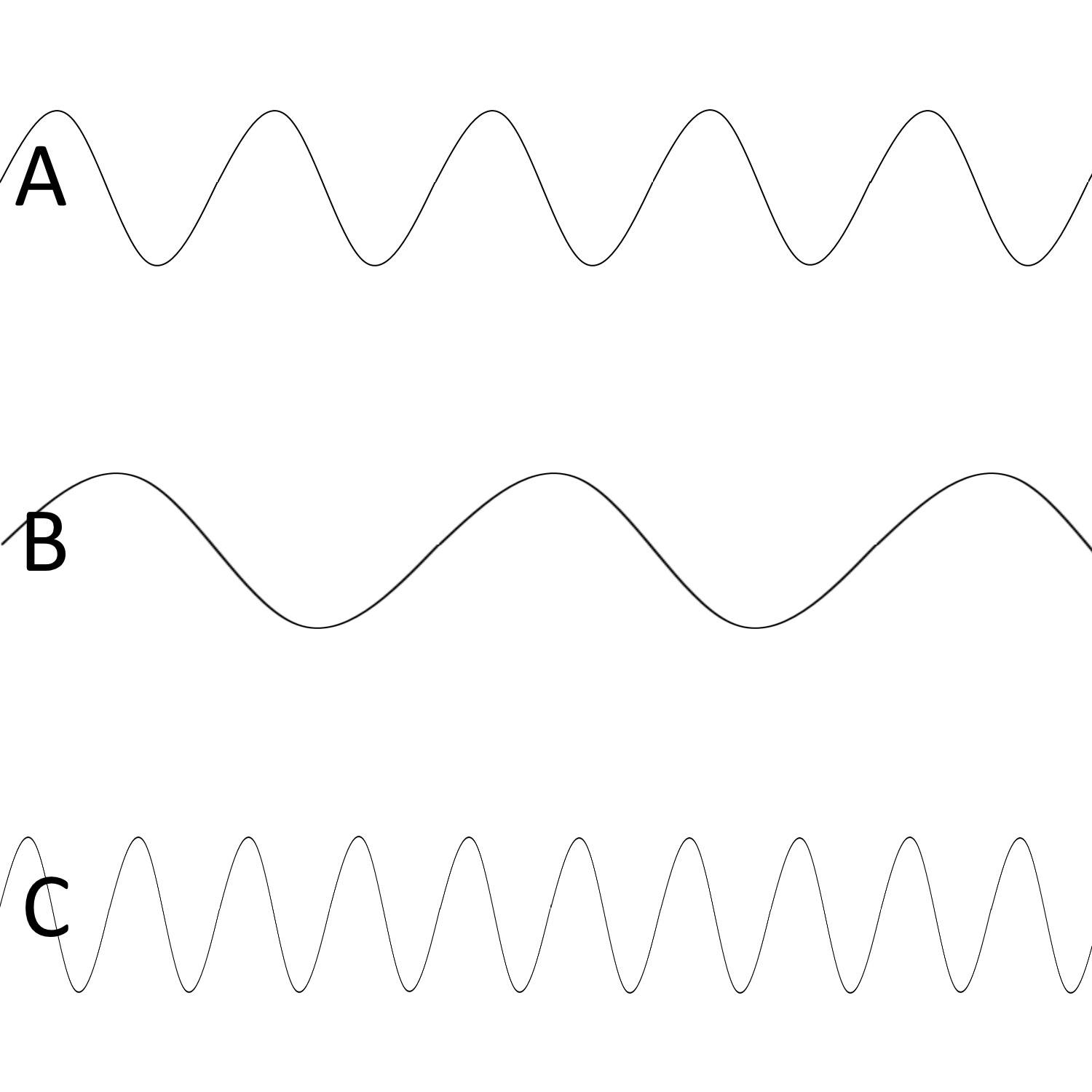
If you double the wavelength (A --> B), what happens to the frequency?
frequency will double
frequency will be half
frequency will stay the same
frequency will be 1/4th as big
If you double the wavelength (A --> B), what happens to the frequency?
frequency will double
frequency will be half
frequency will stay the same
frequency will be 1/4th as big
Which water wave has the most energy?
A Red
D Yellow
B Green
C Blue

What is the Doppler Effect?
A change in frequency due to the relative motion of a wave source and an observer
When a wave overlaps with another wave
When a wave bounces off of another object
When a wave bends due to traveling through a different medium
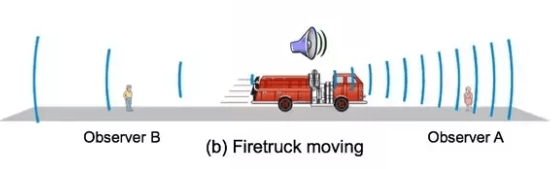
Look at the picture. Who is experiencing a lower pitched, lower frequency sound?
Observer A
Observer B
There is no difference

From the perspective of the camera's position, the ambulance's siren is heard at ____ frequency than is being produced.
a lower
a higher
the same
Which of the following is true for sound waves?
They require a medium.
They are unrelated to vibrations.
They cannot travel through liquids
They can travel in a vacuum
What is the term used to describe the maximum distance that a sound wave displaces air molecules from their original undisturbed position?
Amplitude
Speed
Frequency
Wavelength

Which distance represents the wavelength?
W
X
Y
Z

Which part of the wave is this?
Crest
Trough
Compression
Rarefaction
How do electromagnetic and mechanical waves compare?
Mechanical waves can only travel through a vacuum, but electromagnetic waves can travel through a solid, liquid, or gas.
Mechanical waves can travel through a solid, liquid, or gas, but electromagnetic waves can only travel through a gas.
Mechanical waves can only travel through a solid, liquid, or gas, but electromagnetic waves can travel through a vacuum.
Mechanical waves can travel through a solid, liquid, or gas, but electromagnetic waves can only travel through a solid.
What do radio waves, microwaves, X-rays, and gamma rays all have in common?
They all have the same wavelength.
They are electromagnetic waves.
They are detected in the same way.
They store the same amount of energy.


Which part of the wave is this?
Crest
Trough
Compression
Rarefaction


What is the frequency of a wave travelling at 16 m/s with a wavelength of 2.5 meters?
6.4 Hz
0.16 Hz
40 Hz
13.5 Hz
Which word means that waves bounce off at the same angle of which they hit?
Reflection
Diffraction
Refraction
Polarization

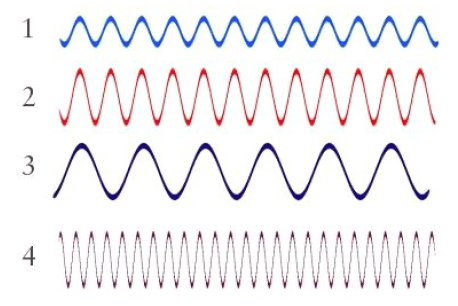
If a satellite or spaceship explodes in outer space, you can see the explosion from a distance but you cannot hear it. Why?
Light waves travel very slow and sound waves travel much faster.
Sound waves transmit energy while light does not transmit energy.
Sound is a mechanical wave and needs a medium to travel through while light is an electromagnetic wave.
Light is a mechanical wave and needs a medium to travel through while sound is an electromagnetic wave.
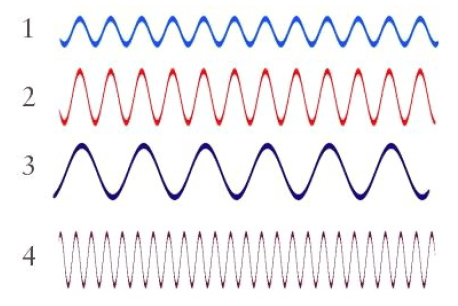

Shorter wave lengths can carry more energy. Which of these probably carries the MOST energy:
Infrared light
Visible light
X-rays
UV light

Infrared rays have a shorter wavelength than
Ultraviolet ray
X-rays
gamma rays
radio waves
Which has the LONGEST wavelength and, therefore, the LOWEST frequency/energy
Gamma Rays
Visible Light
Ultraviolet
Infrared rays
High frequency in EM waves equals
high energy and short wavelength
low energy and short wavelength
high energy and long wavelength
low energy and long wavelength
Reflection is to bouncing as refraction is to:
bending.
breaking.
dissipating.
halting.
What type of wave requires a medium through which to travel?
hand
electrical
mechanical
all of these
Which material is sound able to travel fastest through? Explain.
Vacuums of empty space because there are no particles for the sound to have to bounce around.
Gases because the particles are less packed together so the sound waves can move quickly through it.
Solids because the particles are closely packed together and the sound waves can bounce off of each particle quickly.
Liquids because the particles easily slide around on each other so the sound waves can slide with the liquid particles.
Sound does not travel in space because
The particles in a vacuum are too far apart for sound to bounce off of.
There is not matter in space.
Stellar gases get in the pathway of sound waves.
This statement is incorrect, sound does travel in space.

Based on the data table, what material does light travel fastest through?
empty space
solids
liquids
gases

Based on the pattern in the data table, which material do you think light would travel fastest through?
carbon dioxide
liquid H2O
solid H20
liquid nitrogen

Based on the data table, which material do you think sound would travel the fastest through?
carbon dioxide
liquid H2O
solid H2O
liquid nitrogen

The data table shows the speed of sound through different substances. What can you determine about the density of steel compared to the density of glass based on this data?
Steel is more dense than glass because sound travels faster in steel. Speed of sound and density have a proportional relationship.
Steel is more dense than glass because sound travels faster in steel. Speed of sound and density have an inversely proportional relationship.
Steel is less dense than glass because sound travels faster in steel. Speed of sound and density have a proportional relationship.
Steel is less dense than glass because sound travels faster in steel. Speed of sound and density have an inversely proportional relationship.
When you look at a pencil in a jar of water, why does it look broken?
Light waves slow down from air to water.
Light waves speed up from air to water.
The light waves do not change speeds in different media, but they do look different.
The light waves are bending because water is less dense than air.

Which medium do mechanical waves travel the slowest in?
Solid
Liquid
Gas
Travels the same through all of them
When two waves are in phase with each other and they produce a wave with an increased amplitude this is called:
Destructive interference
Constructive interference
Resonance
Wavelength
All electromagnetic waves travel at
different speeds
the speed of sound
the speed of light
the speed of a vacuum
Electromagnetic waves have the same speed but different:
frequency & medium
wavelength & frequency
medium & wavelength
color & medium
Which color in the visible spectrum of light has the longest wavelength?
Indigo
Red
Blue
Violet
Gamma rays can cause damage to living tissues because...
They have medium wavelengths that can interfere with cell replication.
They have very long wavelengths that can interfere with cell replication.
They have very short wavelengths that can interfere with cell replication.
None of these
What does energy have to do with wavelength and frequency?
The higher the frequency the less energy the wave has.
The lower the frequency the more energy the wave has.
The shorter the wavelength the more energy the wave has.
The longer the wavelength the more energy the wave has.

