wayground logo

Free Printable Worksheets

Font size

S
M
L
XL
Worksheets

12/17/2019

Total questions: 81

Worksheet time: 2hrs 52mins

Name
Class
Date
1.
What is current measured in?
a)
Ω (Ohms)
b)
V (Volts)
c)
A (Amps)
d)
W (Watts)
2.
What is resistance measured in?
a)
Ω (Ohms)
b)
V (Volts)
c)
A (Amps)
d)
W (Watts)
3.
What is Resistance?
a)
The flow of electrons
b)
Electric potential difference
c)
A battery
d)
The ability to reduce the flow of electrons
4.
Electricity that flows in a closed path is called a
a)
path
b)
current
c)
circuit
d)
light
5.
What is a closed path for electrons to flow through?
a)
static electricity
b)
circuit
c)
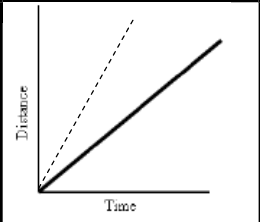
amperes
6.
Lightning is an example of _________.
a)
static electricity
b)
current electricity
c)
watts
d)
voltage
7.
Identify the conductor below.
a)
cloth rag
b)
plastic bottle
c)
gold ring
8.
Identify the insulator below.
a)
aluminum foil
b)
paperclip
c)
rubber eraser
9.
This is an example of a _______ circuit
a)
open
b)
series
c)
parallel
d)
square
10.
If the voltage is increased and the resistance stays the same, current will ____.
a)
Increase
b)
Decrease
c)
Stay the same
d)
Not enough info
11.
What does the I stand for on the ohm's law wheel?
a)
current
b)
voltage
c)
power
d)
ohms
12.
What does the R stand for on the ohm's law wheel?
a)
resistance
b)
voltage
c)
current
d)
mass
13.
Which of the following are magnetic poles?
a)
North and South
b)
East and West
c)
Left and Right
d)
Red and Blue
14.
What do two unlike poles do when they are brought close together?
a)
Nothing
b)
Repel
c)
Attract
d)
Decrease
15.
The arrow on magnetic field lines shows them flowing in which direction?
a)
Left to Right
b)
North to South
c)
South to North
d)
Right to Left
16.
What is one difference between electromagnets and bar magnets?
a)
Bar magnets can be turned off but electromagnets cannot
b)
Electromagnets need electricity but bar magnets do not
c)
Bar magnets have a magnetic field but electromagnets do not
d)
Bar magnets are bigger than electromagnets
17.
How can you reverse a magnetic field in a circuit?
a)
Connect the battery the other way around
b)
Use a different wire
c)
Increase the current
d)
Use a different battery
18.
Which of the following is a complete energy transformation for a flashlight? (Assume kinetic thermal in all transformations)
a)
Chemical energy > light energy
b)
Mechanical energy > electrical energy > light energy
c)
Chemical energy > electrical energy > light energy
d)
Chemical energy > electrical energy
19.
What type of energy does a drawn bow and arrow have?
a)
Elastic potential
b)
 Motion kinetic
c)
Chemical potential
d)
Nuclear potential
20.
What is an example of a conductor?
a)
A wooden block
b)
A plastic fork
c)
A styrofoam cup
d)
Aluminum foil
21.
What is the purpose of a simple electric motor?
a)
To create a magnetic field
b)
To turn mechanical energy to electrical energy
c)
To convert electrical energy to kinetic energy
d)
To produce electrical energy
22.
What is the function of a switch in an electric circuit?
a)
To allow electrons to flow through the circuit
b)
To allow heat to flow through the circuit
c)
To allow chemicals to flow through the circuit
d)
To produce electricity
23.
What is a change of position of an object?
a)
motion
b)
weight
c)
mass
24.
A _________ uses force to move an object towards you. 
a)
Pull
b)
Push
c)
Motion
d)
Force
25.

The location or place of an object.

a)

Position

b)

Reference Point

c)

Push

d)

Dimension

26.

Idea that the observation of motion depends on the observer.

a)

Position

b)

Reference Point

c)

Relative Motion

d)

Dimension

27.

Measurable quantity of a particular kind such as; length, breadth, (width) depth, or height.

a)

Position

b)

Dimension

c)

Reference Point

d)

Speed

28.

A measure of how fast something moves or the distance it moves, in a given amount of time.

a)

Motion

b)

Position

c)

Acceleration

d)

Speed

29.
Which travels faster, light or sound?
a)
light
b)
sound
30.
What is the top of a wave?
a)
trough
b)
crest
31.
What is the top of a wave?
a)
trough
b)
crest
32.
What is the bottom of a wave?
a)
trough
b)
crest
33.
A wave is a disturbance that transfers:
a)
matter
b)
energy
34.
What type of wave is this?
a)
Transverse
b)
Longitudinal
35.
Distance from 'y' to 'y' is a _______
a)
Wavelength
b)
Amplitude
c)
Compression
d)
Rarefaction
36.
What is represented by the blue lines?
a)
Trough
b)
Crest
c)
Wavelength
d)
Amplitude
37.
What happens to frequency when the energy increases?
a)
it increases
b)
it decreases
c)
it stays the same
38.
What part of the wave is shown at letter A?
a)
crest
b)
trough
c)
wavelength
d)
frequency
39.
Which part of the wave is shown at letter B?
a)
crest
b)
trough
c)
wavelength resting point
40.
Which part of the wave is shown at letter D?
a)
trough
b)
resting point
c)
wavelength
d)
frequency
41.
Which part of the wave is shown at letter E?
a)
trough
b)
crest
c)
resting point
d)
amplitude
42.

What kind of wave is light?

a)

longitudinal waves

b)

transverse waves

c)

medium-sized waves

d)

electromagnetic

43.

What is the lowest point of a wave?

a)

trough

b)

crescent

c)

medium

44.
Which type of wave has a wave perpedicular to the disturbance?
a)
surface
b)
mechanical
c)
transverse
d)
longitudinal
45.
Which electromagnetic waves have the highest frequencies and the shortest wavelengths?
a)
microwaves
b)
visible light
c)
gamma rays
46.
Which electromagnetic waves are used in ovens and cell phone communications?
a)
Infrared rays
b)
ultraviolet rays
c)
microwaves
47.
Which type of waves are used in broadcasting?
a)
radio waves
b)
infrared rays
c)
x-rays
48.
Which feature of sound is determined by amplitude?
a)
Pitch
b)
Smoothness
c)
Loudness
49.

The diagram shows a readout from a device that measures sound waves.


How should these waves be described?

a)

mechanical longitudinal

b)

compressional electromagnetic

c)

compressional transverse

d)

mechanical transverse

50.

What is energy?

a)

moving energy

b)

stored energy

c)

renewable energy

d)

The ability to do work.

51.

What is potential energy?

a)

moving energy

b)

stored energy

c)

renewable energy

d)

non renewable energy

52.
What kind of energy does this device use?
a)
Chemical
b)
Electrical
c)
Thermal
d)
Chemical
53.
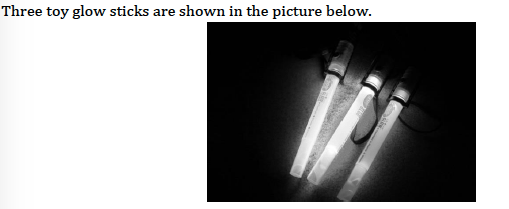
The glow sticks produce light for a short amount of time. The light from the glow stick is a conversion from what to what?
a)
thermal to light
b)
gravitational to potential
c)
radiant to electrical
d)
chemical to light
54.

When an egg is boiled in a pot of water on the stove, there is more than one kind of heat transfer. Heat is transferred from the stove to the pot directly since they are physically touching. Heat is also transferred from the pot to the egg, carried through the water. What two kinds of heat transfer are represented?

a)

Stove → Pot = radiation, Pot → Egg = conduction

b)

Stove → Pot = conduction, Pot → Egg = radiation

c)

Stove → Pot = convection, Pot → Egg = conduction

d)

Stove → Pot = conduction, Pot → Egg = convection

55.

Which of these actions, on their own, will cause ice to change to water? Remember, hot --- > cold

a)

removing heat from the ice

b)

adding sand to the ice

c)

crushing the ice

d)

adding heat to the ice

56.

What energy transformation occurs as bioluminescent algae glow in the ocean?

a)

Radiant --> Chemical

b)

Thermal --> Radiant

c)

Chemical --> Radiant

d)

Thermal --> Chemical

57.

What energy transformation occurs in the chameleon as it quickly launches its tongue to catch an insect?

a)

Radiant --> Chemical

b)

Thermal --> Chemical

c)

Chemical --> Mechanical

d)

Mechanical --> Chemical

58.
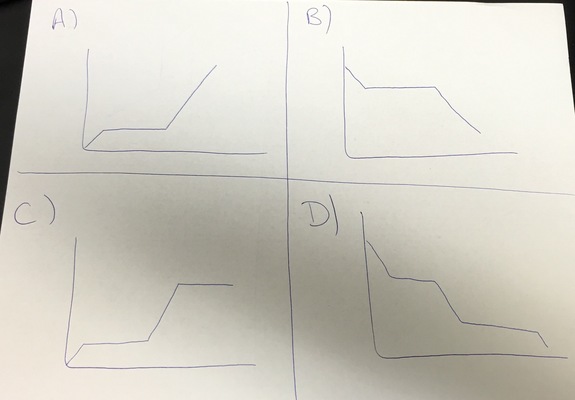
What does picture D show?
a)
Particles being heated and undergoing one phase change.
b)
Particles being cooled and going through one phase change.
c)
Particles being heated and undergoing two phase changes.
d)
Particles being cooled and undergoing two phase changes.
59.
Copper, Stainless Steel, Carbon Steel, and Zinc were all heated using the same thermal energy.  What material would be the coolest after being heated?
a)
Copper
b)
Carbon Steel
c)
Zinc
d)
Stainless Steel
60.

When is your answer negative?

a)

When the sample is cooled or loses heat energy.

b)

When the sample heats up or gains heat energy.

c)

When the sample absorbs heat energy.
61.
Which runner won the race?
a)
A
b)
B
c)
C
62.
Which runner had a head start?
a)
A
b)
B
c)
C
63.
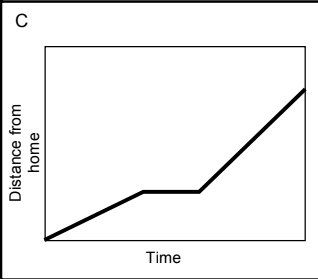
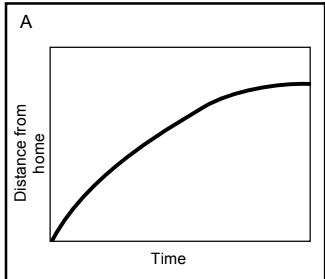
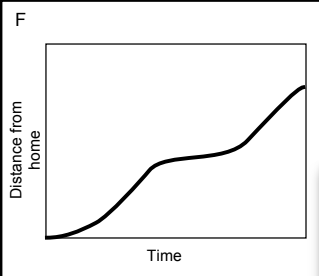
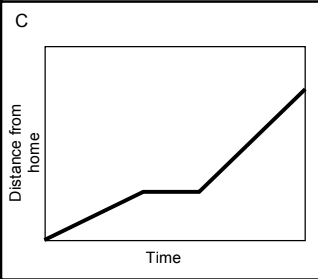
What does this graph represent?
a)
Constant Speed
b)
Acceleration
c)
Not moving
64.
How long did it take this object to travel 10 m?
a)
0 s
b)
10 s
c)
15 s
d)
20 s
65.
a)
b)
c)
d)
66.
a)
b)
c)
d)
67.
a)
b)
c)
d)
68.
a)
b)
c)
d)
69.
Which runner won the race?
a)
A
b)
B
c)
C
70.

Select the description of motion from A - B.

a)

Slowing down away from the origin

b)

Speeding up away from the origin

c)

Constant velocity away from the origin

d)

Constant velocity towards the origin

71.

What segment of the graph shows no motion, or standing still?

a)

A - B

b)

B - C

c)

C - D

d)

None

72.

True or False: this graph shows several segments ALL with constant velocity.

a)

True

b)

False

73.
What is speed?
a)
how far you go
b)
how much distance is covered over a period of time
c)
how fast you accelerate
d)
the change in the location of a object
74.
What is velocity?
a)
the quickness of an object
b)
the location of an object
c)
acceleration
d)
speed in a specific direction
75.
65 miles per hour North is an example of an objects what?
a)
Speed
b)
Velocity
c)
Average Speed
d)
Constant Speed
76.
_____ is how fast an object moves in a specific direction.
a)
velocity
b)
speed
c)
displacement
d)
distance
77.

What is motion?

a)

the stopping of an object to a frame of reference

b)

a change in position relative to a frame of reference

c)

the middle ground between light and shadow, between science and superstition, and it lies between the pit of man's fears and the summit of his knowledge

d)

a change in the time in which it takes to get an office referral

78.
Total distance divided by total time is
a)
average speed
b)
constant speed
c)
instantaneous speed
d)
acceleration
79.
The distance between the line of origin to the top of the wave is called
a)
amplitude
b)
wavelength
c)
frequency
d)
speed
80.
If the wavelength increased, what would happen to the sound made by this wave?
a)
it would get softer
b)
it would get louder
c)
it would have a lower pitch
d)
It would have a higher pitch
81.
Waves that travel at the same speed as light, but have different wavelengths and frequencies make up the
a)
energy fields
b)
electromagnetic spectrum
c)
polarized fields
d)
magnetic field