
 Worksheets
Calculating Speed, Velocity, and Acceleration
Total questions: 80
Worksheet time: 3hrs 11mins
If an object travels 450 meters in 90 seconds, what is its speed?
100 m/s
10 m/s
5 m/s
25 m/s
How is velocity different from speed?
Velocity is the same as speed
Velocity is a scalar quantity
Velocity includes direction, while speed does not.
Velocity is measured in kilometers per hour
Calculate the velocity of a car that travels 100 meters in 20 seconds.
5 m/s
25 m/s
15 m/s
10 m/s
If a car accelerates from 20 m/s to 40 m/s in 5 seconds, what is its acceleration?
6 m/s^2
10 m/s^2
2 m/s^2
4 m/s^2
Explain the difference between positive and negative acceleration.
Positive acceleration means the object is at rest, while negative acceleration means the object is moving at a constant speed.
Positive acceleration means the object is slowing down, while negative acceleration means the object is speeding up.
Positive acceleration means the object is moving in a straight line, while negative acceleration means the object is moving in a curved path.
Positive acceleration means the object is speeding up, while negative acceleration means the object is slowing down.
How can you calculate acceleration if you know the initial velocity, final velocity, and time?
acceleration = (final velocity - initial velocity) * time
acceleration = (final velocity * initial velocity) / time
acceleration = (final velocity - initial velocity) / time
acceleration = (final velocity + initial velocity) / time
A car travels 120 miles in 12 hours. What is the car's speed?
10 mph
10 m/s
240 mph
240 m/s
A bicycle and rider are rolling along at a velocity of 15 meters per second and crash into a brick wall reducing their velocity to zero meters per second in 0.5 seconds. What was their negative acceleration in this instance?
0 s m − 15 sm ÷0.5 s =-30 meters / second squared
30 meters/ second squared
15 meters/ second squared
-15 meters/ second squared
If a car goes from 10 meters a second to 50 meters a second in 6 seconds, what is its acceleration? (remember to subtract the final speed from the initial speed to get your actual speed)
6.7 meters per second squared
0.15 meters per second squared
6.7 miles per hour
0.15 miles per hour
If a car goes from zero to 50 meters/ second in 30 seconds, what is its acceleration?
1.7 meters / second squared
0.6 meters / second squared


5 m/s
45 m/s
5 s/m
45 s/m


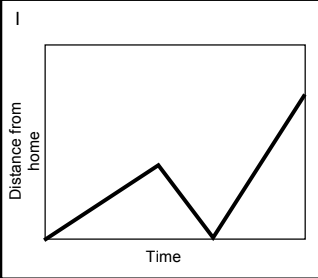
Describe the motion in the graph:
Constant Speed (positive slope)
Stopped (at rest)
Acceleration (increasing speed)
Return Home (negative slope)

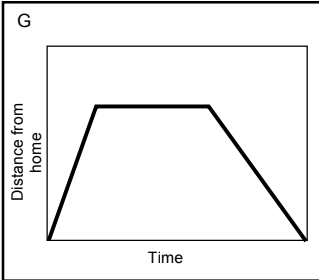
Describe the motion in the graph:
Constant Speed (positive slope)
Stopped (at rest)
Acceleration (increasing speed)
Constant speed (negative slope)

What was occurring from point B to point C?

Which is faster?
walking
skating
biking
Which type of exercise has the greatest acceleration?
walking
skating
biking
they all have zero acceleration

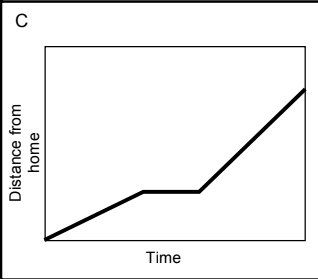
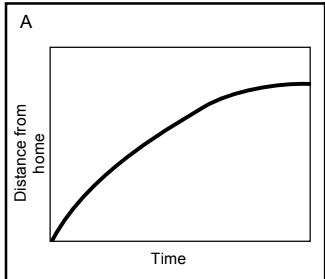
Which scene matches the graph?
Jonathon walked to his girlfriends house - stayed a while then walked home
Justice rode her bike to the mall
Yeshua walked home from school

What is the rate of acceleration during the first line segment? (slope between 0 - 10 sec)
0 m/s2
2.7 m/s2
6 m/s2
- 4 m/s2
What is the rate of acceleration during the third line segment? (slope between 15 - 40 sec)
0 m/s2
4 m/s2
6 m/s2
- 4 m/s2
What is the velocity during the second line segment? (10-15 sec)
0 m/s
60 m/s
15 m/s
4 m/s
Which is an example of velocity?
A car driving 55 miles per hour south.
A bicyclist traveling 10 meters per hour.
A roller coaster is traveling 10 meters per second.
A rocket blasting off at 2,500 meters per second.

What is happening at segment E?
acceleration
deceleration
constant speed
no motion/object at rest

Is this a speed or acceleration graph?
speed
acceleration

A helicopter flies south 200 miles in 2 hours. What is its velocity?
99 mph
100 mph south
400 mph south
297 mph south



What is happening at segment A?
no motion/object at rest
constant speed
deceleration
Is this a speed or acceleration graph?
speed
acceleration
What is happening at segment B?
acceleration
deceleration
constant speed
no motion/object at rest

Which of Newton's laws is shown
1st law
3rd law
2nd law

This is Newton's 3rd law
True
False

If there is a big mass, it would need a stronger force to accelerate it. Which law does this describe?
3rd law
1st law
2nd law

When there is a change in motion?
When forces are balanced
When the forces are unbalanced
Whe forces are equal
Never
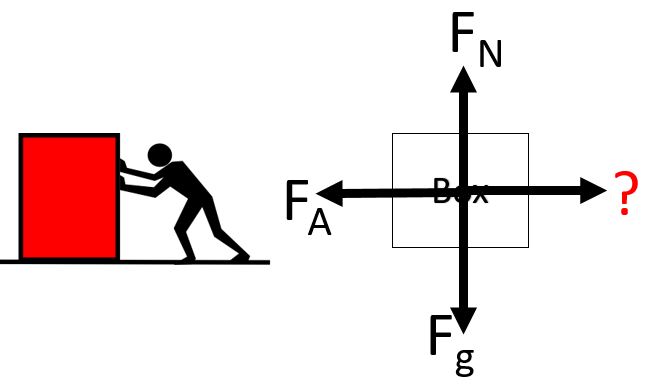
Name the missing force...
Frictional force
Weight force
Thrust
Buoyant force
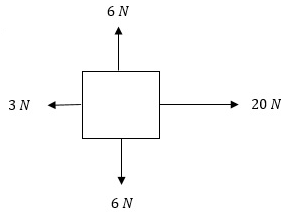
What is the net force of this diagram?
17 N, right
17 N, left
23 N, right
12 N, up

When two forces act in the same direction, how would you calculate the net force?
Subtract the forces
Balance the forces
Add the forces
Divide the forces
A rightward force is applied to a dresser to accelerate it to the right across the bedroom floor.


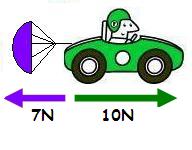
The words "constant speed" in a problem means
the acceleration is 0 m/s2
the Net Force = 0 Newtons
All forces balance out
all of these
You are driving to a birthday party with the cake sitting in the passenger's seat. You slam on your brakes to avoid hitting a deer. This causes the cake to splatter all over your dashboard and the floor of the passenger's side. Which of Newton's Laws best explains why this happens?
Newton's First Law (Inertia)
Newton's Second Law (Net force = mass x acceleration)
Newton's Third Law (Action/Reaction)
Law of Universal Gravitation
An object moving at a constant speed (has no acceleration). What can we accurately say about the forces on the object?
Net Force = 0 Newtons
There is definitely a force pushing it forward
There is definitely a force pushing it backwards
We can't accurately say anything without more information
A child weighs 98 Newtons. What is the child's mass?
10 kg
20 kg
30 kg
40 kg
There are two forces acting on a system. One is 30 Newtons to the right and the other is 70 Newtons also to the right. In order to put this system into equilibrium, there must also be a force of
100 Newtons to the left
40 Newtons to the left
100 Newtons to the right
40 Newtons to the right
The net force on an object is 15 Newtons to the right. There are two forces acting on the object. One is 25 Newtons to the left while the other is
15 Newtons to the right
25 Newtons tot he right
40 Newtons to the right
10 Newtons to the right
Tom pushes a desk across the rough floor at a constant speed. He exerts a force of 500 Newtons to the right. What is the net force on the desk?
0 Newtons
500 Newtons to the right
500 Newtons to the left
None of these
A 100 Newton force acts on a kitten and a horse. Assuming the animals are of relatively normal mass for their species, which animal will accelerate more?
The kitten
The horse
They will have the same acceleration
Impossible to tell
An object is in equilibrium which means all of the forces are balanced out. The speed of the object will
increase
decrease
stay the same
not enough information to say

A person who has a mass of 60 kg on Earth will have a mass of ________ when he stands on the moon.
less than 60 kg
60 kg
more than 60 kg
less or more mass on the moon it just depends on whether she has fallen into a crater or is standing on top of a hill.
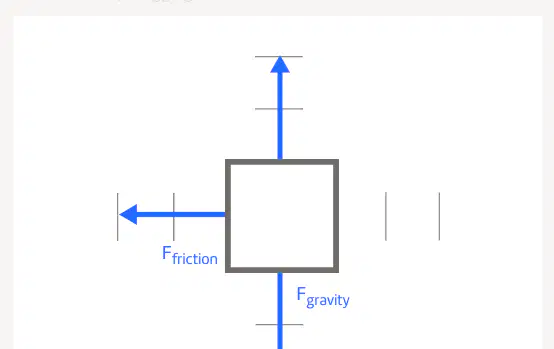
Model the following scenarios using free body diagrams.
A softball player is sliding to the right towards the base. Ignore air resistance.
You push a table to the right so that it accelerates across the bedroom floor. Ignore air resistance.
A sled is pulled across snow, to the right at constant speed. Ignore air resistance.
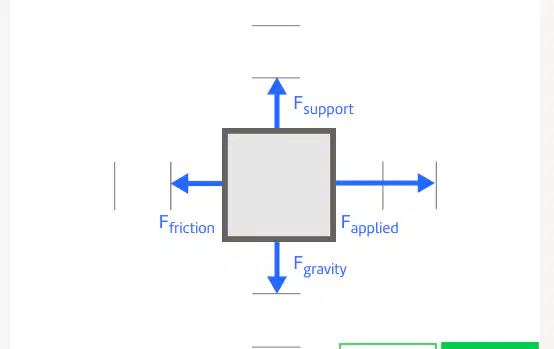
What
You push a table to the right so that it accelerates across the bedroom floor. Ignore air resistance.
A sled is pulled across snow, to the right at constant speed. Ignore air resistance.
A football is moving up and to the right, high above the ground, after being kicked. Ignore air resistance.
A downward-moving skydiver who has just opened the parachute is slowing down.


Two forces are applied to a 2.0-kilogram block on a frictionless, horizontal surface, as shown in the diagram below. What is the acceleration of the block?
5.0 m/s2 to the left
3.0 m/s2 to the right
3.0 m/s2 to the left
5.0 m/s2 to the right
Which of the following stays the same regardless of location?
Newtons


This 2000 N weight is raised 1 meter by pulling 4 meters of rope. What force was required to pull the rope?

To lift this 2000 N weight to a height of 1 meter by hand, a mover did 2000 joules of work. Assuming the pulleys are frictionless, how much work does he do when using this block-and-tackle device?
5J
150 J
It took 50 joules to push a chair 5 meters across the floor. With how much force was the chair pushed?
100 N
0.10 N

A lever is used to lift a heavy box with an input arm of 4 meters and an output arm of 0.8 meters. What is the mechanical advantage of the lever?
5
0.2
3.2
6

Which lever will require the LEAST amount of effort force?
A
B
C
D


The graph describes the speed of a falling object (person). What probably happened at 2 seconds?
At 2 seconds the atmosphere was changed into a vacuum
At 2 seconds a parachute opened
At 2 seconds the object hit the ground and stopped
At 2 seconds the object stopped going up, and started falling down

A bowling ball and a bag of potato chips are dropped at the same time from a tall tower on Earth. What happens?
Both speed up but the bag of chips is affected by the air resistance more so the bowling ball hits the ground first.
Both speed up but the bowling ball is affected by the air resistance more so the bag of chips hits the ground first.
Both speed up at the same rate and both hit the ground at the same time.

A bowling ball and a bag of potato chips are dropped at the same time from a tall tower on the Moon. There is no air on the Moon. What happens?
Both speed up but the bag of chips is not as heavy so the bowling ball hits the ground first.
Both speed up but the bowling ball has more inertia (resistance to the pull of gravity) so the bag of chips hits the ground first.
Both hit the surface at the same time because light and heavy objects fall at the same speed when there is no air resistance.

A feather and a bowling ball are dropped from the same height in a room with air. Which object lands first?
The feather
The bowling ball
Both land at the same time

A feather and a bowling ball are dropped from the same height in a room with no air. Which object lands first?
The feather
The bowling ball
Both land at the same time
The don't fall

