wayground logo

Free Printable Worksheets

Font size

S
M
L
XL
Worksheets

Igcse Revision

Total questions: 85

Worksheet time: 1hrs 25mins

Name
Class
Date
1.
The measure of cycles per second is called the ____________.
a)
period
b)
frequency
c)
wavelength
d)
velocity
2.
The SI unit used to measure the frequency of a wave is _____________.
a)
hertz
b)
seconds
c)
meters
d)
decibels
3.
The amount of time for one wave cycle to occur is called the ____________.
a)
wavelength
b)
trough
c)
period
d)
frequency
4.
A wave can bend and change speed, as it passes through a boundary from one medium to another. This is called __________.
a)
refraction
b)
reflection
c)
diffraction
d)
absorption
5.
The musical term "pitch" is directly associated with which wave property?
a)
wavelength
b)
amplitude
c)
frequency
d)
period
6.
The loudness or volume of sound is related to which wave property?
a)
wavelength
b)
frequency
c)
amplitude
d)
speed
7.
What is the approximate speed of sound in normal air?
a)
34 m/s
b)
340 m/s
c)
30,000 m/s
d)
300 million m/s
8.
The product of frequency and wavelength is always equal to the wave's ______________.
a)
amplitude
b)
velocity
c)
period
d)
color
9.
The lowest point of a transverse wave is called the _________.
a)
crest
b)
trough
c)
amplitude
d)
rest position
10.
The amplitude measures the distance between the:
a)
crest and next crest
b)
trough and next trough
c)
crest and trough
d)
rest position and crest
11.

wavelength = 0.5 m

wave speed = 5 m/s

Calculate the frequency!

v = fλ

a)

5 seconds

b)

10 Hz

c)

2.5 Hz

d)

1/5 m

12.
The oscillations of these types of waves cause the medium to move perpendicular to the direction of the wave's motion.
a)
longitudinal
b)
transverse
c)
sound
d)
seismic
13.
using f = 1/T, calculate the frequency of a wave that takes 2 seconds to pass by.
a)
1/2 seconds
b)
1/2 Hz
c)
2 seconds
d)
2 Hz
14.
Which is NOT a property of light?
a)
light travels in straight lines
b)
light has mass
c)
light carries energy
d)
light has acts like a wave
15.
Which region of the electromagnetic spectrum has MORE energy than visible light?
a)
ultraviolet rays
b)
radio waves
c)
microwaves
d)
infrared radiation
16.
The combination of all colours of light is called _______ light.
a)
invisible
b)
ROYGBIV
c)
electromagnetic
d)
white
17.
BLUE light has  _______ frequency when compared to RED light.
a)
a higher
b)
a lower
c)
an equal
d)
an uneven
18.
The Law of Reflection states that the angle of ___________ is equal to the angle of reflection.
a)
inversion
b)
refraction
c)
incidence
d)
absorption
19.
Materials with a higher refractive index, n , tend to refract light at  ________ angle.
a)
a larger
b)
a smaller
c)
at an inconsistent
d)
a very tight
20.
The colour of visible light is directly related to its ____________.
a)
wavelength
b)
amplitude
c)
intensity
d)
brightness
21.
Which regions are in order of INCREASING wavelength?
a)
gamma, UV, radio
b)
x-ray, UV, gamma
c)
microwave, infrared, visible light
d)
radio, visible light, gamma
22.
When a wave approaches a barrier with a gap in the middle, some of the wave energy will reflect backwards but some will pass through the gap and then
a)
diffract
b)
refract
c)
reflect
d)
disappear
23.
The lens shown in the diagram
a)
is a converging lens
b)
can not be used in magnifying glasses
c)
is a diverging lens
d)
acts like a mirror when the object is far away
24.
When a prism has visible light passing through it that is white as shown in the diagram
a)
the white light will spread out into different lines
b)
the different colours that make up white light will take different paths through the prism
c)
violet light bends the least
d)
red light travels along the dotted line
25.

Human hearing range of frequencies

a)

20 Hz - 20 kHz

b)

20 kHz - 20 000 kHz

c)

2 kHz - 200 kHz

d)

25 kHz - 25 kHz

26.
The reading shown on the micrometer is:
a)
6.48 mm
b)
6.20 mm
c)
6.02 mm
d)
5.98 mm
27.
The average of these three measurements:
34.53 s    33.97 s   34.09 s
a)
102.59 s
b)
34.20 s
c)
34.17 s
d)
102.5 s
28.
The instrument used to measure volumes of liquid
a)
measuring cylinder
b)
measuring cup
c)
measuring bucket
d)
measuring beaker
29.
The SI unit for density
a)
kgm-3
b)
kgm3
c)
kg3m
d)
kg-3m
30.
Determine the volume taken up by 1650 g of iron if the density is known to be 7895 kgm-3
a)
209 cm3
b)
209 m3
c)
0.000209 cm3
d)
20.9 m3
31.
Weight is
a)
a gravitational force
b)
a gravitational field
c)
a mass
d)
a gravitational acceleration
32.
The product of mass and acceleration is
a)
net force
b)
friction 
c)
weight
d)
velocity
33.
Air resistance is a form of 
a)
thrust
b)
friction
c)
weight
d)
acceleration
34.
If there is no resultant force acting on an object it will 
a)
remain at rest 
b)
continue at a steady velocity
c)
remain at rest or continue at a steady velocity
d)
slow down
35.
For a system to be in equilibrium the sum of the forces acting must equal zero and 
a)
clockwise moments = anticlockwise moments
b)
the sum of the velocities must equal zero
c)
the sum of the momentums must equal zero
d)
all work must be done around a pivot point
36.
The type of force here is
a)
electrostatic attractive
b)
electrostatic repulsive
c)
magnetic
d)
gravitational
37.
The lines with arrows around the charge indicate the 
a)
electric field
b)
electric force
c)
magnetic field
d)
gravitational field
38.
Electric current is defined by the equation I=Q/t
In words:
a)
rate of flow of charge
b)
ratio of energy to time
c)
energy flow
d)
charge flow
39.
The instrument pictured is used to measure
a)
electric current
b)
electric charge
c)
voltage
d)
resistance
40.
In metal circuits conventional current flows from
a)
positive to negative terminals
b)
negative to positive terminals
c)
both ways
d)
none of these
41.
Electrons move inside metal wires from
a)
negative to positive terminals
b)
positive to negative terminals
c)
both ways
d)
none of these
42.
A fuse protects 
a)
circuits from overheating and catching fire
b)
people from getting electric shocks
c)
transistors from large voltages
d)
all of these
43.
RCDs or circuit breakers protect
a)
circuits from overheating and catching fire
b)
people from getting electric shocks
c)
transistors from large voltages
d)
all of these
44.
Power is defined as
a)
the rate at which energy is transformed
b)
the rate of voltage use
c)
the rate of current use
d)
the total amount of work done per unit charge
45.
The circuit pictured has 2 resistors connected in _________. If each resistor value is 40 Ohms, the total resistance in this case will be ___Ohms.
a)
parallel, 20
b)
series, 20
c)
parallel, 80
d)
series, 
46.
Ionising radiation is casues atoms to turn into ions by adding or removing electrons from neutral atoms. Types of ionsing radiation includes:
a)
alpha, beta, gamma
b)
microwaves and T.V. waves
c)
protons and neutrinos
d)
neutrons and infra-red waves
47.
Even when a radioactive source is not placed anywhere near the GM tube it still detects some radioactivity. This is due to 
a)
malfunction
b)
background radiation
c)
the weather 
d)
humidity
48.
Alpha paticles
a)
have a charge of 2+
b)
are made from 4 neutrons
c)
are the nucleus of a hydrogen
d)
all of these
49.
Gamma radiation
a)
is part of the EM spectrum
b)
has no mass
c)
is the least ionising radiation
d)
all of these
50.

Due to their charges alpha, beta and gamma radiations deflect in different ways when entering an electric field. In this case

a)

red = beta

b)

yellow = gamma

c)

blue = alpha

d)

blue = beta

51.
Due to their charges alpha, beta and gamma radiations deflect in different ways when entering a magnetic field. In this case the magnetic field is directed out of the screen, and 
a)
blue = alpha
b)
red = beta
c)
yellow = gamma
d)
all of these are correct
52.
According to the graph the half life indicated is about
a)
3.5
b)
3.0
c)
8.0
d)
7.5
53.
The definition of radioactive half life is
a)
the time taken for the activity of a sample to halve
b)
the time taken for half the number of nuclei in a sample to decay
c)
the time taken for the received count rate of a sample to halve
d)
all of these are correct
54.

A radioisotope has an initial activity of 34 000 Bq. What will the activity be after 4 half lives have passed?

a)

2125 Bq

b)

4250 Bq

c)

1062.5 Bq

d)

8500 Bq

55.
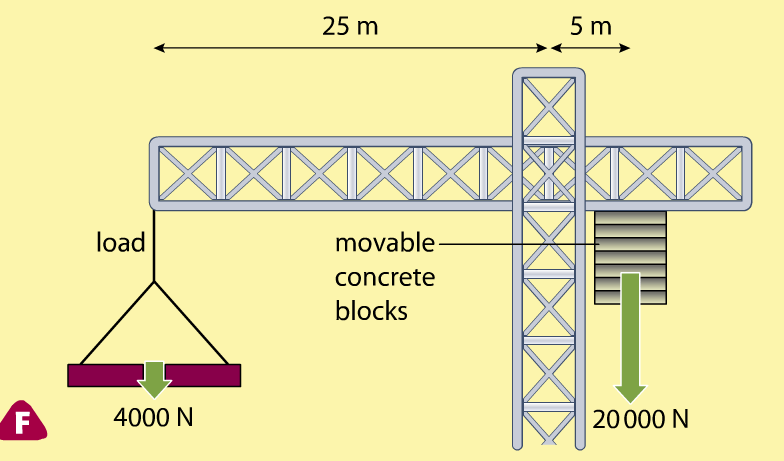
What is the anticlockwise moment acting on this crane?
a)
80,000Nm
b)
100,000Nm
c)
120,000Nm
d)
140,000Nm
56.
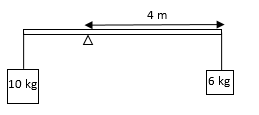
What is the moment acting on the seesaw?
a)
1.6Nm
b)
15Nm
c)
16N
d)
4Nm
57.
A seesaw is unbalanced with two people of different masses sitting equal distances from the center. Which of the following will result in equilibrium?
a)
The larger person moving further away from the center.
b)
Moving the smaller person closer to the center.
c)
Moving the smaller person further from the center.
d)
Making the larger person do nothing.
58.

Two masses of mass 10.0 and 6.0 kg are hung from massless strings at the end of a light rod. The rod is virtually weightless. A pivot (fulcrum) is placed off center and the system is free to rotate. If the 6.0 kg mass is 4.0 m away from the pivot, how far away is the 10.0 kg mass if the system is not rotating?

a)

0.42 m

b)

2.4 m

c)

4.8 m

d)

4.2 m

59.
If a net force is acting on an object, 
a)
its velocity must be constant
b)
its velocity must be changing
c)
its mass must be changing
d)
its acceleration = 0 
60.
If the battery produced 12.6 Volts and what would be the current flow be for a 6 Ohm resistor
a)
2.1 Amps
b)
2.4 Amps
c)
1.71 Amps
d)
15 Amps
61.
What is the current through a 11V bulb with a power of 99W?
a)
9W
b)
9A
c)
60V
d)
60A
62.
An object becomes charged when the atoms in the object gain or lose
a)
electrons
b)
protons
c)
neutrons
d)
all of the above
63.
If you rub a glass rod with a piece of silk, the rod becomes positively charged. This means that
a)
friction destroyed electrons in the rod.
b)
the silk has become negatively charged.
c)
protons have moved to the rod.
d)
glass attracts more protons.
64.
If you bring a charged object near an electrically neutral surface without allowing the object to touch the surface, the charges in the surface are rearranged by
a)
friction.
b)
convection.
c)
induction.
d)
conduction.
65.

if you push a cart with a force of 60 N for 2 m... how much work have you done

a)

120 J

b)

30 J

c)

120 N

d)

30 N

66.
You do 90 joules of work in 30 seconds. How much power have you generated?
a)
30 watts
b)
3 watts
c)
120 watts
d)
270 watts
67.
What are the parts of a longitudinal wave?
a)
Compressions and rarefactions
b)
Crests and troughs
c)
Compressions and crests
d)
Rarefactions and troughs
68.
What is the speed of a wave that has a wavelength of 2 and a frequency of 2.5?
a)
2.5 m/s
b)
5 m/s
c)
4.5 m/s
d)
6 m/s
69.
What pressure does a 4000N horse exert on the ground if each foot is 10cm2?
a)
40 N/cm2
b)
100 N/cm2
c)
400 N/cm2
d)
10 N/cm2
70.

Which of these is a unit of measure of pressure?

a)

kilometers

b)

Joules

c)

Pascals

d)

watts

71.
If you cut a magnet in half, what happens to the poles?
a)
One half gets the North Pole, the other half gets the South Pole
b)
Both halves get only a North Pole
c)
Both halves get only a South Pole
d)
Both halves get a North pole and a South Pole
72.
In order of most to least penetrating radiation we have
a)
Alpha , Beta,  Gamma
b)
Beta , Gamma , Alpha
c)
Gamma, Beta, Alpha
d)
Gamma, Alpha, Beta
73.

Which type of radiation releases an electron?

a)

Alpha radiation

b)

Beta radiation

c)

Gamma radiation

d)

Theta radiation

74.
a)

A

b)

B

c)

C

d)

D

75.
a)

A

b)

B

c)

C

d)

D

76.
a)

A

b)

B

c)

C

d)

D

77.
a)

A

b)

B

c)

C

d)

D

78.
a)

A

b)

B

c)

C

d)

D

79.
a)

A

b)

B

c)

C

d)

D

80.
a)

A

b)

B

c)

C

d)

D

81.
a)

A

b)

B

c)

C

d)

D

82.
a)

A

b)

B

c)

C

d)

D

83.
a)

A

b)

B

c)

C

d)

D

84.
a)

A

b)

B

c)

C

d)

D

85.
a)

A

b)

B

c)

C

d)

D