wayground logo

Free Printable Worksheets

Font size

S
M
L
XL
Worksheets

Force and Motion Unit 6

Total questions: 84

Worksheet time: 1hrs 25mins

Name
Class
Date
1.
What does the slope of each line on the graph tell you?
a)
The speed of each runner
b)
The acceleration of each runner
2.
Which runner complete the 100 meter race in the least amount of time?
a)
Albert
b)
Bob
c)
Charlie
3.
Which runner started out the fastest?
a)
Albert
b)
Bob
c)
Charlie
4.
What is happening between 9am and 11am?
a)
The cyclist is traveling up a hill
b)
The cyclists is speeding up
c)
The cyclists is traveling at a constant speed
d)
The cyclist is slowing down
5.
What do you think the cyclist is doing between 11am and 1pm?
a)
The cyclist has stopped for lunch
b)
The cyclists is riding at a constant speed on flat ground
c)
The cyclist is practicing sprints
d)
The cyclist is riding up a hill
6.
What is the total distance covered by 2 pm?
a)
40 miles
b)
30 miles
c)
60 miles
d)
10 miles
7.

The 2 objects have the same average speed over the 7 seconds. Why?

a)

Both objects traveled the same distance in the same amount of time.

b)

The graph for Object B is steeper at the end of the time.

c)

Object B has sections of zero speed while Object A is never stopped

d)

The final position on the graph for Object A is much greater.

8.

What is happening in section C?

a)

going down a hill

b)

speed is increasing

c)

speed is decreasing

9.

What is occurring at E?

a)

It is traveling at a constant speed

b)

there is no change in motion

10.

At which position is the object accelerating the fastest?

a)

c

b)

k

c)

neither because they are slowing down, which isn't acceleration

11.

How Far did object A travel from 0-7 seconds?

a)

1 meter

b)

2 meters

c)

3 meters

d)

4 meters

12.
What is the line on this graph showing?
a)
moving away from starting point at a constant speed
b)
moving back towards the starting point at a constant speed
c)
acceleration (getting faster)
d)
deceleration (getting slower)
13.
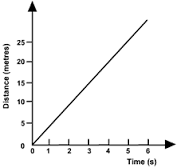
What does this graph represent?
a)
Constant speed
b)
Acceleration
c)
Not moving
14.
What is speed?
a)
how far you go
b)
how much distance is covered over a period of time
c)
how fast you accelerate
d)
the change in the location of a object
15.
A runner races in the 100 meter dash.  It takes her 10 seconds to finish.  What is her average speed?
a)
10 m/s
b)
1000 m/s
c)
100 seconds
d)
10 seconds
16.
What is a PUSH or PULL of an object?
a)
Motion
b)
Force
c)
Friction
d)
Gravity
17.
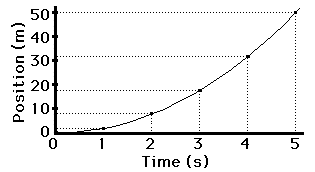
The picture of the position vs. time graph shows an object that is...
a)
accelerating/speeding up
b)
moving at a constant speed 
c)
not moving 
d)
accelerating/slowing down. 
18.
If it takes Heather 3 seconds to run from the batter's box to first base at an average speed of 6.5 meters per second, what is the distance she covers in that time?
a)
19.5 m
b)
0.46 m
c)
2.2 m
d)
3.5 m
19.
If Mike rides his motorcycle at an average speed of 20 m/s for 500 seconds, how far does he ride?
a)
10,000 m
b)
25 m
c)
0.04 m
d)
250 m
20.
Sarah backstrokes at an average speed of 8 meters per second. How long will it take her to complete a 200-meter race?
a)
0.04 s
b)
1600 s
c)
50 s
d)
25 s
21.

Two toy cars are traveling on a track. Thirteen minutes after they start, how do the speeds of the cars compare?

a)

Both cars are traveling at the same speed.

b)

Both cars have stopped moving on the track.

c)

Car 1 is moving faster.

d)

Car 2 is moving faster.

22.

Which of these is an example of Newton’s first law of motion?

a)

A baseball hit with a baseball bat travels faster than a bowling ball hit with the same force.

b)

A basketball bounces on the ground with the same force that the ground pushes up on the ball.

c)

A person jumps to a dock from a boat, and the boat moves away from the dock.

d)

A person standing on a bus moves backward when the bus suddenly moves forward.

23.

This is a graph of the motion of a small boat traveling at a constant speed. How far will the boat travel in 15 hours?

a)

10 km

b)

15 km

c)

25 km

d)

30 km

24.

This graph shows the motion of an object as it moves away from a point and then back to its starting point. Which graph shows the total distance traveled by the object?

a)
b)
c)
d)
25.

Four students went on a 3-kilomater hike. Each student was hiking a different speed. The distance the students hiked during the first 30 minutes is shown in each graph. If each student continued at the same speed, which graph shows the hiker that finished the 3-kilometer hike first?

a)
b)
c)
d)
26.

The graph shows the motion of a student walking at different speeds. During which time interval does the student walk with a negative acceleration?

a)

0-2 seconds

b)

2 - 4 seconds

c)

4- 8 seconds

d)

8-12 seconds

27.

Which graph could represent a car moving at a constant speed in a forward direction?

a)
b)
c)
d)
28.

Which is newtons first law states

a)

An object at rest will remain at rest unless a force is applied

b)

An object is moving

c)

An object has stopped

d)

An moving object will keep going when a force is applied to it

29.

Which is newtons 3rd law

a)

for every thing there is reaction

b)

for every reaction there is a unusual action

c)

For every reaction there is an equal and opposite reaction

d)

for every reaction there is an good action

30.

Which is newtons 2nd law

a)

Acceleration is a change in speed

b)

Acceleration is a change in action

c)

Acceleration is a change in name

d)

Acceleration is a change in velocity

31.

What is an example of newtons 2nd law

a)

sleeping

b)

velocity

c)

driving

d)

sitting

32.

What is an example of newtons 3rd law

a)

running

b)

car crash

c)

high five

d)

walking

33.

An example of newtons 1st law

a)

kicking a ball

b)

walking

c)

moving

d)

running

34.

Which type of force(s) will cause a change in an object's motion?

a)

gravity

b)

balanced forces

c)

unbalanced force

d)

net force

35.

A magician pulls a rabbit out from in his hat

a)

Newton's 2nd Law

b)

Newton's 1st Law

c)

Newton's 3rd Law

36.

Newton's third law states that any action will have a(n) _______ and ______ reaction

a)

equal and same

b)

equal and opposite

c)

equal and equal to

37.

What are the appropriate units to describe acceleration?

a)

m/p

b)

m/h

c)

m/s

d)

m/s square

38.

The tendency of objects to resist a change in motion is called:

a)

Friction

b)

Inertia

c)

Gravity

d)

Velocity

39.

The force required to maintain a body at constant velocity in free space is equal to:

a)

Zero

b)

The mass of the body

c)

The weight of the body

d)

None of these

40.

In referring to how much matter a body contains, we use the term:

a)

Volume

b)

Weight

c)

Mass

41.

If an object has twice as much mass as another, then it also has twice as much:

a)

Area

b)

Center of gravity

c)

Weight

d)

Acceleration

42.

An elephant and a feather fall through the air. The force of air resistance is greatest on the:

a)

elephant

b)

feather

c)

same

43.

6.8C- Which two measurements are needed to determine the speed of an object?

a)

Position and time

b)

Distance and time

c)

Position and direction

d)

Distance and direction

44.
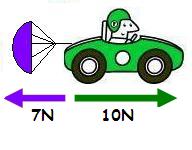
What is the net force?
a)
17 N Right
b)
3 N Right
c)
3 N Left
d)
17 N Left
45.

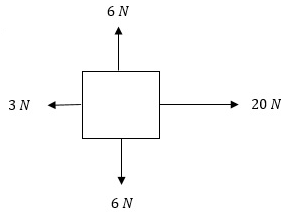
What is the NET FORCE of this diagram?

a)

17 N, right

b)

17 N, left

c)

23 N, right

d)

12 N, up

46.

An object resting on a surface experiences +980 N of Normal force. What is the mass of the object?


W=mg

a)

-98 kg

b)

9.8 kg

c)

100 kg

d)

-100 kg

47.
8 N to the left , and 4 N to the right. Find the net force. Is this balanced 
a)
12 N Right  No
b)
4 N Left  No
c)
12 N Right  Yes
d)
4 N Left  Yes
48.
Calculate the net force acting upon the object.
a)
10 N north
b)
10 N south
c)
14.1 N east
d)
0 N
49.
Calculate the net force acting upon the object.
a)
10 N east
b)
0 N
c)
14.1 N east
d)
20 N north
50.

An apple weighs 1 N. The net force on the apple when it is in free fall is

a)

0 N.

b)

0.1 N.

c)

1 N.

d)

10 N

51.

Calculate the net force acting upon the object.

a)

10N, north

b)

20N, south

c)

10N, south

d)

22.4N, north

52.

What is the net force of the block?

a)

8N, right

b)

2N, right

c)

8N, left

d)

2N, left

53.

Calculate the net force acting upon the object.

a)

10N, north

b)

20N, south

c)

10N, south

d)

22.4N, north

54.
What is the net force?
a)
5000 N right
b)
4000 N right
c)
40 N left
d)
4000 N left
55.
What is the net force?
a)
5000 N right
b)
4000 N right
c)
40 N left
d)
4000 N left
56.
The Free body diagram shown represents
a)
An upward force of 7N, a force to the right of 6 N and a force to the left of 5 N
b)
An upward force of 6N, a force to the right of 6 N and a force to the left of 6 N
c)
An upward force of 7N, a force to the right of 6 N and a force to the left of 3 N
d)
An upward force of 8N, a force to the right of 6 N and a force to the left of 5 N
57.
The free body diagram displayed shows
a)
A rightward gravitational force of100N
b)
A downward gravitational force of 100N
c)
A leftward gravitational force of 100N
d)
An upward gravitational force of 400N
58.

Determine the net force and direction of motion:

a)

16 N Right

b)

16 N Left

c)

0 N not moving

d)

0 N left

59.

Determine the net force and direction:

a)

11 N Left

b)

11 N Right

c)

0 N Left

d)

5 N Left

60.

Determine the net force and direction

a)

20 N up

b)

0 N no movement

c)

20 N down

d)

40 N down

61.

Determine the net force and direction

a)

15 N up

b)

15 N down

c)

0 N no movement

d)

30 N up

62.

Determine the missing force at C:

a)

700 N

b)

200 N

c)

0 N

d)

1100 N

63.

Determine the force at G:

a)

30 N

b)

20 N

c)

50 N

d)

0 N

64.

What is the force at D and E?

a)

D: 300 N, E: 20 N

b)

E: 300 N, D: 80 N

c)

E: 300 N, D: 20 N

d)

E: 300 N, D: 60 N

65.
a)

A: 200 N; B: 50 N

b)

A: 250 N; B: 250 N

c)

A: 500 N; B: 200 N

d)

A: 50 N; B: 200 N

66.

What can you tell about the forces on F and H?

a)

They must be unbalanced.

b)

They are negative.

c)

They must be the same.

d)

They are equal to the net force.

67.
What is the net force and the direction of movement?
a)
50 Newtons, Left
b)
50 Newtons, Right
c)
500 Newtons, RIght
d)
450 Newtons, LEft
68.
What is Newtons 1st law of motion?
a)
Force= Mass multiplied by acceleration 
b)
An object at rest stays at rest unless acted on an unbalanced force. (inertia)
c)
For every action there is a equal and opposite  re-action.
d)
law of gravity 
69.
What law of motion does this picture represent?
a)
Newtons 3rd law
b)
Newtons 4th law
c)
Newtons 1st law
d)
Newtons 2nd law 
70.
What is Newtons 2nd law of motion?
a)
Pancakes 
b)
Force= Mass multiplied by acceleration
c)
For every action there is a equal and opposite  re-action.
d)
Law of gravity 
71.
What law of motion does this picture represent?
a)
Newtons 1st law
b)
law of gravity 
c)
Newtons 4th law 
d)
Newtons 2nd law
72.
What law of motion does this picture represent?
a)
Newtons 1st law
b)
Newtons 4th law 
c)
Newtons 3rd law 
d)
Newtons 2nd law
73.
What law of motion does this picture represent?
a)
Newtons 1st law
b)
Newtons 4th law 
c)
Newtons 3rd law 
d)
Newtons 2nd law
74.
A net force of 15 N is exerted on an encyclopedia to cause it to accelerate at a rate of 5 m/s2. Determine the mass of the encyclopedia?
a)
 m = 3.0 kg
b)
m = 4.0 kg 
c)
m = 3.0 ml 
d)
m = 30.0 g
75.
Determine the accelerations that result when a 12-N net force is applied to a 3-kg object. 
a)
3 m/s
b)
4 ft/s 
c)
13 m/s
d)
4 m/s 
76.
For every action there is a equal and opposite...
a)
action
b)
movement 
c)
re-action 
d)
Newtons law of inertia 
77.
What Newtons law does this picture represent
a)
Newtons 2nd law 
b)
Law of gravity 
c)
Newtons 1st law
d)
Newtons 5th law
78.
For every action there is a equal and opposite...
a)
action
b)
movement 
c)
re-action 
d)
Newtons law of inertia 
79.
What Newtons law does this picture represent
a)
Newtons 2nd law 
b)
Law of gravity 
c)
Newtons 1st law
d)
Newtons 5th law
80.
Mass is a measure of an object's inertia. Objects with greater mass have a greater inertia; objects with less mass have less inertia.
a)
true 
b)
false 
81.
__________ is the sum of all forces acting on an object. It is capable of accelerating a mass. 
a)
velocity
b)
gravity
c)
net force
d)
distance
82.
A unbalanced force means that an object is 
a)
zero net force
b)
changing its motion
c)
sitting still
d)
object at rest
83.
What is the tendency of an object to resist a change in motion?
a)
coffee
b)
motion
c)
inertia
d)
gravity
84.
Which car is accelerating?
a)
A car that is not moving
b)
A  car that rounds a curve at a constant speed
c)
A car traveling  at a constant speed 
d)
A car that has a set speed of 60mph