
 Worksheets
UNIT REVIEW
Total questions: 80
Worksheet time: 3hrs 40mins
The distance between the rest position to the highest/lowest point of a wave is called......
Crest
Amplitude
Trough
Wavelength
How do you measure a wavelength for a transverse wave?
From one compression to the next
From one crest to one trough
From crest/crest or trough/trough
From one amplitude to another
What are the two types of Mechanical waves?
Water and Air
Longitudinal and Transverse
Sound and Game
Air and Solids
What direction does a longitudinal wave travel?
Up and down
Left and right
What direction for a transverse wave travel?
Up and down
Left and right
In a transverse wave, the wave travels _________ to the medium.
Parallel
Perpendicular
Alongside
Slanted
In a longitudinal wave, the wave travels _________ to the medium.
Parallel
Perpendicular
Alongside
Slanted
In class, what did we use to demonstrate a longitudinal wave?
String
Rulers
Slinkys
Cup-Phones

Which wave has the highest frequency?
Green
Blue
Red
None

Which wave has the largest amplitude?
Green
Blue
Red

Which wave has the lowest frequency?
C
A
F
D
Sound waves can travel through:
solids
liquids
gasses
all of these
Sound waves cannot travel through:
solids
liquids
gasses
empty space
A sound wave is a type of:
longitudinal wave
transverse wave
mechanical wave
mechanical and longitudinal wave
Sound waves require a __________ to travel through.
medium
person
transverse
Slinky
Energy stored because of gravity is called:
Gravitational Potential Energy
Kinetic Energy
Mechanical Advantage
Chemical Energy
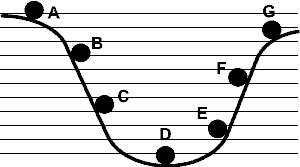
At which point does the ball has the greatest gravitational potential energy (GPE)?
A
G
D
C
G

You throw a ball into the air as shown in the diagram. At what point does the ball have the most gravitational potential energy?
W
X
Y
Z
If the height is zero, gravitational potential energy
is zero
at its maximum
100J
200J

What is the Total Mechanical Energy at point A?
500,000 J
400,000 J
200,000 J
50,000 J
What is the Kinetic Energy at point D?
500,000 J
250,000 J
300,000 J
50,000 J

Which letter shows the ball when it has THE MOST kinetic energy?
B
C
D
E
F
Which letter shows the ball when it is moving the fastest?
B
C
D
E
F
The Law of Conservation of Energy states:
Energy can created or destroyed but not transformed
Energy cannot be created or destroyed, it can only transformed
Energy can't be created, destroyed or transformed
Energy cannot be created or destroyed.
According to the law of conservation of energy, energy can be created or destroyed.
True
False

Identify the energy transfer
chemical to kinetic
solar to electrical
thermal to light
electrical to light
Stored energy or energy due to its position is called
mechanical energy
potential energy
kinetic energy
thermal energy

Which letter shows where is potential energy stored or at its maximum point?
Y
W
X
Z
The two types of energy listed under mechanical energy
kinetic and nuclear
potential and kinetic
potential and nuclear
wind and thermal
Energy in motion is called
kinetic energy
potential energy
nuclear energy
transfer energy
Energy that transforms from potential to kinetic is neither_____ nor _______.
created, force
created, destroyed
force,motion
destroyed, law of conservation of energy


When an object is moving, friction acts in the _______ direction as the motion.
perpendicular
same
opposite
precise
An object in motion will stay in motion and an object at rest will stay at rest unless acted upon by an outside force. Which law does this describe
2nd law
1st law
3rd law
Object tendency to resist change
Friction
Inertia
Forcé
Gravity
What is another name for Newton’s 1st law?
Law of Inertia
Law of Acceleration
Law of Action/Reaction
Which law of motion says that you must push or pull objects harder if they have more mass?
1st
2nd
3rd
4th
What Unit do we Measure Force in?
Newtons
Joules
Force
Kilograms
Newton's third law states that any action will have a(n) _______ and ______ reaction
Equal and similar
Equal and opposite
Equal and different
Greater and opposite

Which of Newton's laws is shown
1st law
3rd law
2nd law

What are the appropriate units to describe acceleration?
m/p
m/h
m/s
m/s square

Which one of Newton's laws are displayed
2nd law
1st law
3rd law

From the figure, what is the displacement?
20 meters
25 meters
15 meters
25 meters NE

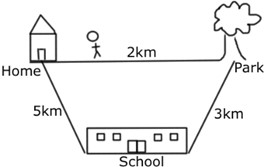
Jerry walked from home to school, then from the school to the park. What is his total distance?
2 km
5 km
8 km
10 km
Jasmine runs exactly 3 laps around a 400 meter track. What is the DISPLACEMENT?
800 m
400 m
0 m
1200 m
David walks 3 km north, and then turns east and walks 4 km. What is the DISTANCE?
7 km
3 km
4 km
1 km

Calculate the distance you will travel if you will drive for 2 hours at 56km/h.
84 km
100 km
110 km
112 km

( Fill in the blank) Long hair should be ____________ in the laboratory.
tied back
cut
down
curled
(True or False) Horse playing is allowed in the laboratory
true
false
(True or False) It is okay to pick up broken glass with your bare hands as long as the glass is placed in the trash can
true
false


When is it OK to eat or drink at the lab tables?
Always
Only during group work, not during labs
Never
Whenever I'm hungry
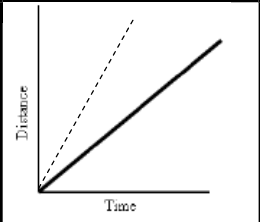

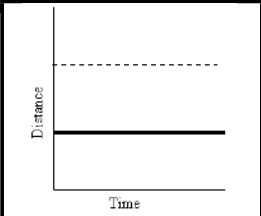
Describe the motion in the graph:
Constant Speed (positive slope)
Stopped (at rest)
Acceleration (increasing speed)
Return Home (negative slope)
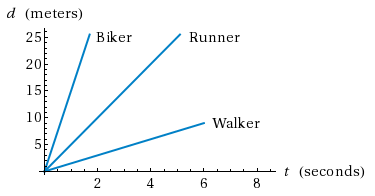
Which person moved the fastest in 3 seconds?
biker
runner
walker
they are all moving equally

What is this?
trough
wavelength
crest
equilibrium

What is this?
crest
trough
wavelength
amplitude

What is this?
amplitude
equilibrium
wavelength
crest

What is this?
crest
trough
amplitude
wavelength

