
 Worksheets
Power To The People
Total questions: 76
Worksheet time: 1hrs 4mins

A student builds a circuit made up of a battery, two light bulbs, and a switch. What will the student most likely observe in this circuit?
Light bulb 1 and light bulb 2 will both be on
Light bulb 1 will be off, but light bulb 2 will be on
Light bulb 1 and light bulb 2 will both be off
Light bulb 1 will be on, but light bulb 2 will be off

The diagram shows a series circuit with three lit bulbs. How many of the bulbs will remain lit if the wire is cut a the point shown by the arrow?
0
1
2
3

A string of lights with small bulbs is shown below. The bulbs are connected by wire that is covered in an insulator. When the lights are on, electricity travels in....
a complete circuit
a sound wave
a light ray
an incomplete path


Why is electrical wiring usually made from copper?
Because copper is shiny
Because copper conducts electricity
Because copper is not magnetic
Because copper insulates electricity

Describe a series circuit.
a circuit that has multiple branches
a circuit that has one path
a circuit that dead ends after a light bulb
What is a parallel circuit?
a continuous loop
a circuit with one path
a circuit with multiple branches for each individual appliance or light

Will the light bulbs light up in this image?
Yes, both of them will
Yes, but only the one on the right
No, neither of them will
Yes, but only the one on the left

What type of circuit is this an image of?
series circuit
parallel circuit

In this image is a...
series circuit
parallel circuit

Is this a working circuit?
Yes
No
I'm not sure, I would need to test it myself.

Will this circuit light the bulbs?
Yes, both will light up
Yes, but only the one on the right
Yes, but only one on the left
No, neither of the bulbs will light up

When the switch is closed the buzzer will sound because -

The flow of electricity is called...
circuit
load
electrical current
power source


What is missing from this circuit? Why would the light bulbs be off?
The battery, there is no power for the circuit to work.
The switch is open, so the circuit is broken.
The third light bulb, that is needed to complete the circuit.
The wires are not connected properly.
What will most likely happen if you add an additional battery to a circuit?
the bulb will shine half as bright as it did with one battery
the bulb will shine the same
the bulb will shine brighter than it did with one battery
the bulb will not shine
Area around a magnet in which magnetic forces can act
magnetic field
magnets
magnetic pole
an object that attracts certain kinds of metals, such as iron
magnetic field
magnets
magnetic pole
the end of a magnet, where magnetic forces are greatest
magnetic field
magnets
magnetic pole

Is the image showing magnets repelling or attracting another magnet?
(a)
What are the two magnetic poles
(a)
Which of these substances conducts electricity the best
wood
brick
copper
plastic
What is a switch's function in a circuit?
to make the current hotter or colder
turn on and off the flow of current
the pathway that current flows
to add more power to the circuit
What is a battery?
switch
power source
insulator
Where is the strongest attraction force of the magnet?
at the poles
in the middle
above the magnet
below the magnet
The force of magnetism is stronger when magnets are ______________.
cold
round
closer together
farther apart
A magnetic field is a force field created by
gravity
force
magnets
Energy due to motion
kinetic
potential
A north pole and a south pole will attract each other.
True
False

What will happen when these magnets are brought close together?
They will attract each other.
They will repel each other.
Both the magnets will turn to the left.
Both the magnets will turn to the right.
compass
magnetic field
What charge is the proton?
positive
no charge (neutral)
negative
Senaida-charged
What charge is the electron?
Logan-charged
negative
positive
no charge (neutral)
What charge is the neutron?
no charge (neutral)
positive
negative
Katlyn-charged

Is a metal cookie sheet a conductor or an insulator?
Conductor
Insulator
Heat transfer that occurs when objects of different temperatures are touching
Radiation
Convection
Conduction
The only heat transfer that can occur through empty space. It travels through electromagnetic waves.
Conduction
Convection
Radiation

As the ball is dropped, the potential energy decreases while the kinetic energy increases however the amount of energy stays the same.
True
False
The stored energy of an object is called ______?
flowing energy
kinetic energy
potential energy
sun energy

Energy stored because of gravity is called:
Gravitational Potential Energy
Kinetic Energy
Mechanical Advantage
Chemical Energy
According to the law of conservation of energy, energy can be created or destroyed.
True
False
A stretched rubber band represents what type of potential energy?
gravitational potential energy
elastic potential energy
chemical potential energy
kinetic potential energy

What is the wasted energy here? (we want movement)
heat, light and sound
chemical, electrical and movement
Sound, sound and sound
What is the main energy transfer that happens in a gas heater?
Electrical energy to heat energy
Chemical potential energy to heat energy
Kinetic energy to heat energy
Chemical potential energy to kinetic energy
What is “useful output” energy?
Energy that is used by the appliance
Useful energy that is put into the system
Energy that is produced that we cannot use
Energy that is produced that we can use to do work
In an electric drill, the input energy is electrical energy. Which of these is wasted output energy?
A – Sound energy B – Kinetic energy C – Heat energy
A, B
A, C
B, C
B
When is energy lost?
During transformations only
During transformations and transfers
During transfers only
During GPS outages
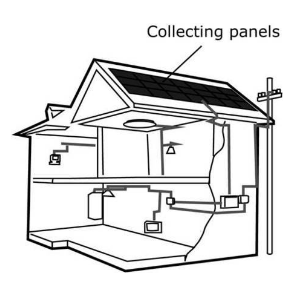
Which alternative energy source does this house use?
A kettle uses 100J of electrical energy to produce 7J of sound energy and 93J of thermal energy. How efficient is the kettle?
100%
7%
93%
95%
A washing machine uses 250J of electrical energy to produce 125J of useful energy. How efficient is it?
5%
50%
55%
100%

Which form of energy is represented in this image?
kinetic
thermal
potential
radiant


The SI Unit for Energy is
Joule
Potential
Calorie
Kilojoule
Heat energy is also called ______ energy.
chemical
electrical
mechanical
thermal

