
 Worksheets
Earth in Space Practice
Total questions: 50
Worksheet time: 25mins
Name
Class
Date
1.

Earth's rotation takes about
a)
365 days
b)
6 months
c)
24 hours
d)
1 month
2.

Day and night are caused by
a)
the tilt of Earth's axis
b)
Earth's revolution around the sun
c)
eclipses
d)
Earth's rotation on its axis
3.

When the north end of Earth's axis is tilted toward the sun, North America will experience
a)
more indirect rays and shorter days
b)
more indirect rays and longer days
c)
more direct rays and shorter days
d)
more direct rays and longer days
4.

Earth has seasons because
a)
it rotates on its axis
b)
the distance between Earth and sun changes
c)
its axis is tilted as it moves around the sun
d)
the temperature of the sun changes
5.

The phase of the moon you see depends on
a)
where you are on Earth's surface
b)
how much of the sunlit side of the moon faces Earth
c)
how much of the moon's surface is lit by the sun
d)
whether or not an eclipse is occurring
6.

From the new moon phase to full moon phase, you see
a)
an increasing amount of the lit side of the moon
b)
a decreasing amount of the lit side of the moon
c)
the same amount of the lit side of the moon
d)
more of the lit side, then less of the lit side of the moon
7.

Because the moon rotates once for each revolution around Earth,
a)
you see some phases more than others
b)
a different side of the moon faces Earth each day
c)
you never see the far side of the moon from Earth
d)
the far side of the moon in visible only during the full moon phase
8.

The amount of the lit side of the moon you can see is the same during
a)
new moon and full moon phase
b)
new moon and first quarter phase
c)
first quarter and third quarter
d)
full moon and third quarter
9.

During what phase of the moon can a lunar eclipse occur?
a)
new moon
b)
first quarter
c)
waxing gibbous
d)
full moon
10.

For a solar eclipse to occur,
a)
the sun must be directly between Earth and the moon
b)
the moon must be directly between Earth and the sun
c)
the moon must be directly behind Earth
d)
Earth must be directly between the sun and the moon
11.

When are tides highest?
a)
during the moon's first quarter phase
b)
when the sun, Earth, and moon are nearly in a line
c)
during the moon's third quarter phase
d)
when the moon is at a right angle to the sun
12.

Tides are caused by
a)
Earth's rotation on its axis
b)
differences in how much the sun pulls on different parts of Earth
c)
strong winds blowing water onto coasts
d)
differences in how much the moon and the sun pull on different parts of Earth
13.

When do neap tides occur?
a)
at new moon
b)
when the sun's pull is in the same direction as the moon's pull
c)
when the sun's pull is at right angles to the moon's pull
d)
at full moon
14.

It's a basic law of physics that for every force, or action, there is
a)
a decreased force, or reaction
b)
an equal force in the same direction
c)
an increased force, or reaction
d)
an equal and opposite force, or reaction
15.

The space race was between
a)
the United States and China
b)
Great Britain and the Soviet Union
c)
the Soviet Union and China
d)
the United States and the Soviet Union
16.

Which country launched the first human into space?
a)
Canada
b)
China
c)
The United States
d)
The Soviet Union
17.

A large artificial satellite on which people can live and work for long periods is called a
a)
space shuttle
b)
space probe
c)
space station
d)
rover
18.

The main source of power for the International Space Station is
a)
solar panels
b)
oxygen
c)
rocket fuel
d)
nuclear power
19.

Exploration of space beyond our moon has been done by
a)
space probes with no human crew
b)
astronauts in space shuttles
c)
space probes with human crews
d)
the International Space Station
20.

Spacecrafts must be airtight because
a)
there is little gravity in space
b)
space is composed of mostly hydrogen and helium
c)
the forces exerted by space can cause health problems
d)
space is nearly a vacuum
21.

One of the main uses of satellites is
a)
launching deep-space expeditions
b)
controlling the weather
c)
observing Earth's surface
d)
preventing ozone depletion
22.

Pictures of Earth's surface based on computer data are called
a)
planetary images
b)
x-ray images
c)
ultraviolet images
d)
satellite photographs
23.

Which of the following is NOT an example of the economic impact the space program has had on Florida?
a)
The Kennedy Space Center employs almost 15,000 people.
b)
NASA and NASA employees buy products and services from local businesses.
c)
The state of Florida pays for the launch of scientific spacecrafts from the Kennedy Space Center.
d)
Over a million tourists visit the Kennedy Space Center each year.
24.

The apparent movement of a star when seen from a different position is called
a)
pickles
b)
prominence
c)
parallax
d)
accretion
25.

Parallax is used to determine a star's
a)
distance from Earth
b)
temperature
c)
composition
d)
color
26.

The sun is located 1.5 x 10¹¹ meters away from Earth. When all the zeroes are written out, this distance is
a)
1,500,000,000 m
b)
150,000,000,000 m
c)
0.0000000015 m
d)
150 m
27.

A light-year is
a)
365 days.
b)
the distance light travels in a year.
c)
the distance from Earth to the Sun.
d)
the amount of light the sun produces in a year.
28.

What is a giant ball of hot gases that undergo nuclear fusion?
a)
a planet
b)
a star
c)
a star cluster
d)
a solar system
29.

The Milky Way and the Andromeda galaxies are a examples of
a)
spiral galaxies.
b)
quasars.
c)
elliptical galaxies.
d)
irregular galaxies.
30.

The strength of the force of gravity depends on
a)
the masses of the objects and their speeds.
b)
the masses of the objects and the distance between them.
c)
the weight of the objects and their speeds.
d)
the masses of the objects and their weights.
31.

Which two factors did Newton conclude combine to keep Earth in orbit?
a)
gravity and weight
b)
inertia and gravity
c)
weight and inertia
d)
acceleration and inertia
32.

Gravity helps form stars, planets, and solar systems by the gradual gathering together of smaller pieces in a process called
a)
accretion
b)
inertia
c)
spinning
d)
collapsing
33.

What color are the coolest stars?
a)
blue-white
b)
yellow
c)
red
d)
orange
34.
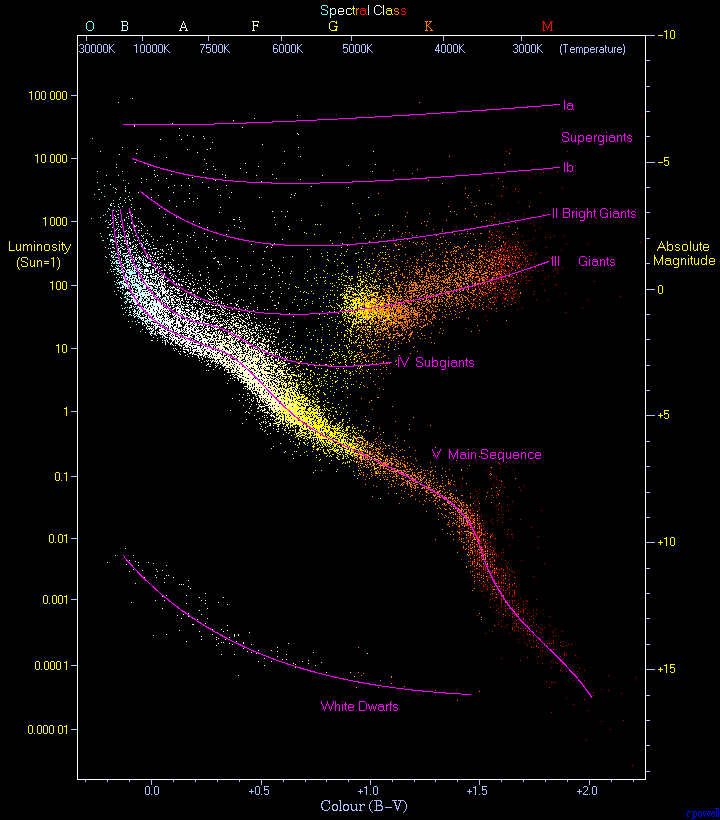
The Hertzsprung-Russell diagram shows that main sequence stars
a)
are mostly hot and dim.
b)
are mostly cool and bright.
c)
increase in brightness as they increase in temperature.
d)
decrease in brightness as they increase in temperature.
35.
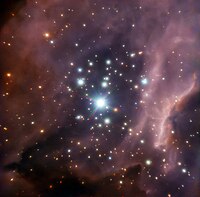
A star is born when
a)
a nebula expands.
b)
helium and oxygen combine.
c)
nuclear fusion starts.
d)
a protostar begins to cool.
36.

The variable that determines whether a protostar becomes a star is its
a)
surface temperature.
b)
age.
c)
mass.
d)
color and brightness.
37.

The lifetime of a star depends on its
a)
temperature.
b)
absolute brightness.
c)
mass.
d)
apparent brightness.
38.

The force that pulls together the matter in stars is
a)
gravity.
b)
nuclear fusion.
c)
dark energy.
d)
dark matter.
39.

A supernova is the explosion of a dying
a)
medium-mass star.
b)
high-mass star.
c)
protostar.
d)
low-mass star.
40.

In which part of the sun does nuclear fusion occur?
a)
the core
b)
the radiation zone
c)
the corona
d)
the convection zone
41.

Our solar system consists of a star, several kinds of smaller objects such as comets and asteroids, and
a)
eight planets and their moons.
b)
the star Proxima Centauri.
c)
six planets and their moons.
d)
more than 100 planets.
42.

The solar system formed from
a)
an expanding galaxy.
b)
a giant cloud of gas and dust.
c)
a dwarf star.
d)
a black hole.
43.

Maria on the moon's surface were formed by ancient
a)
oceans.
b)
lava flows.
c)
ice flows.
d)
meteoroid impacts.
44.

Galileo saw that much of the moon's surface is covered with round pits called
a)
highlands.
b)
seas.
c)
craters.
d)
maria.
45.

How large is the moon compared to Earth?
a)
about the same diameter as Earth
b)
about one-half the diameter of Earth
c)
about one-fourth the diameter of Earth
d)
about one-eighth the diameter of Earth
46.

What do all the inner planets have in common?
a)
They all have rings.
b)
They all have abundant liquid water.
c)
They all have many moons.
d)
They are all small and have rocky surfaces.
47.

What do the four outer planets have in common?
a)
They are much larger than Earth and are made mainly of hydrogen and helium.
b)
They are about the same size os Earth and are made mainly of hydrogen and helium.
c)
They are much larger than Earth and are made mainly of iron.
d)
They are about the same size as Earth and are made mainly of iron.
48.

Saturn's rings are made up mostly of
a)
nitrogen and helium.
b)
ice and water vapor.
c)
volcanic dust particles.
d)
chunks of ice and rock.
49.

Which model of the solar system has Earth at the center of the revolving planets and stars?
a)
geocentric
b)
heliocentric
c)
Newtonian
d)
mercurian
50.

In a heliocentric system
a)
all of the planets revolve around the sun.
b)
the sun revolves around Earth.
c)
Earth is the center of the universe.
d)
the sun appears to move backward among the planets.
100 %

