
 Worksheets
OCEAN WATER
Total questions: 61
Worksheet time: 46mins
Name
Class
Date
1.
the ratio of the mass of a substance to the volume of the substance
a)
salinity
b)
profit
c)
density
d)
weight
2.
free-floating microscopic plants and animals
a)
plankton
b)
kelp
c)
crustaceans
d)
boats
3.
a measure of the amount of dissolved solids in a given amount of liquid
a)
DDT
b)
plankton
c)
salinity
d)
icee
4.
Plankton can be called “the foundation of life in the ocean” because they
a)
are marine organisms that need sunlight
b)
live in the upper 100 m of water
c)
form the base of complex food webs in the ocean
d)
are one of three main food sources in the ocean
5.
This type of ocean water dissolves gases most easily
a)
cold
b)
warm
c)
shallow
d)
salty
6.
In the benthic zone of the ocean, you would most likely find
a)
dolphins
b)
whales
c)
swordfish
d)
starfish
7.
Which of the following items is NOT a means of obtaining fresh water from the ocean?
a)
aquaculture
b)
desalination
c)
freezing
d)
reverse osmosis desalination
8.
Which of the following sea life is an example of benthos?
a)
plankton
b)
dolphins
c)
squid
d)
crabs
9.
Cold water is _______ dense than warm water
a)
More
b)
Less
c)
equally
10.
Which factor does not affect the salinity of ocean water?
a)
precipitation
b)
dissolved gasses
c)
temperature
d)
evaporation
11.
How is the density of ocean water calculated?
a)
volume/mass
b)
salinity/volume
c)
mass/volume
d)
salinity/mass
12.
What is the primary cause of ocean waves?
a)
upwellings
b)
wind
c)
density differences in ocean water
d)
temperature differences in ocean water
13.
Upwelling is the process where warm, nutrient rich water from deep in the ocean rises to the surface.
a)
False
b)
True
14.
A result of upwelling is a/an _________ in nutrients in the water.
a)
Decrease
b)
Increase
c)
No Change
15.
Upwelling causes the water off the western coasts of continents in the tropics to
a)
Have warmer temperatures than other tropical waters
b)
be productive fishing grounds
c)
produce El Nino
d)
ride over cold denser waters below
16.

Ocean bottom plants and animals
a)
Nekton
b)
Plankton
c)
Benthos
d)
Big Daddy O
17.

Swimming ocean animals
a)
Nekton
b)
Plankton
c)
Benthos
d)
Mrs. Bekken
18.

Tiny ocean plants and animals that float
a)
Plankton
b)
Nekton
c)
Benthos
d)
Mr. Salisbury
19.

An area on the ocean bottom, heated by magma, where water sinks and rises through cracks
a)
Upwelling
b)
Geyser
c)
Guyout
d)
Hydrothermal Vent
20.

A n inlet or bay where fresh water from rivers mixes with salty ocean water
a)
Estuary
b)
Abyssal Plain
c)
Sargassum
d)
Ooze
21.

A smooth nearly flat region of the deep ocean
a)
Neap tide
b)
Neritic Zone
c)
Barrier Beach
d)
Abyssal Plain
22.

Upward flow of cold water from the ocean bottom
a)
Neap Tide
b)
Capillary action
c)
Upwelling
d)
Mr. Jordan
23.

Part of the ocean from the low tide line to the continental shelf
a)
Neap tide
b)
Hydrothermal Vent
c)
Abyssal Plain
d)
Neritic Zone
24.

Light produced by living things
a)
Mr. Orbell
b)
Glowin' stuff
c)
Nekton
d)
Bioluminescence
25.
_____ is the middle layer of the ocean where no sunlight can reach, so all animals that live here must eat other animals.
a)
aphotic zone
b)
brackish water
c)
photic zone
d)
upwelling
26.
_________________ is the lowest layer of the ocean.
a)
hydrothermal vents
b)
twilight zone
c)
salinity
d)
downwelling
27.
________ are underwater cracks in the ocean that allow water to fall in and be heated.
a)
hydrothermal vents
b)
twilight zone
c)
salinity
d)
downwelling
28.

What type of tides would this arrangement of earth-moon-sun create?
a)
neap tide
b)
spring tide
c)
new moon tide
d)
full moon tide
29.

Wha type of tide would this arrangement of earth-moon-sun create?
a)
full moon tide
b)
new moon tide
c)
neap tide
d)
spring tide
30.

Which moon phase is shown in this diagram?
a)
new moon
b)
1st quarter
c)
full moon
d)
last quarter/3rd quarter
31.

We can measure wavelength by measuring the distance from crest to crest or ______ to _______.
a)
amplitude, amplitude
b)
length, width
c)
trough, trough
d)
height, height
32.
What is the steep slope at the edge of the continental shelf?
a)
seamount
b)
mid-ocean ridge
c)
continental slope
d)
rift zone
33.
What are underwater mountain ranges called?
a)
continental shelf
b)
mid-ocean ridges
c)
abyssal plains
d)
continental slopes
34.
Where is the shallowest part of the ocean floor?
a)
continental slope
b)
continental shelf
c)
abyssal plains
d)
rift zones
35.
What is the flat land located on either side of the mid-ocean ridge?
a)
continental slope
b)
continental shelf
c)
abyssal plain
d)
ocean basin
36.
What is the deepest part of the ocean basin?
a)
abyssal plains
b)
trenches
c)
rift zones
d)
mid-ocean ridge
37.

Letter A is pointing to the _______________________.
a)
Continental shelf
b)
Mid-ocean ridge
c)
Continental slope
d)
Trench
38.

Which letter is pointing to a volcanic island?
a)
G
b)
F
c)
A
d)
E
39.

Label F
a)
continental slope
b)
continental shelf
c)
abyssal plain
d)
sea mount
40.

Which letter is pointing to a trench?
a)
A
b)
D
c)
G
d)
B
41.

What is letter C pointing to?
a)
abyssal plain
b)
seamount
c)
mid-ocean ridge
d)
continental shelf
42.
The shallowest(least deep) part of the ocean is the ____________________
a)
trench
b)
abyssal plain
c)
continental shelf
d)
continental slope
43.
What is sonar
a)
Ice Cream
b)
Sound navigating and ranging
c)
Korean Pop
d)
Cellphones measuring distance
44.
What drives the deep ocean currents
a)
Density difference
b)
Salt Content
c)
Upwelling
d)
Downwelling
45.
A wave is a ________________.
a)
Squiggly line
b)
Motion of water
c)
Carrier of energy
d)
wall of water
46.
The higher the salt content in the ocean the ________ dense the water will be.
a)
less
b)
more
c)
nothing happens
47.
The top part of a wave is known as the __________?
a)
trough
b)
wavelength
c)
crest
48.
Which of the following organisms is an example of nekton?
a)
Lobster
b)
Dolphin
c)
Clam
d)
Seastar
49.
The part of the ocean that extends from the low-tide line to the edge of the continental shelf is the
a)
Nertic Zone
b)
Open Ocean Zone
c)
Intertidal Zone
d)
Deep Zone
50.
The only part of the open ocean that receives enough sunlight to support the growth of algae is
a)
Intertidal Zone
b)
Around Hot Vents
c)
Deep Zone
d)
Surface Zone
51.
This is the zone between high-tide and low-tide (literally means between tides)
a)
Twilight Zone
b)
Neretic Zone
c)
Open-ocean Zone
d)
Intertidal Zone
52.

______ are all organisms that swim freely, independent of currents.
a)
Benthic
b)
Zooplankton
c)
Nekton
53.
List the zones of ocean areas from shallow to deep.
a)
Neritic, intertidal, oceanic.
b)
Oceanic, neritic, intertidal
c)
Intertidal, neritic, oceanic.
d)
Intertidal, oceanic, neritic
54.
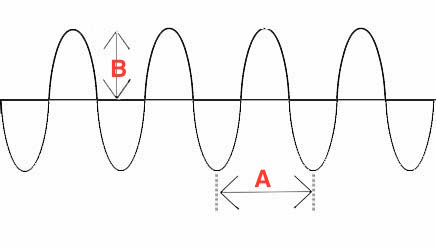
What property of this wave is represented by the letter "A"
a)
amplitude
b)
crest
c)
trough
d)
wavelength
55.
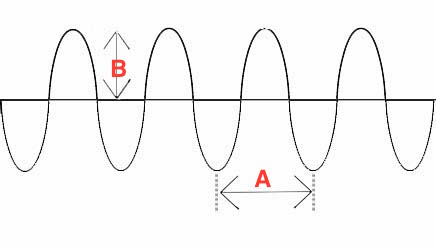
What property of the wave is represented by the letter "B"?
a)
amplitude
b)
crest
c)
trough
d)
wavelength
56.
The highest point on a wave is:
a)
the crest
b)
the trough
c)
the top
d)
the coast
57.
The lowest point on a wave is the:
a)
Amplitude
b)
Crest
c)
Trough
d)
Wavelength
58.
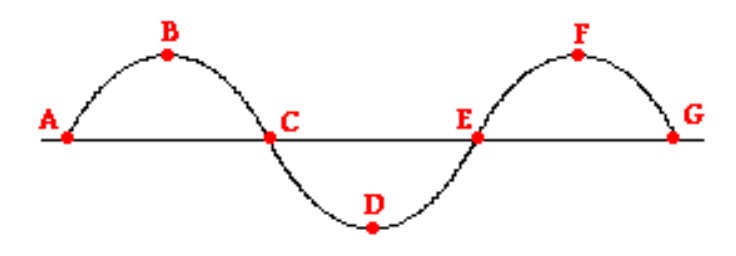
Which letter(s) represent the trough of the wave?
a)
A
b)
B & D
c)
D
d)
C & G
59.
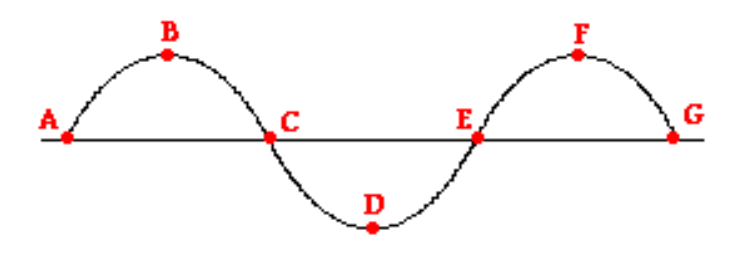
Which letter(s) represent the crest of the wave?
a)
A
b)
B & D
c)
B & F
d)
F
60.
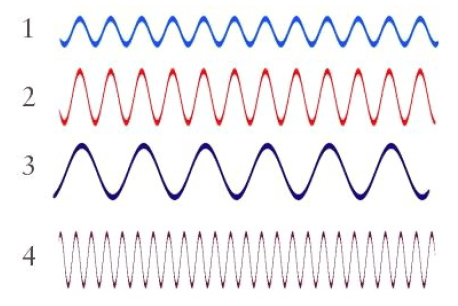
Which wave in the diagram has the greatest frequency?
a)
1
b)
2
c)
3
d)
4
61.
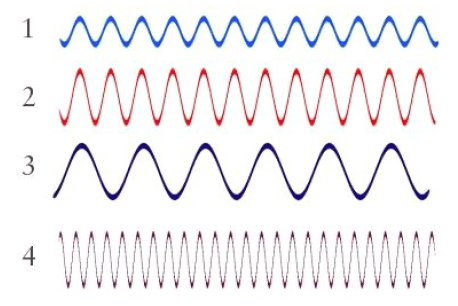
Which wave in the diagram has the greatest wavelength?
a)
1
b)
2
c)
3
d)
4
100 %

