wayground logo

Free Printable Worksheets

NEW

Font size

S
M
L
XL
Worksheets

DNARNAPS Test review

Total questions: 61

Worksheet time: 41mins

Name
Class
Date
1.

What are the nucleotides made of?

a)

Phosphate, Sugar, nitrogen base

b)

Phosphate, Adenine, nitrogen base

c)

Thymine, Adenine, Cytomine

d)

Phosphate, Nitrogen, Adenine

2.
Which of the following best describes a DNA molecule?
a)
double helix
b)
contains ribose
c)
made of amino acids
d)
contains Uracil
3.

Which of the following units are repeatedly joined together to form a strand of DNA? (DNA is composed of ?)

a)

amino acids

b)

nucleotides

c)

fatty acids

d)

polysaccharides

4.
Adenine bonds with ______________.
a)
Guanine
b)
Thymine
c)
Cytosine
d)
Adenine
5.
Guanine bonds with ______________.
a)
Adenine
b)
Guanine
c)
Cytosine
d)
Thymine
6.
What are the 4 nitrogen bases?
a)
adenine, thymine, cytoplasm, and guanine
b)
adenine, thymine cytosine, and guanine
c)
adenine, thymine, cytosine, and gylcerol
d)
adenine, thymine, cytosine, and glucose
7.
Which 2 molecules forms the sides (backbone) of the DNA ladder?
a)
deoxyribose and adenine
b)
deoxyribose and a hydrogen bond
c)
sugar and the nucleus
d)
deoxyribose (sugar) and phosphate
8.
Which organelle is DNA usually found in?
a)
cell membrane
b)
vacuole
c)
chloroplast
d)
nucleus
9.
Which sequence of DNA bases would pair with this partial strand
ATG TGA CAG
a)
ATG TGA CAG
b)
TAC ACT GTC
c)
GTA AGT GAC
d)
CAT TCA CTG
10.
In a molecule of double-stranded DNA, the amount of Adenine present is always equal to the amount of
a)
cytosine
b)
guanine
c)
thymine
d)
uracil
11.
What determines the code, or information, of a DNA molecule?
a)
the shape (structure) of the nitrogen bases
b)
the order (sequence) of the nitrogen bases
c)
the color of the nitrogen bases
d)
the frequency (number) of nitrogen bases
12.
Nitrogenous bases are joined by which type of bond?
a)
polar bonds
b)
ionic bonds
c)
covalent bonds
d)
hydrogen bonds
13.
Replicate the following strand of DNA: 
AATCATGGA
a)
AATCATGGA
b)
TTAGTACCT
c)
UUAGUACCU
d)
GGATAUCUA
14.
The enzyme that unzips the DNA to prepare for replication
a)
helicase
b)
replicase
c)
polymerase
d)
synthase
15.
DNA replication results in two DNA molecules,
a)
each one with two original strands
b)
each one with two new strands
c)
each one with one new strand and one original strand
d)
one with two new strands and the other with two original strands
16.
order of replication
a)
3, 2, 1, 4
b)
2, 1, 4, 3
c)
2, 3, 1, 4
d)
3, 4, 1, 2
17.
A process in which DNA has the unique ability to make an exact copy of itself.
a)
Replication
b)
Translation
c)
Transcription
18.

In what phase of the cell cycle does DNA replication take place?

a)

Mitosis

b)

Interphase (S stage)

c)

Cytokinesis

19.
The process to go from mRNA to a protein is called ____
a)
transcription
b)
rRNA
c)
replication
d)
translation
20.

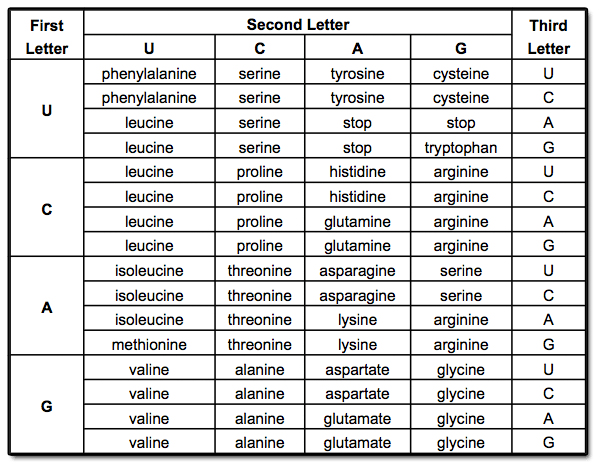
What amino acid is represented by the codon UUA?

a)

Phenylalanine

b)

Tyrosine

c)

Leucine

d)

Stop codon

21.
What is the location in the cell for translation?
a)
nucleus
b)
mitochondria
c)
ribosome
d)
chloroplast
22.
What is the three base sequence of mRNA that codes for a single amino acid?
a)
Anticodon
b)
Codon
c)
Protein
23.
Translation is the process where
a)
mRNA is created in the Nucleus
b)
mRNA is decoded to form a protein 
c)
glucose molecules are made
d)
is where lipids are synthesised
24.

What is the correct amino acid sequence for the mRNA code AUGCCAGUAUGA

a)

Met-Val-Pro-Stop

b)

Met-Pro-Val-Stop

c)

Met-Tyr-Gly-His-Stop

d)

Tyr-Gly-Arg-His

25.
RNA contains the sugar
a)
ribose
b)
deoxyribose
c)
glucose
d)
lactose
26.
Which of the following is a base that is NOT contained in DNA?
a)
Adenine
b)
Thymine
c)
Uracil
d)
Guanine
27.
Which of the following statements is true?
a)
DNA is single-stranded
b)
RNA is single-stranded
c)
DNA contains uracil
d)
RNA contains deoxyribose
28.

RNA - A pairs with?

a)

G

b)

4

c)

U

d)

T

29.
What does this picture represent?
a)
amino acid
b)
base pairing
c)
nucleotide
d)
the DNA molecule
30.
In eukaryotic cells, I travel out of the nucleus to a ribosome.
a)
Both DNA and RNA
b)
DNA
c)
RNA
31.
I include the bases guanine, cytosine, and adenine.
a)
DNA
b)
RNA
c)
Both DNA and RNA
32.
What is the difference between DNA and RNA in terms of bases?
a)
RNA contains uracil in place of thymine
b)
RNA contains uracil in place of adenine
c)
RNA contains uracil in place of guanine
d)
RNA contains uracil in place of  cytosine
33.
What is the product of translation?
a)
DNA
b)
mRNA
c)
tRNA
d)
proteins
34.
How many nucleotides make a codon?
a)
1
b)
2
c)
3
d)
6
35.

The process of creating a protein from RNA

a)

Transcription

b)

Translation

c)

Replication

36.

The Process of creating mRNA from DNA

a)

Transcription

b)

Translation

c)

Replication

37.

In RNA the base T is replaced with

a)

U

b)

G

c)

C

d)

A

38.

Transcribe the following DNA strand: CTG AAT

a)

GAC TTA

b)

CTG AAT

c)

GAC UUA

d)

CUG AAU

39.

What combines together to make a protein?

a)

Amino Acid

b)

RNA

c)

Ribosome

d)

DNA

40.

What is the order for Protein Synthesis?

a)

Transcription -> Translation -> Protein

b)

Translation - > Transcription -> Protein

c)

Protein -> Transcription -> Translation

d)

Translation -> Protein -> Transcription
41.
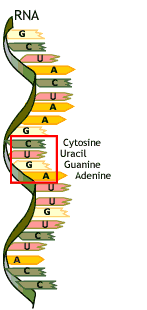
In RNA, Uracil pairs with ______. 
a)
cytosine
b)
adenine
c)
guanine
d)
thymine
42.
The process to go from DNA to mRNA is _______
a)
translation
b)
transcription
c)
replication
43.
The process to go from mRNA to a protein is called ____
a)
transcription
b)
rRNA
c)
replication
d)
translation
44.
DNA holds the code for
a)
lipids
b)
carbohydrates
c)
protein
d)
sugar
45.

What amino acid is represented by the codon UGA?

a)

Phenylalanine

b)

Tyrosine

c)

Leucine

d)

Stop codon

46.

15% of a DNA sequence is composed of Adenine, what % is Guanine?

a)

15%

b)

30%

c)

35%

d)

70%

47.
How many amino acids are coded for by this sequence of nucleotides:
ATG GGA ACT CCA
a)
4
b)
2
c)
6
d)
12
48.

How many (mRNA) codons can be made from 30 nitrogenous bases?

a)

10

b)

15

c)

30

d)

90

49.

30 (mRNA) codons make up how many amino acids?

a)

10

b)

30

c)

60

d)

120

50.

If a DNA sequence with a total of 200 nucleotides has 40 Adenine, it will have how many cytosine?

a)

40

b)

50

c)

60

d)

120

51.

What is the product of transcription?

a)

DNA

b)

mRNA

c)

tRNA

d)

proteins

52.

What is the order for Protein Synthesis?

a)

DNA -> mRNA - > tRNA -> Amino Acid -> Protein

b)

DNA -> RNA -> Protein

c)

DNA -> transcription - > translation -> Protein

d)

all are correct

53.
DNA molecule segment is : TTACGCAAG
The mutated DNA segment is TTACGCAAC. This is an example of ___ mutation.
a)
Substitution
b)
Insertion
c)
Inversion
d)
Translocation
54.
Any change in the sequence of DNA is...
a)
transgenic shift
b)
Single Genotype
c)
Monohybrid Trait
d)
Mutation
55.
Normal-
AGA-TTC-ATA-GCG
Mutant-
AGA-TTC-AAT-AGC-G
a)
deletion frameshift
b)
insertion frameshift
c)
substitution
d)
nonsense
56.
DNA molecule segment is : TTACGCAAG
The mutated DNA segment is TTCGCAAG. This is an example of ___ mutation.
a)
Substitution
b)
Deletion
c)
Insertion
d)
Inversion
57.

Insertion

a)

A

b)

B

c)

C

58.

Deletion

a)

A

b)

B

c)

C

59.

Sickle cell anemia is caused by what type of mutation?

a)

DNA substitution mutation

b)

Point mutation

c)

Both of these

d)

None of these

60.

What type of frameshift mutation causes Cystic Fibrosis?

a)

DNA addition (insertion) mutation

b)

DNA deletion mutation

c)

Both of these

d)

None of these

61.

During replication, what enzyme adds complimentary bases and corrects mistakes (proof reads)?

a)

helicase

b)

double helix

c)

DNA polymerase