wayground logo

Free Printable Worksheets

Font size

S
M
L
XL
Worksheets

Life Science Summative Exam! 17-18

Total questions: 63

Worksheet time: 46mins

Name
Class
Date
1.

Examine the picture above of various Galapagos island tortoises. Based on the pictures of the Galapagos island tortoises, choose the best explanation for why their neck lengths vary.

a)

Only the turtle with the longest neck will be able to eat

b)

Each tortoise is adapt to its environment from several generations of ancestors going through natural selection.

c)

Its just random chance that the tortoises have different neck lengths

d)

Neck length in turtles is so they can exercise their necks to reach for really tall plants.

2.

The diagram above shows several layer of sediment below the surface and some fossils that can be found in these layers. The organism at point W was a bony fish. The organism at point X was a dinosaur. The organism at point Y was a trilobite. The organism at point Z was an amphibian. This diagram suggest that

a)

trilobites are the oldest living thing.

b)

at different times in Earth's history different species lived at different times.

c)

amphibians are common ancestors of dinosaurs and trilobites.

d)

dinosaurs became extinct before the evolution of bony fish

3.
Individuals that are well adapted to their environment will survive and produce:
a)
Fewer mutations
b)
Stronger genes
c)
More offspring
d)
Better traits
4.
Which statement best explains how natural selection occurs?
a)
when adaptations help an organism reproduce and survive.
b)
when organisms are geographically isolated.
c)
when an organism’s offspring grow vestigial structures.
d)
when characteristics from the parent organism are inherited.
5.
The habitat of a moth species included trees with both light and dark colored bark.Therefore the moth species included both light and dark colored variants.Then the light-colored trees were wiped out by a disease, and within a few years nearly all the moths in this forest were dark colored. Which of the following choices BEST explains what happened?
a)
The light moths that survived all had dark offspring in order to adapt to the change.
b)
The dark moths were less visible to predators, so mostly light moths were eaten.
c)
The few light moths that survived did not mate, and therefore they had no offspring.
d)
The light moths changed their wing pigments to darker colors to avoid being eaten.
6.

Observe the characteristic facial features of the Galapagos Island finches below:
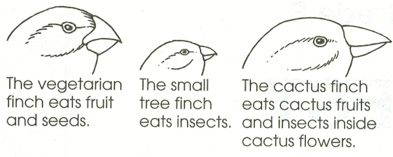
Which statement is most likely true about the Galapagos Island finches?

a)

The different beaks are the result of adaptations to eating certain kinds of foods on the islands.

b)

The different beaks are the result of adaptations to the amount of food available: the more food, the larger the beak.

c)

The different beaks are the result of adaptations to the amount of food available: the more food, the larger the beak.

d)

The different beaks are the result of adaptations to the amount of food available: the more food, the larger the beak.

7.
Natural selection
a)
process by which individuals that are better suited to their environment survive and reproduce most successfully; also called survival of the fittest
b)
Humans select which animals live and die
c)
both 
d)
IDK
8.

​Examine the diagram below.​Examine the bones in the diagram above. What conclusion can be made about these four organisms?

​Examine the bones in the diagram above. What conclusion can be made about these four organisms?

a)

The four organisms have similar bones because they live in similar environments.

b)

The four organisms have different ancestors since they live in different environments.

c)

The four organisms have no connection to each other because they live in the different ecosystems.

d)

The four organisms have a common ancestor since they have the same number of bones in the same positions.
9.
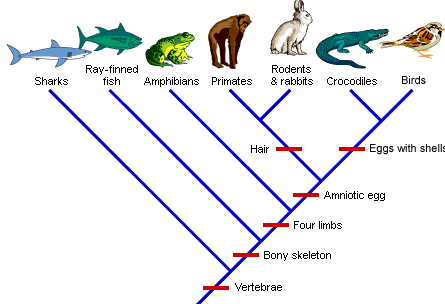
According to this cladogram, sharks are MOST closely related to which organism? 
a)
Amphibians
b)
Ray finned fish
c)
Crocodiles
d)
Birds
10.

What trait separates amphibians from primates in this cladogram?

a)

amniotic egg

b)

four limbs

c)

egg with shells

d)

bony skeleton

11.

which two organisms share a most recent common ancestor in this cladogram?

a)

turtles and leopards

b)

lancelet and lamprey

c)

salamander and turtle

d)

lamprey and tuna

12.

Genes are located on

a)

chromosomes

b)

ribosomes

c)

mitochondria

d)

cell wall

13.
A chromosome is a single, long DNA molecule in a compact formation
a)
True
b)
False
14.

What is a change in the DNA of a gene or chromosome?

a)

allele

b)

trait

c)

homozyogous

d)

mutation

15.
Which of the following cell types is formed by meiosis?
a)
muscle cells
b)
skin cells
c)
sperm cells
d)
blood cells
16.
How many chromosomes do humans have?
a)
46
b)
21
c)
10
17.
Why would it be important to replicate DNA before a cell divides in mitosis or meiosis?
a)
In order for genetic information to be transferred into daughter cells.
b)
In order for the cell to be able to increase in size.
c)
In order for the DNA to be contained in the nucleus.
d)
In order for the cell to re-order the DNA sequencing in the new cells.
18.
Which cellular process is shown?
a)
meiosis
b)
endocytosis
c)
mitosis
d)
phagocytosis
19.
Which best describes the process shown?
a)
mutation in which the DNA content of the gene is ltered
b)
segregation of sister chromatids
c)
condensation and segregation of the alleles
d)
crossing-over which alleles are exchanged
20.
Sperm and egg cells are an example of what?
a)
gametes
b)
chromosomes
c)
meiosis
d)
stages
21.

If an organism has 26 chromosomes in its somatic (body) cells, how many chromosomes did it inherit from each parent?

a)

13

b)

15

c)

26

d)

12

22.
In mitosis, the two resulting cells are
a)
different from the starting cell and identical to each other.
b)
different from the starting cell and different from each other.
c)
identical to the starting cell and different from each other.
d)
identical to the starting cell and identical to each other.
23.
Fruit fly body cells have 8 chromosomes. After mitosis, you would expect a resulting fruit fly daughter cell to have -
a)
16 chromosomes.
b)
46 chromosomes.
c)
8 chromosomes.
d)
4 chromosomes.
24.

Which answers represent genotypes?

a)

Hh

b)

brown hair

c)

cleft chin

d)

HH

25.

Which option represent a phenotype?

a)

Hh

b)

hh

c)

curly hair

d)

brown eyes

26.

Red hair is a recessive trait. Which genotype would represent a person with red hair?

a)

KK

b)

Kk

c)

kk

d)

XX

27.

Click all the parts of the cell theory.

a)

Cells are the smallest thing in the world

b)

All cells come from other cells

c)

Cells are the smallest unit of life

d)

Living things are made of cells

28.

What are the main parts of all cells?

a)

DNA (in a nucleus or loose)

b)

cytoplasm

c)

cell membrane

d)

cell wall

29.
Where does a cell contain it's genetic material?
a)
nucleus
b)
nucleolus
c)
cytoskeleton
d)
golgi
30.

The process where plant cells use the sun's energy to make food

a)

respiration

b)

reproduction

c)

photosynthesis

d)

cycling

31.
What is the difference between biotic and abiotic?
a)
Biotic are non-living things
b)
Abiotic are living organisms
c)
Biotic is life,
Abiotic is non-living
d)
Biotic is non-living, Abiotic is living
32.

Exam the picture of the bee and flower.
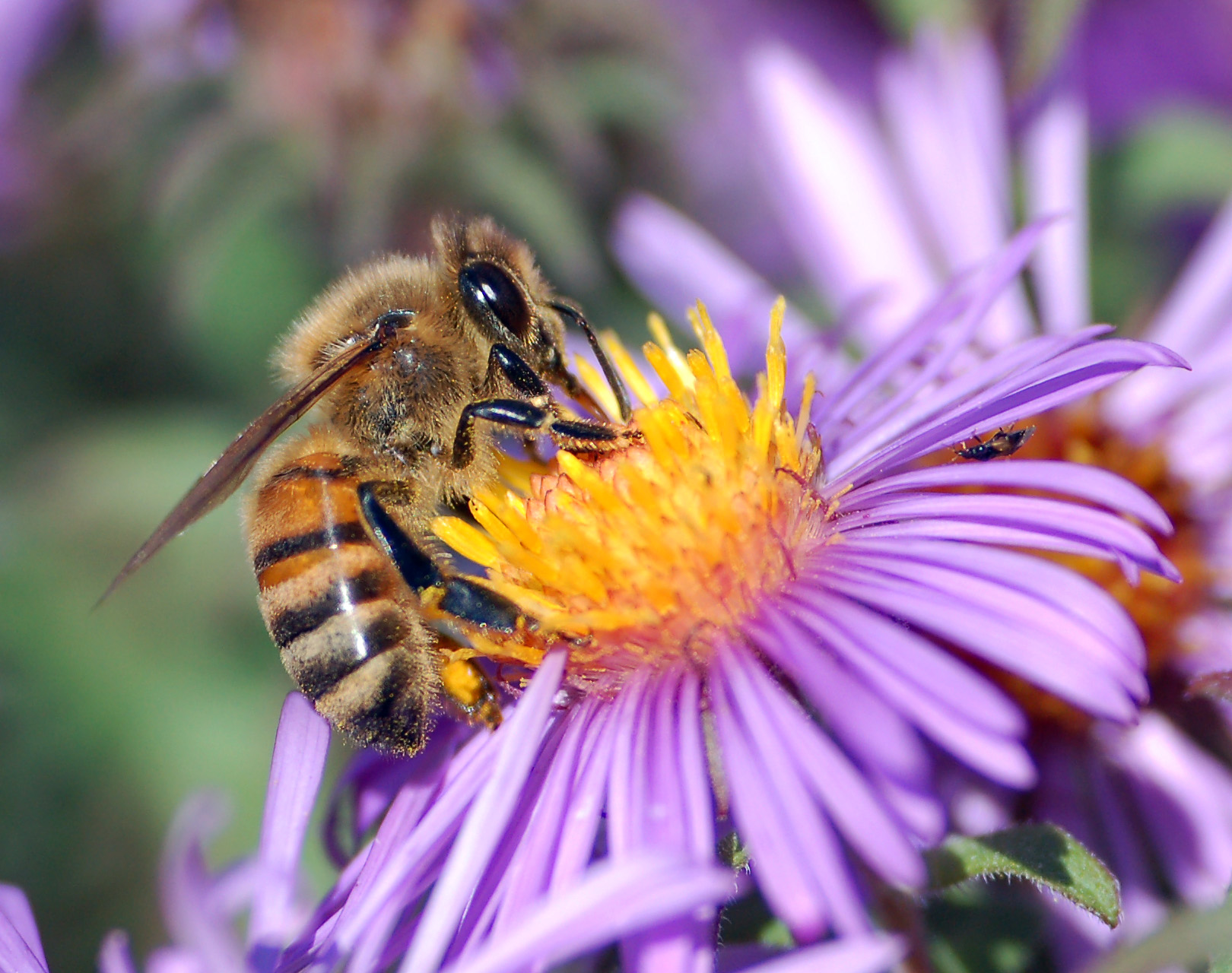
Predict the type of interaction between the bee and flower.

a)

competitive: the bee competes with the flower for pollen

b)

predatory: the bee is a predator which consumes (eats) the flower

c)

parasitic: the bee is killing the flower by taking its nectar

d)

mutually beneficial: the bee gets nectar and helps the flower reproduce

33.

What will happen if a drought causes the grass to decrease?

a)

The population of decomposers will decrease because there are less organisms dying.

b)

The population of owl will not be affected because they are predators who do not eat grass.

c)

The population of mice will decrease because there will be less food available due to the drought.

d)

The population of grasshoppers will increase because they will find a different, better food source.

34.

Use the food web bellow to answer the following questions. If the population of frogs decreases, which organisms population would increase?

a)

foxes

b)

hawks

c)

catepillars

d)

snakes

35.

A tall pea plant is crossed with a short pea plant. All of the offspring that are produced are tall. Two of these tall offspring are crossed. The Punnett square for this cross is shown below.

What can be concluded from this cross?

a)

Tall pea plants can only produce tall offspring.

b)

Tall pea plants can only produce short offspring.

c)

Tall pea plants can create tall, medium and even short offspring.

d)

Tall pea plants can carry the short trait and create some tall and short offspring.

36.

A forest is being turned into a new housing development. Predict the impact this will have on the bird populations in this area.

a)

The bird populations will increase.

b)

The bird populations will decrease.

c)

The bird populations will stay the same.

d)

There will be no more birds.

37.

Based on the graph above, what were the peak years for the zebra muscles population?

a)

1992, 1997, 2007

b)

1997, 2001, 2006

c)

1992, 2008

d)

1992, 1994, 1996, 1998, 2000

38.
What does biodiversity mean?
a)
Only one species in an area.
b)
The different amount of species in an area
c)
All abiotic life
d)
Nitrogen fixation
39.
How do humans affect their environment?
a)
positvely
b)
negatively
c)
both
40.
Where is pollution found on the earth?


a)
only in the air 
b)
only on the land 
c)
only in the water 
d)
on land, in the air, and in the water 
41.
Most water pollution is the result of
a)
human activities.
b)
drought.
c)
volcanic eruptions.
d)
storms.
42.
A farmer is using a crop duster to help spray chemicals on his crops to kill insects. The chemicals the farmer uses seeps into the soil and drains into the nearby river. How does this affect the animals that live in the river?
a)
They swim away
b)
They change color
c)
They get sick or die
d)
The chemicals give them more energy
43.
Why do scientists use the scientific method?
a)
To make sure they get credit for their discoveries.
b)
To make sure their results are valid and can be performed by other scientists.
c)
So that other scientist don't get mad at them
44.
What step does every scientific experiment begin with?
a)
hypothesis
b)
question/problem
c)
procedures
d)
conclusion
45.
What is a hypothesis?
a)
an educated guess stating what you believe will be the result of your experiement
b)
a random guess
c)
a statement of the outcome of your experiment
d)
step by step directions for your experiment
46.
True or False: Your hypothesis can never be wrong.
a)
True
b)
False
47.
If plants are exposed to sunlight, then they will grow taller.
What part of the scientific method is this an example of?
a)
Procedure
b)
Hypothesis
c)
Question
d)
Results
48.
Observations made during an experiment are considered:
a)
data
b)
problems
c)
conclusions
d)
questions
49.
The summary at the end of an experiment that explains the results. 
a)
conclusion
b)
procedures
c)
materials
d)
hypothesis
50.
What is being changed in this experiment?
a)
ramp height
b)
the speed that the ball rolls
c)
type of ball
51.
What is being measured or the result/effect of this experiment?
a)
ramp height
b)
the speed that the ball rolls
c)
type of ball
52.
What is being kept constant?
a)
ramp height
b)
speed of the ball rolling
c)
type of ball
53.
What is being measured or the result/effect of this experiment?
a)
how fast the water boils
b)
amount of water
c)
temperature of stove
54.
On what axis should the independent variable always be?
a)
X
b)
Y
55.
The scientific name for a wolf is Canis lupus. What does the first word in the name represent?
a)
Species
b)
Kingdom
c)
Genus
d)
Domain
56.
An experiment is performed on plants to see how different liquids affect plant growth. Each plant in the experiment is given a different liquid; water, apple juice, or milk. Each plant has the same amount of soil, sunlight, and listens to the same music. In this investigation, the independent variable is ...
a)
The type of plant
b)
The amount of sunlight
c)
The type of music
d)
The type of liquid
57.
A student wants to test the effects of type of exercise on heart rate.  What is the dependent variable?
a)
heart rate
b)
type of exercise
c)
amount of exercise
d)
time of day exercise occurs
58.
Humans depend on the natural environment for their basic needs.  Which doesnʻt belong
a)
food
b)
shelter
c)
clothing
d)
electronics
59.
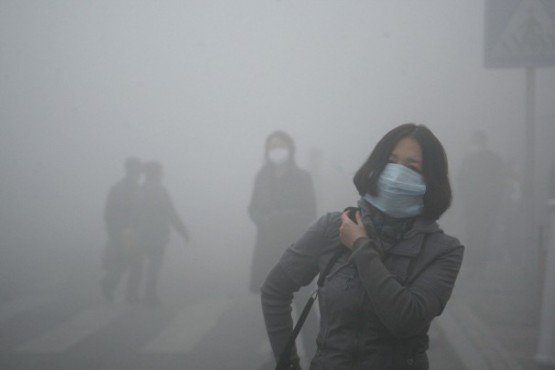
This picture shows people walking through a highly-polluted city in China. From what type of pollution are they protecting themselves based on what they are wearing?

a)
air pollution
b)
water pollution
c)
land pollution
d)
noise pollution
60.
The photo shows litter that washed up on the coast of Hawaii. Which of these human activities is a form of pollution that could harm the habitats of living things?


a)
throwing garbage on the ground
b)
planting more trees on land that is bare
c)
making compost of left-over food for your garden
d)
using the landfill for throwing away garbage 
61.
A landfill overflows into the river. What could happen to the plants and animals that live in the area around the river?
a)
The river will dry up
b)
They might get sick
c)
They will be healthier
d)
They will stay the same
62.
Which one is an example of recycling


a)
Reusing a paper bag for lunch. 
b)
 Using less water to take a bath. 
c)
Making new glass bottles from old ones.
d)
Using plastic cups instead of paper cups. 
63.
Energy sources are considered nonrenewable if they cannot be replenished (made again) in a short period of time. __________ energy sources such as solar and wind can be replenished naturally. 
a)
Non renewable 
b)
Renewable 
c)
Energy