
 Worksheets
Topic 1: Lessons 1-3
Total questions: 60
Worksheet time: 31mins
Which of the following is the function of the cell membrane?
To produce energy for the cell
To move materials into and out of the cell
To provide structure and support for the cell
To package and deliver materials to other organelles within the cell

Which structure, found in both animal and plant cells, controls what materials enter and exit the cell?
Structure 1
Structure 2
Structure 3
Structure 4
What is chlorophyll?
The substance found in green plants that conducts photosynthesis.
The organelle that breaks down and recycles materials within an animal cell.
The organelle that controls and coordinates the cell's functions and activities.
The organelle that is larger in plant cells and stores water, nutrients, and waste for the cell.
What organelle creates energy for a cell?
Ribosome
Endoplasmic Reticulum
Chloroplast
Mitochondrion
What type of cell are mitochondria found in?
Plant only
Animal only
Plant and Animal Cells
Neither type of cell
What is the difference between a multicellular and a unicellular organism?
Multicellular = 1 cell
Unicellular = 1 cell
Multicellular = 2 or more cells
Unicellular = 1 cell
Multicellular = 2 or more cells
Unicellular = 2 or more cells
Multicellular = 1 cell
Unicellular = 2 or more cells
What is the best description of the function of the Golgi Apparatus?
Produces proteins
Controls what materials enter and exit a cell
Creates glucose (sugar) for the cell
Packages and delivers materials to other organelles of the cell
What is the function of a cell wall for a plant cell?
To control what materials enter and exit the cell
To provide structure and support for the cell
To create glucose (sugar) for the cell using the energy captured from the Sun
To transport materials within the cell

The dark spot within each cell, that we also observed in class when we stained our cheek cells, is known as what organelle?
Cell Wall
Cytoplasm
Nucleus
Ribosome
Cells have a majority of organelles in common with one another. Which choice correctly identifies the organelles that are specific to a plant cell?
Cell Membrane and Ribosomes
Cell Wall and Nucleus
Chloroplast and Cytoplasm
Cell Wall and Chloroplast
What is the function of the ribosome?
To transport materials within the cell
To control what enters and exits the cell
To create (synthesize) proteins
To provide structure and support for the cell
The gel-like material that holds the organelles within the cell and also allows the organelles and other materials to move around the inside of the cell is known as the ______.
Chloroplast
Cytoplasm
Cell Wall
Chlorophyll
A cell is composed of ________ that help to carry out the life functions.
Organisms
Microorganisms
Organs
Organelles
A microscope has an ocular lens of 10x and three objective lenses (5x, 15x, and 25x). What is the lowest total magntification?
5x
50x
150x
250x
A microscope has an ocular lens of 10x and three objective lenses (5x, 15x, and 25x). What is the highest total magntification?
25x
55x
150x
250x
Which knob on a microscope is used to move the stage up and down and first bring the specimen into view/focus?
Base
Revolving Nosepiece
Coarse Adjustment Knob
Fine Adjustment Knob
Which knob on a microscope is used to sharpen an image and make it more clear when switching between objective lenses?
Base
Revolving Nosepiece
Coarse Adjustment Knob
Fine Adjustment Knob

All of the organisms are considered living because they all contain at least one ____.
Pint of blood
Organ
Cell
Wing/arm
The organelle that holds water, food (nutrients), and waste for a cell is known as a ______.
Vacuole
Ribosome
Cytoplasm
Cell Membrane
The organelle that contains the DNA of a cell and performs the life function of regulation for the cell (controlling and coordinating all cell activities) is known as the ______.
Nucleolus
Golgi Apparatus
Vacuole
Lysosome
Nucleus
What is the difference between passive and active transport?
Passive = Uses energy
Active = Uses energy
Passive = Doesn't use energy
Active = Uses energy
Passive = Doesn't use energy
Active = Doesn't use energy
Passive = Uses energy
Active = Doesn't use energy
If a cell uses energy to bring materials into itself, then it is known as which type of active transport?
Endocytosis
Exocytosis
Diffusion
Osmosis
Facilitated Diffusion
If a cell uses energy to send materials out of itself, then it is known as which type of active transport?
Endocytosis
Exocytosis
Diffusion
Osmosis
Facilitated Diffusion
If a cell moves particles/molecules of a substance (not water) into itself without using any energy, then it is known as which type of transport?
Endocytosis
Exocytosis
Diffusion
Osmosis
Facilitated Diffusion
If a cell moves water into or out of itself without using any energy, then it is known as which type of transport?
Endocytosis
Exocytosis
Diffusion
Osmosis
Facilitated Diffusion
If a cell moves particles/molecules that are too large to fit through the cell membrane through protein channels without using any energy, then it is known as which type of transport?
Endocytosis
Exocytosis
Diffusion
Osmosis
Facilitated Diffusion
How do materials move during passive transport?
From an area of lower concentration to an area of higher concentration, WITH the use of energy
From an area of higher concentration to an area of lower concentration, WITHOUT the use of energy
Materials cannot move during passive transport, since there is no energy
From an area of higher concentration to an area of lower concentration, WITH the use of energy
How do materials move during active transport?
From an area of lower concentration to an area of higher concentration, WITH the use of energy
From an area of higher concentration to an area of lower concentration, WITHOUT the use of energy
Materials will move randomly since there is so much energy involved and no control over movement
From an area of lower concentration to an area of higher concentration, WITHOUT the use of energy

As you read the diagram from left to right, the particles moved across the cell membrane to become more even on both sides (inside and outside of the cell). This is an example of what type of transport?
Endocytosis, an active transport
Exocytosis, an active transport
Diffusion, an active transport
Diffusion, a passive transport

Identify which type of transport is being shown for each diagram.
Left = Active
Right = Active
Left = Passive
Right = Active
Left = Passive
Right = Passive
Left = Active
Right = Passive
Identify which of the following are considered active transport. (Select all that apply)
Endocytosis
Exocytosis
Diffusion
Osmosis
Facilitated Diffusion
Identify which of the following are considered passive transport. (Select all that apply)
Endocytosis
Exocytosis
Diffusion
Osmosis
Facilitated Diffusion
Molecules (not water) are being moved from high to low without the use of energy. This best describes which type of transport?
Exocytosis
Diffusion
Endocytosis
Osmosis

Identify the types of solutions that would cause the cells to react in the way shown.
Left = Hypertonic
Middle = Isotonic
Right = Hypotonic
Left = Hypotonic
Middle = Isotonic
Right = Hypertonic
Left = Isotonic
Middle = Hypotonic
Right = Hypertonic
Left = Hypertonic
Middle = Hypotonic
Right = Isotonic
Water is able to move into and out of the cells in each of the solutions by ______.
Passive transport known as osmosis
Active transport known as osmosis
Endocytosis and Exocytosis, which are passive transports
Active Transport known as Facilitated Diffusion
What do both passive and active transport have in common?
The both use energy
They both don't use energy
They both move particles
They both move particles from higher concentrations to lower concentrations
They both move particles from lower concentrations to higher concentrations

This is a small rounded structure that is considered the waste remover of the cell. It uses chemicals to break down particles and waste that the cell no longer needs.
Vacuoles
Ribosomes
Chloroplasts
Lysosomes

Sac within the cytoplasm that STORES fluid, plants have a larger one that stores food and water.
vacuole
lysosome
cell wall
ribosome

This bean-shaped organelle is considered the "powerhouse" of the cell. It performs respiration and produces ENERGY!
Ribosome
Vacuole
Golgi Body
Mitochondria

This cell part controls and regulates (coordinates) the cells activities. It contains the genetic information (DNA) of a cell and is visible under a microscope when stained.
Mitochondria
Ribosomes
Nucleus
Endoplasmic Reticulum

Only found in plant cells
"solar panels"
cell wall
cell membrane
chloroplast
cytoplasm
All cells -----
come from other dead cells
come from other living cells
crystallize out of the air
There are three parts to the cell theory. Which is NOT one of those parts?
All organisms are composed of one or more cells.
The cell is the basic unit of structure and organization in organisms.
Cells spontaneously arise from carbon and nutrients carried in the bloodstream.
All cells come from pre-existing cells.
What does a 'region with high concentration' mean?
SMALL number of particles
LARGE number of particles
UNEVEN number of particles
no particles

The dashed line represents the semi-permeable membrane of a cell. There are 5 water molecules within the cell and 1 water molecule outside of the cell. Which way will the water molecules move during osmosis?
Out of the cell, so the cell shrinks (gets smaller).
Out of the cell, so the cell swells (gets bigger).
Into the cell, so the cell shrinks (gets smaller).
Into the cell, so the cell swells (gets bigger).
The cell is moving something against a concentration gradient (from a lower concentration into a higher concentration)
The cell is moving something with a concentration gradient (from a higher concentration to a lower concentration)
Which of the following is NOT a type of passive transport?
is the maintenance of a relatively stable internal environment
is the maintenance of a relatively stable external environment


The Cell Theory states - (select all that apply)
The cell is the basic unit of structure and function of living things
All cells are created from existing cells
All cells reproduce sexually
All living organisms are made from cells

This picture represents which type of active transport?
diffusion
Most energy that is released during respiration is produced in the ____
sky
mitochondria
stoma
chloroplast
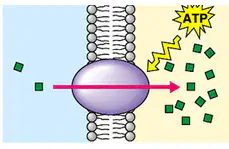
ATP = Energy
The process shown is displaying how molecules are being moved from an area of lower concentration to an area of higher concentration. This movement of molecules is known as what type of transport?
Facilitated Diffusion
Active Transport
Osmosis
Passive Transport
Endo-osmosis

