
 Worksheets
Life Science Review - TCAP
Total questions: 60
Worksheet time: 43mins
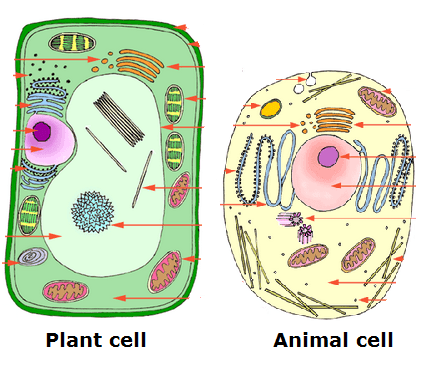
What distinguishes a plant cell from an animal cell? (How do you tell them apart) Hint: There's 3 ways (Check all 3)
Central Vacuole
Mitochondria
Cell Wall
Ribosomes
Chloroplasts

Cellular Respiration occurs within me and I am in BOTH plant and animal cells. I am a....
Nucleus
Golgi Body
Cytoskeleton
Mitochondria

I am the "brain" of the cell or the "control center" for everything happening within the cell. I am a...
Golgi Body/Apparatus
Nucleus
Ribosome
Lysosome

Photosynthesis takes place within me. I am a...
Mitochondria
Cell Wall
Chlorine
Chloroplast

I decide what goes in and out of the cell. I am fluid like and found in BOTH plant and animal cells. I am a...
Cell Wall
Cell Membrane
Cytoplasm
Golgi Apparatus

I provide plant cells their rigid shape. I am the...
Nucleus
Cytoskeleton
Cell Membrane
Cell Wall
If a cell is placed in an environment with MORE oxygen OUTSIDE the cell than inside, the cell will...
gain oxygen
lose oxygen
gain water
lose water
These cells have no nucleus
Prokaryotic
Eukaryotic
Both
These cells HAVE a nucleus
Prokaryotic
Eukaryotic
Both
These cells ONLY have single celled organisms
Prokaryotic
Eukaryotic
Both
Archaea... (choose all that apply)
are in the same kingdom as bacteria
live in extreme environments.
are prokaryotic
are multicellular.
are unicellular


Which type of reproduction requires 2 parent cells combining to create a new cell (offspring)?
sexual
asexual
Which of the following is an advantage to sexual reproduction?
Rapid reproduction of a large amount of offspring
More genetic mutations occur
genetic variation
offspring are identical to parents
Which type of reproduction only requires one parent?
sexual
asexual
Which of the following is a disadvantage to sexual reproduction?
Requires more time and energy
There is more genetic variation
There is greater chance of genetic mutation
Which of the human body systems is responsible for exchanging gases between the body and the air?
Nervous System
Digestive System
Respiratory System
Skeletal System
Which two body systems would work together to quickly move a hand away from a flame?
nervous and muscular
respiratory and skeletal
digestive and nervous
muscular and circulatory
The human immune system and the skin both play a role in which of the following functions?
sending and receiving messages from the brain
transporting oxygen to all parts of the body
storing nutrients for later use
protecting the body from illness
The digestive and circulatory systems work together to provide the body with -
skin
bones
nutrients
waste
What is the main function of the muscular system?
It helps the heart communicate with the brain.
It converts food in simpler substances for the body to absorb as nutrients and gives the body energy.
It supplies blood with oxygen in the lungs, and removes carbon dioxide from the body into the atmosphere.
It allows the body to move when attached to the bone. It also allows movement in internal organs, such as heart and intestines.
The ________________ filter the blood and remove toxins, excess water, and other waste.
heart and brain
stomach and intestines
liver and kidneys
bladder and heart
_____________ make up tissues. Tissues make up organs. Organs make up organ systems. Organ systems make up organisms.
cells
bacteria
blood
muscles


Adaptation: Bear sleeping in a cave during the winter months
Adaption: birds flying south for the winter


What is the energy source needed for photosynthesis to occur.
sugar
water
sunlight
A Drake soundtrack
What is made by plants during photosynthesis that can be used for energy by both plants and animals
Salt
Tacos
Sugar (glucose)
Carbon Dioxide
Reactants (ingredients) needed by the plant to do photosynthesis include sunlight and
Sugar and oxygen
oxygen and water
Autotrophs
Carbon Dioxide and water
Which of the following are the products of photosynthesis?
O2 + Glucose
Glucose + Sunlight
Glucose + CO2
CO2 + Sunlight
Which of the following are the reactants of respiration?
O2 + CO2
H2O + Glucose
Glucose + O2
H2O + CO2 + Sunlight
Which of the following are the products of respiration?
O2 + Glucose + ATP
Glucose + Sunlight + CO2
CO2 + H2O + ATP
CO2 + H2O + Sunlight

How are photosynthesis and respiration related?
ATP is a product of both reactions
The same products are made in both reactions
The two processes occur in the same organelle
The products of one are the reactants of the other
The genotype for a yellow plant is...
w= non-white hair
If you cross a horse with WW and a horse with ww what fraction of the offspring would be expected to have white hair?

Which organelle is DNA usually found in?
cell membrane
vacuole
chloroplast
nucleus
What is the purpose of cellular respiration?
to make food
to release energy from food
to take in food
to release oxygen
Which of the following puts an enormous amount of carbon in the atmosphere?
photosynthesis
burning fossil fuels
cellular respiration
decomposition

