wayground logo

Free Printable Worksheets

NEW

Font size

S
M
L
XL
Worksheets

Energy Self Check

Total questions: 60

Worksheet time: 41mins

Name
Class
Date
1.

All energy in an ecosystem comes from the sun. This energy is passed through the ecosystem as organisms eat other organsims.

a)

Ominvores

b)

Herbivores

c)

Detritivores

d)

Flow of energy

2.

Animal that gets its energy and nutrition from eating plants.

a)

Parasite

b)

Herbivore

c)

Carnivore

d)

Ominvore

3.

Animal that gets its energy and nutrition from eating meat.

a)

Detritivore

b)

Ominvore

c)

Carnivore

d)

Herbivore

4.

Organisms that produce their own food mostly through photosynthesis (producers). Examples are plants and algae.

a)

Ominvore

b)

Detritivore

c)

Heterotroph

d)

Autotroph

5.

Organisms that get their energy and nutrition from other organisms (consumers).

a)

Heterotroph

b)

Autotroph

c)

Decomposer

d)

Detritivore

6.

The level in an Ecological pyramid that includes all the organisms that share the same place in a food chain.

a)

Trophic Levels

b)

Toxic Levels

c)

KeKe Levels

d)

Environmental Systems

7.

What is the first source of energy for almost all food webs?

a)

Plants

b)

Sunlight

c)

Mineral in the soil

d)

Decomposers

8.
During ____________, _____________ convert light energy into the chemical energy in sugar molecules. 
a)
chemosynthesis, consumers
b)
chemosynthesis, producers
c)
photosynthesis, producers
9.
What is a food chain?
a)
A chain that shows how heat passes from organism to organism.
b)
A way of showing how matter and energy pass from one organism to another.
c)
A representation of all the predator-prey relationships in a community.
10.
What type of organisms are the first step in a food chain?
a)
Consumers
b)
Predators
c)
Producers
11.
What's a food web?
a)
A representation of all the feeding relationships within a community.
b)
A way of showing how matter and energy pass from one organism to another.
c)
A food chain provides a more complete model of feeding relationships within a community.
12.
What does an energy pyramid represent?
a)
Food pyramids show the different food chains in a community.
b)
Energy pyramids show the same total matter at all levels.
c)
Shows the amount of energy available at each feeding level in an ecosystem.
13.
Which of the following is a herbivore?
a)
cricket
b)
frog
c)
hawk
d)
shrew
14.
Which one is NOT an example of a decomposer?
a)
mushroom
b)
leaves
c)
mold
d)
worm
15.
Examples of just producer
a)
frog, fly, lillypad
b)
algae, grass, tree
c)
worm, dirt, fish
d)
mouse, seeds, bird
16.
An organism that needs to eat other organisms to obtain energy is known as a:
a)
Autotroph
b)
Producer
c)
Consumer
d)
Mutualist
17.
The arrows in a food chain or web represents what?
a)
They point to the organism that is being eaten.
b)
It shows how sunlight flows within an ecosystem.
c)
They show what direction the energy is flowing between organisms. 
d)
They represent how water is transferred within a habitat.
18.
Which of this energy roles is always located at the bottom of an energy pyramid?
a)
Producer
b)
Second-Level Carnivores
c)
Herbivores.
d)
First-Level Consumers.
19.

All the living things and non-living things in an environment.

a)

ecosystem

b)

food chain

c)

food web

d)

energy pyramid

20.

Biotic things in an environment are

a)

living things

b)

non-living things

21.

Abiotic things in an environment are

a)

Living things

b)

Non-living things

22.

Which one of the following is an example of an omnivore?

a)

lion

b)

racoon

c)

tiger

d)

rabbit

23.

What does a scavenger do in an ecosystem?

a)

eat plants

b)

eat flesh

c)

eat both plant and flesh

d)

consume already dead organisms

24.

Which of the following best summarizes photosynthesis?

a)

An adaptation of plants that allows them to add nutrients to the soil

b)

A chemical reaction involving nitrogen and other atmospheric gases

c)

A process by which plants produce sugar using the energy of sunlight

d)

An exchange of gases between animals and the air or water of their habitat

25.

Which of the following best summarizes the process of cellular respiration in plants and animals?

a)

Glucose + Oxygen --> Carbon Dioxide + Water

b)

Oxygen + Carbon Dioxide --> Glucose + Water

c)

Water + Carbon Dioxide --> Oxygen + Glucose

d)

Carbon Dioxide + Glucose --> Oxygen + Water

26.

Decomposers can be found where on the food chain?

a)

1st level

b)

2nd level

c)

3rd level

d)

Anywhere on the food chain.

27.
The total mass of all the organisms in a given area is called?
a)
Biomass
b)
Mass
c)
Organisms
d)
Life
28.
All the organisms on earth get their energy directly or indirectly from?
a)
Oxygen
b)
Water 
c)
Nitrogen
d)
The Sun
29.

4) What is the role of a consumer in the flow of energy through a food chain?

a)

A) Obtaining necessary nutrients from the soil

b)

B) Transforming the Sun's energy to make food

c)

C) Gaining energy by eating other living things.

d)

D) Decomposing the remains of living things.

30.

Which organisms are capable of photosynthesis?

a)

Plants and Fungi

b)

Animals

c)

Humans

d)

Plants

31.

Photosynthesis takes place in which eukaryotic organelle?

a)

Mitochondria

b)

Ribosome

c)

Chloroplast

d)

Cytoplasm

32.

Cellular respiration takes place in which eukaryotic organelle?

a)

Mitochondria

b)

Ribosome

c)

Chloroplast

d)

Cytoplasm

33.

If a plant was watered daily but placed in a closet, receiving no sunlight, what process would NOT occur?

a)

Cellular Respiration

b)

Water Absorption

c)

Photosynthesis

34.
Which cell structure is found in plant and animals cells and controls what can come into or leave a cell?
a)
cell membrane
b)
cytoplasm
c)
nucleus
d)
vacuole
35.
Cell organelles that are responsible for digesting food, worn out organelles and other cellular wastes are called ___________________.
a)
Mitochondria
b)
Vacuoles
c)
Lysosomes
d)
Chlororplasts
36.
What is one basic function of the vacuoles?
a)
circulating oxygen
b)
producing food
c)
controlling cell processes
d)
storing water
37.
Chloroplasts in plant cells allow the plant to perform a function that animal cells cannot do.  What is the main function of the chloroplasts found in plant cells?
a)
to absorb light energy and manufacture food
b)
to remove waste materials by active transport
c)
to manufacture chemical energy from food
d)
to control the shape of the cell
38.
All cells need energy to function.  Which cell organelle is responsible for producing energy in the cell?
a)
chloroplasts
b)
mitochondria
c)
nucleus
d)
vacuoles
39.
The basic unit of structure and function in a living things.
a)
chloroplast
b)
nucleus
c)
cell
d)
cell membrane
40.
Which organelle uses energy from sunlight to make sugar?
a)
mitochondria
b)
nucleus
c)
chloroplasts
d)
vacuoles
41.

Provides extra support for the plant cell and gives it shape

a)

chlorophyll

b)

chloroplast

c)

cell wall

d)

vacuole

42.
I am the outer most layer of an animal cell. What am I?
a)
cell wall
b)
nucleus
c)
cell membrane 
d)
cell skin
43.
A rigid layer that lies outside the cell's  membrane is...
a)
Cytoskeleton
b)
Cilia
c)
Cell Wall
d)
Flagella
44.
What is the gel-like substance inside of cells called?

a)
photoplasm
b)
photosynthesis
c)
cytoskeleton
d)
cytoplasm
45.
An organism that uses sunlight to create its own food is known as a:
a)
Producer
b)
Heterotroph
c)
Consumer
d)
Decomposer
46.
What does a food web represent?
a)
All connections of energy flow throughout all organisms in a habitat.
b)
The specific ways that mutualism is carried out.
c)
A single pathway or energy flow between organisms. 
d)
How carnivores get their food. 
47.
What is a trophic level?
a)
Each level represented within a food chain or web.
b)
Levels of ecosystems that the world is divided into.
c)
Different levels of nutrients present within an organism.
d)
The levels of sunlight an autotroph needs to survive. 
48.
An energy pyramid represents what?
a)
How much sunlight is available for the ecosystem to use. 
b)
How much energy a particular organism needs. 
c)
How much energy is needed to build a pyramid. 
d)
The amount of energy available to the next 'feeder' in a food web.
49.
How much energy is available to be passed on to the next trophic level in an ecosystem?
a)
100%
b)
10%
c)
50%
d)
75%
50.
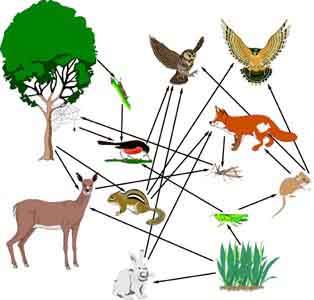
The fox in this food web would be considered a:
a)
Tertiary Consumer
b)
Producer
c)
Secondary Consumer
d)
Primary Consumer
51.
The mouse in this food web would be considered a:
a)
Primary Consumer
b)
Producer
c)
Tertiary Consumer
d)
Secondary Consumer
52.
What is this called?
a)
Food Web
b)
Food Chain
c)
Abiotic Factors
53.

For an energy pyramid, the 10% rule states that

a)

10% of the energy is transferred from one organism to the next.

b)

10% of the energy is gained.

c)

10% of the animals will starve.

d)

10% of the producers are eaten.

54.

Identify the energy transfer

a)

kinetic to mechamical

b)

light to thermal

c)

potential to kinetic

d)

electrical to magnetism

55.

When you eat food, your body gains ___________ energy.

a)

electrical

b)

chemical

c)

thermal

d)

light

56.

A battery converts what type of energy to another?

a)

sound to kinetic

b)

radiant to heat

c)

mechanical to electrical

d)

chemical to electrical

57.

Identify the energy transfer

a)

electrical to chemical to radiant

b)

kinetic to potential

c)

chemical to electrical to radiant

d)

radiant to sound

58.

Plants get the food they use for energy and growth by...

a)

breaking down bacteria.

b)

eating small insects.

c)

absorbing it from other living things.

d)

making it from sunlight.

59.

The process by which plants make food is called?

a)

Photosynthesis

b)

Precipitation

c)

Respiration

60.

During photosynthesis, plants need carbon dioxide, water, and which of the following?

a)

Nutrients from the soil

b)

Minerals found in rocks

c)

Energy from the sun

d)

Dead and decaying animals