wayground logo

Free Printable Worksheets

Font size

S
M
L
XL
Worksheets

Food Web, Photosynthesis & Taxonomy

Total questions: 60

Worksheet time: 1hrs 14mins

Name
Class
Date
1.

Who developed the classification system?

a)

Carl Linnaeus

b)

Albert Einstein

c)

The President

d)

Scientist

2.

What is the definition of Kingdom?

a)

The smallest and most specific group

b)

Related and create offspring

c)

The largest and least specific group

d)

Not related

3.

What is the smallest and most specific group?

a)

Order

b)

Class

c)

family

d)

species

4.

Why is it important to have a classification system?

(a)  

5.

What is Taxonomy?

a)

The study of organisms

b)

Classification System

c)

The countries that we live in.

d)

The different types of organisms

6.

HOW MANY KINGDOMS ARE THERE?

a)

4

b)

5

c)

6

d)

7

7.
Archeabacteria...
a)
are eukaryotic
b)
live in extreme environments
c)
are non-living
d)
live in the soil
8.

MUSHROOMS ARE IN WHAT KINGDOM

a)

PLANTAE

b)

ANIMALIA

c)

FUNGI

d)

PROTISTA

9.

AMOEBA-PARAMECIUM-EUGLENA-DINOFLAGELLATES BELONG TO WHAT KINGDOM

a)

PLANTAE

b)

PROTISTA

c)

FUNGI

d)

ANIMALIA

e)

ARCHAEBACTERIA

10.

APES BELONG TO WHAT KINGDOM

a)

PLANTAE

b)

ANIMALIA

c)

FUNGI

d)

PROTISTA

11.

The Eukarya Domain has which organisms?

a)

Bacteria that causes diseases

b)

Bacteria found in volcanoes

c)

plants, animals., fungi and protista

d)

none of the above

12.

Multicellular organisms belong in which kingdom?

a)

Archaebacteria

b)

Fungi

c)

Protista

d)

Eubacteria

13.

Kingdom Animalia is

a)

Eukayotic

b)

Prokaryotic

14.

Kingdom Archaebacteria is...

a)

unicellular

b)

multicellular

15.
In what kingdom would you find trees and flowers?
a)
Plantae
b)
Fungi
c)
Eubacteria
d)
Animalia
16.
Eukaryotes are single celled organisms.
a)
TRUE
b)
FALSE
17.
Which tool do taxonomists use to classify organisms?
a)
Periodical Table
b)
Bohrs' Model
c)
Dichotomous Key
d)
Aristotles' Method
18.
A paramecium is a single celled organism with a nucleus that consumes other organisms for energy. The offspring are genetically different from its parents.
a)
Prokaryotic
b)
Eukaryotic
19.
A mushroom is composed of many cells that have a nucleus
In which domain does a mushroom belong?
a)
Archaea
b)
Eukarya
c)
Bacteria
20.
Which of the following terms means "a cell that does not have a nucleus"?
a)
Prokaryotic
b)
Eukaryotic
c)
Protista
d)
Archaea
21.
Which of the following is autotrophic?
a)
 a tree
b)
a bird
c)
a worm
d)
a mushroom
22.
Where is DNA located in a eukaryotic cell?
a)
chloroplast
b)
nucleus
c)
amoeba
23.
Which of the following determines if an organism is eukaryotic?
a)
having identical offspring
b)
producing their own food
c)
having a nucleus
d)
number of cells
24.
Which of the following domains would a prokaryotic organism belong?
a)
Animalia
b)
Protista
c)
Eukarya
d)
Bacteria
25.
In which of the following domains would a lion cub belong?
a)
Protista
b)
Animalia
c)
Eukarya
d)
Archaea
26.
All organisms can be classified into..
a)
3 kingdoms and 6 domains
b)
3 domains and 6 kingdoms
27.
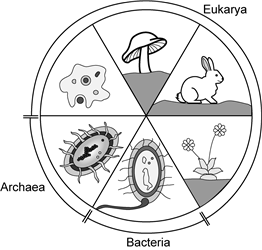
The taxonomic levels represented in this picture are the three —
a)
classes, the lowest levels of organization, and their associated phyla.
b)
kingdoms, the broadest levels of organization, and their associated phyla.
c)
domains, the broadest levels of organization, and their associated kingdoms.
d)
orders, the lowest levels of organization, and their associated domains.
28.
The domains of living organisms are —
a)
Prokarya, Bryozoa, and Bacteria, and they are the lowest level of taxonomic organization.
b)
Archaea, Euryarchaeota, and Eukarya, and they are the broadest level of taxonomic organization.
c)
Archaea, Bacteria, and Eukarya, and they are the broadest level of taxonomic organization.
d)
Flustrina, Archaea, and Bryozoa, and they are the second-lowest level of taxonomic organization.
29.
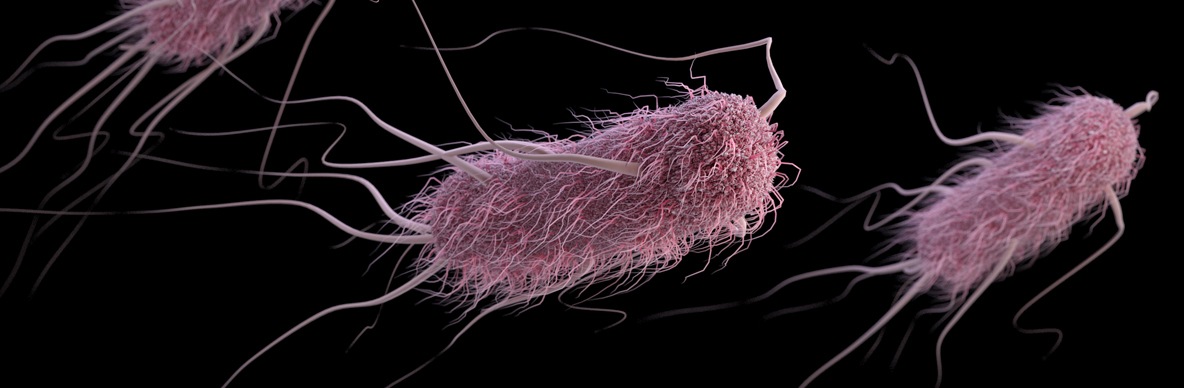
Escherichia coli, or E. coli, is a single-celled, prokaryotic organism. These characteristics require E. coli to be classified in the kingdom —
a)
Protista.
b)
Bacteria.
c)
Plantae
d)
Fungi
30.
What is the most basic difference between autotrophs and heterotrophs?
a)
Heterotrophs respond to their surroundings, while autotrophs do not.
b)
Heterotrophs remain in one place, while autotrophs move around.
c)
Heterotrophs get nutrition by eating, while autotrophs make their own food.
d)
Heterotrophs excrete waste products, while autotrophs do not.
31.
Green algae, ferns, and pine trees are classified in the plant kingdom. These organisms share certain characteristics. Which of the following is a characteristic used to classify these organisms as plants?
a)
They engage in photosynthesis.
b)
They have an immune system.
c)
They can be found in many different regions on Earth.
d)
They produce flowers.
32.
Amanda learns that some species of algae share the characteristics of being unicellular and producing sugar by photosynthesis. These species of algae fall into which kingdom?
a)
Fungi
b)
Animalia
c)
Protista
d)
Plantae
33.
Bacteria can be classified into two kingdoms: Archaea and Eubacteria. Bacteria in both of these kingdoms are all —
a)
organisms that live in harsh environments.
b)
autotrophs.
c)
organisms that reproduce sexually.
d)
prokaryotes.
34.
An organism is unicellular, reproduces asexually, and lives in a hot hydrothermal vent at the bottom of the ocean. This organism most likely belongs to the kingdom —
a)
Archaea
b)
Eubacteria   
c)
Animalia
d)
Protista.
35.
The characteristics of a particular organism are listed below. 
 
• Is unicellular
• Has cell nuclei
• Lives in moist environments
• Reproduces asexually
• Is mobile
 
In which kingdom should this organism be classified?
a)
Animalia
b)
Protista
c)
Plantae
d)
Eubacteria
36.
The characteristics of a particular organism are listed below.

• Is multicellular
• Is a consumer
• Has cells with nuclei
• Reproduces sexually
• Is mobile
• Digests foods internally

 
In which kingdom should this organism be classified?
a)
Animalia
b)
Fungi
c)
Archaea
d)
Plantae
37.

The broadest category in the classification system is the

a)

Family

b)

Class

c)

Order

d)

Domain

38.

Which shows the taxonomy levels in order?

a)

domain, kingdom, phyla, class, order, family, genus, species

b)

species, genus, family, order, class, phyla, kingdom, domain

c)

domain, species, kingdom, genus, phyla, class, order, family

39.

You

a)

Uni

b)

Multi

c)

Both

40.

Preforms all life processes in one cell

a)

Uni

b)

Multi

c)

Both

41.

Rose bush

a)

Uni

b)

Multi

c)

Both

42.
Use the diagram answer the question.
What is a fitting description for this diagram?
a)
A Food Chain
b)
An Ecosystem
c)
A Food Web
d)
Biotic and Abiotic Factors
43.
Use the diagram to answer the question.
The Mayfly is a food source for which 3 organisms?
a)
Frog, Dragon Fly and snake
b)
Frog, trout and dragon fly
c)
Frog, salamander and trout
d)
Frog and phytoplankton
44.
Use the diagram to answer the question.
The trout is a source of food for the human and the eagle. When there are more than one organism vying for the same source we call this____?
a)
Population
b)
Resources
c)
Community
d)
Competition
45.
What is the best explanation for an energy pyramid?
a)
It shows the FLOW of energy from one organism to the next. 
b)
It shows HOW much energy flows through a food web
c)
It shows the MEMBERS in a single organism
46.
True or False. In this Food Web Pyramid the consumers on each level only get about 10 percent of energy that the plants have stored.
a)
True
b)
False
47.
In this Food Web Pyramid what is the proper name for the organisms above the producer level at the bottom.
a)
herbivores
b)
consumers
c)
carnivores 
d)
omnivores
48.
The deer, grasshopper, and bird are all examples of which type of consumers on this food pyramid?
a)
decomposers
b)
omnivores
c)
carnivore
d)
herbivore
49.
The snake and the frog, are all examples of which type of consumers on this food pyramid?
a)
decomposers
b)
omnivores
c)
carnivore
d)
herbivore
50.
About how much percent of energy is passed on from one organism to to the next on a food web pyramid. 
a)
100 percent of all energy gets passed
b)
45 percent of all energy gets passed
c)
10 percent of all energy gets passed
d)
0 percent of all energy gets passed
51.

A plant is...

a)

an autotroph

b)

a heterotroph

c)

a primary consumer

d)

a carnivore

52.

A person who eats a chicken that ate grain is a ...

a)

primary producer

b)

primary consumer

c)

secondary consumer

d)

quaternary consumer

53.

Primary consumers eat...

a)

primary producers

b)

primary consumers

c)

secondary consumers

d)

quaternary consumers

54.

Secondary consumers eat...

a)

primary producers

b)

primary consumers

c)

tertiary consumers

d)

quaternary consumers

55.

Tertiary consumers eat...

a)

primary producers

b)

primary consumer

c)

secondary consumers

d)

quaternary consumers

56.

A bear, that eats a fish, that ate bugs, that ate algae is a...

a)

primary producer

b)

secondary consumer

c)

primary consumer

d)

tertiary consumer

57.

A heterotroph...

a)

is an autotroph

b)

eats other organisms

c)

is a primary producer

d)

is an autotroph & a primary producer

58.
What gas goes into the plant before photosynthesis?
a)
Carbon Dioxide
b)
Carbon Monoxide
c)
Oxygen
d)
Nitrogen
59.
Plants need what to do photosynthesis?
a)
Food absorbed from ground
b)
Sun's energy
c)
Food broken down
d)
Minerals from the soil
60.
What two products does a plant make during photosynthesis?
a)
Water and Glucose
b)
Oxygen and Glucose
c)
Oxygen and Water
d)
CO2 and Glucose