wayground logo

Free Printable Worksheets

Font size

S
M
L
XL
Worksheets

Bio Exam 1: Cells, Diffusion, Energy

Total questions: 62

Worksheet time: 2hrs 52mins

Name
Class
Date
1.

A cell WITH OUT membrane bound organelles is called

a)

a prokaryotic cell

b)

a eukaryotic cell

c)

an animal cell

d)

a plant cell

2.

Identify the MITOCHONDRIA.

a)

K

b)

F

c)

A

d)

H

3.

Identify the Rough Endoplasmic Reticulum.

a)

D

b)

R

c)

P

d)

F

4.

What is the function of nuclear pores?

a)

for the nucleus to breath

b)

to allow in/out of nucleus

c)

to store new DNA inside the nucleus

d)

to remove old DNA from nucleus

5.

Identify the MITOCHONDRIA.

a)

K

b)

F

c)

A

d)

H

6.

Diffusion & Facilitated Diffusion are both __________ transport.

a)

Passive

b)

Active

c)

Easy

d)

Free

7.

Passive Transport is the movement of particles across the membrane from an area of [ ___ ] to an area of [ ___ ]

a)

high to low

b)

low to high

c)

low to low

d)

high to high

8.

Passive Transport uses ____ energy

a)

no

b)

a lot of

c)

a little bit of

d)

some

9.

_____________ is the free movement of particles across the membrane with the concentration gradient

a)

diffusion

b)

facilitated diffusion

c)

active transport

d)

fusion

10.

Passive Transport is the movement of particles _________ the concentration gradient.

a)

with

b)

against

c)

opposing

d)

throughout

11.

Small changes of particles moving across the membrane that sum together to produce no net change.

a)

equilibrium

b)

dynamic equilibrium

c)

net movement

12.

The relative amount of a given substance contained within a solution or in a particular volume of space; the amount of solute per unit volume of solution. The higher the concentration, the more solute is present.

a)

concentration gradient

b)

concentration

c)

[high] --> [low]

13.
During osmosis
a)
water moves from high to low concentration
b)
large or oddly shaped molecules move across a cell membrane
c)
water moves when energy is used
d)
proteins are built
14.

Ideally, most cells should be in a(n) _______ solution

a)
Hypertonic
b)
Hypotonic
c)
Isotonic
d)

Redbull

15.
The picture below is an example of _________________.
a)
osmosis
b)
isotonic
c)
diffusion
d)
active transport
16.
_______ regulates what enters and leaves a cell.  
a)
Cell Membrane
b)
Nucleus
c)
Mitochondria
d)
Cytoplasm
17.
Osmosis
a)
diffusion of water molecules through a semi-permeable mebrane from an area of low concentration to an area of high concentration
b)
the diffusion of particles from an area of high concentration to an area of low concentration
c)
diffusion of water molecules through a semi-permeable membrane from an area of high concentration to an area of low concentration
d)
the diffusion of particles from an area of low concentration to an area of high concentration
18.
The cell below is in a _________ solution.
a)
Hypotonic
b)
Hypertonic
c)
Isotonic
19.
Which cell is placed into a hypotonic environment? 
a)
A
b)
B
c)
C
d)
D
20.

Which organelle contains digestive enzymes

a)

Mitochondria

b)

Lysosome

c)

Centriole

21.
Which of the following is directly involved in the transportation of materials inside the cells?
a)
endoplasmic reticulum
b)
lysosome
c)
vacuole
d)
mitochondria
22.

What are the chromatin composed of?

a)

RNA

b)

DNA

c)

Phospholipid

d)

Chromosome

23.

Where are the ribosomes made?

a)

Chromatin

b)

Nuclear pores

c)

Nuclear membrane

d)

Nucleolus

24.

What are the two locations that ribosomes can be allocated into?

a)

Nucleus

b)

Cytoplasm

c)

Smooth Endomembrane Reticulum

d)

Rough Endomembrane Reticulum

25.
Where can you find ribosomes? 
a)
only in prokaryotic cells
b)
only in plant cells
c)
only in eukaryotic cells
d)
in both prokaryotic and eukaryotic cells
26.

Ribosomes are found in following cells

a)

animal

b)

plant

c)

prokaryotic

d)

bacteria

27.
What is the energy needed to start an chemical reaction referred to?
a)
Cascading Energy
b)
Potential Energy 
c)
Kinetic Energy
d)
Activation energy
28.
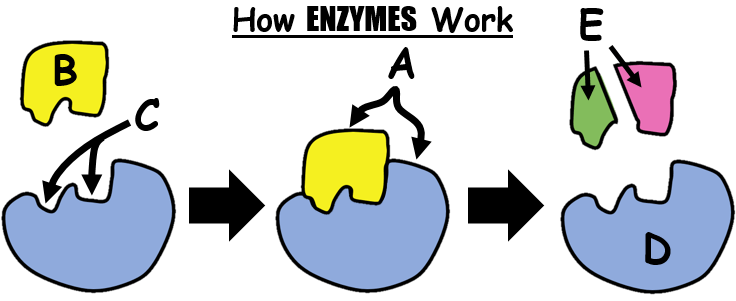
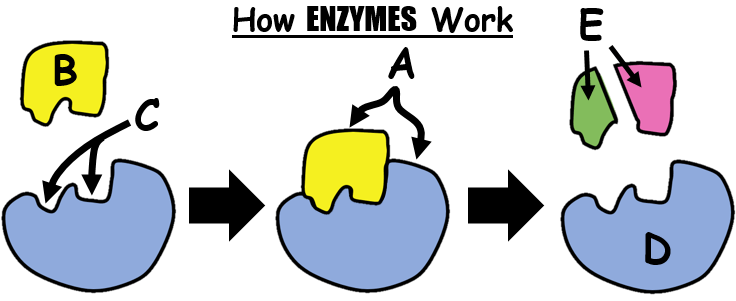
What is being represented by the letter A in the image?
a)
Substrate
b)
Enzyme
c)
Product
d)
Complex
29.
What is being represented by the letter B in the image?
a)
Substrate
b)
Enzyme
c)
Substrate
d)
Product
30.
If an enzyme becomes over heated what effect, if any, will the heat have on the enzymatic activity? 
a)
The enzyme will not store much chemical energy.
b)
The enzyme will not be able to catalyze reactions.
c)
The enzyme will lose its net electrical charge.
d)
The enzyme will lose stored genetic information.
31.
Enzymes are capable of increasing the rate of a chemical reaction within a living cell.  Enzymes accomplish this through which of the following means?
a)
reducing the number of products   
b)
reducing the activation energy
c)
increasing the temperature of the cell
d)
increasing the concentration of reactants 
32.
Cells can produce over one thousand different enzymes at a time.  Enzymes are critical to the metabolism of these cells, but why are so many different enzymes needed?
a)
Cells are completely unable to control what enzymes
they produce
b)
The variety of enzymes prevents their actions from being inhibited. 
c)
The active site of an enzyme can only bind to a specific substrate.
d)
The products of a reaction are always converted into new enzymes.
33.
Which factors can change the shape of an enzyme and thus denatures a enzyme?
a)
Excessive heat and changes in pH
b)
Nothing can
c)
Exposure to light and sound
d)
Exposure to bacteria and Amoebas
34.
Enzymes are composed of what organic molecule?
a)
Sugars
b)
DNA
c)
Proteins
d)
Fatty Acids
35.
What happens to an enzyme when it is denatured?
a)
Activation energy is lowered.
b)
It becomes stronger.
c)
It loses its shape.
d)
Activation energy is raised.
36.
Every enzyme has a optimal temperature and pH. True or False?
a)
True 
b)
False
37.
Enzymes influence chemical reactions in living systems by:
a)
Providing the substrate required for the reaction to occur.
b)
Affecting the rate at which reactions occur.
c)
Absorbing water released when polymers are formed.
d)
Combining with excess hydrogen to from gaseous wastes. 
38.
The "lock and key hypothesis" attempts to explain the mechanism of?
a)
Vacuole formation
b)
Pinocytosis
c)
Sharing of electrons
d)
Enzyme are specific to a substrate
39.
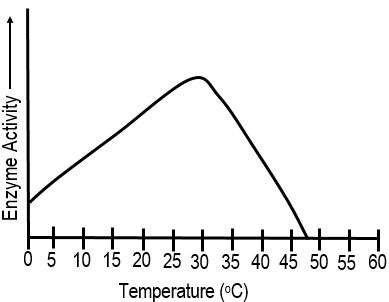
Based on the graph, what temperature does this enzyme work best? 
a)
15 C
b)
40 C
c)
30 C
40.
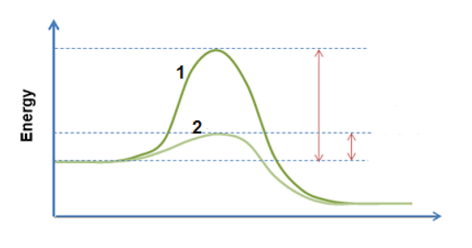
Which line represents an enzyme-catalyzed reaction? 
a)
Line 1
b)
Line 2
41.
In a chemical reaction, a reactant binds to an enzyme at a region known as the
a)
catalyst.
b)
product.
c)
substrate.
d)
active site. 
42.

The ________ of the microscope would give you the SMALLEST field of view.

a)

low power objective

b)

medium power objective

c)

high power objective

d)

stage

43.
Find total magnification for:
Eyepiece = 10X 
Objective lens = 4X
 
a)
4x
b)
6x
c)
14x
d)
40x
44.
Find total magnification for:
Eyepiece = 20X 
Objective lens = 20X
 
a)
20x
b)
40x
c)
200x
d)
400x
45.

The largest field of view shown is under the total magnification _____X.

a)

40

b)

100

c)

400

46.
Which of the following is correct about the Golgi? 
a)
Digests waste materials 
b)
Protection and Support 
c)
Modifies and packages molecules 
d)
cellular movement 
47.
What characteristic defines this organism as prokaryotic?
a)
Ability to move
b)
Ability to respond
c)
Shape and size
d)
Lacking of membrane-bound organelles
48.

The energy required to start a chemical reaction is ___.

a)

endothermic

b)

exothermic

c)

activation

d)

released

49.

Net release of energy

a)

endergonic

b)

exergonic

50.

Which statement is true according to the image?

a)

A: endergonic; B: exergonic

b)

A: exothermic; B: endothermic

c)

A: exergonic; B: endergonic

d)

A: endothermic; B: exothermic

51.

Draw an exergonic reaction

52.

Draw a cell in a hypertonic solution
53.
With what 3 letters do enzymes typically end?
a)
-ose
b)
-ase
c)
-ese
d)
-tic
54.
Letter B...
a)
active site
b)
enzyme
c)
substrate
d)
products
55.
Letter C...
a)
active site
b)
enzymes
c)
substrate
d)
products
56.
Letter E...
a)
active site
b)
enzyme
c)
substrate
d)
products
57.
Letter D...
a)
active site
b)
enzyme
c)
substrate
d)
products
58.
With what 3 letters do enzymes typically end?
a)
-ose
b)
-ase
c)
-ese
d)
-tic
59.
What is a substance called if it speeds up a chemical reaction?
a)
reusable
b)
catalyst
c)
specific
d)
fragile
60.

....... Acts as a storage organelle.

a)

Smooth ER

b)

Rough ER

c)

Both of above

d)

None of above

61.

Synthesis and packeging of proteins occurs in...

a)

Rough ER

b)

Smooth ER

c)

Lysosome

d)

Plasma membrane

62.

......is important in the creation and storage of lipids and steroids.

a)

Smooth ER

b)

Rough ER

c)

Lysosome

d)

Mitochondria