

wayground logo

Free Printable Worksheets

NEW

Font size

S
M
L
XL
Worksheets

Middle Ages Test Review

Total questions: 36

Worksheet time: 19mins
Name
Class
Date
1.
How did the emergence of medieval feudalism in Europe influence the Christian Church?
a)
The Church encouraged voyages of exploration.
b)
The Church published the Bible in the vernacular.
c)
The Church adopted Latin as the official language.
d)
The Church served as the unifying power in society.
2.
A major goal of the Catholic Church during the Crusades (1096-1291) was to –
a)
Unite Arab peoples
b)
Establish Christianity in Western Europe
c)
Capture the Holy Land from Islamic rulers
d)
Strengthen the power of European rulers
3.
Which is the most valid generalization about the impact of the Crusades?
a)
They strengthened the power of the serfs in Europe
b)
They increased trade between Europe and Asia
c)
They brought European influence to Asia
d)
They promoted the idea of religious freedom
4.
What title was given to Charlemagne by the Pope in 800 AD?
a)
King of England
b)
Holy Roman Emperor
c)
Head of the Eastern Orthodox Church
d)
None of the above
5.
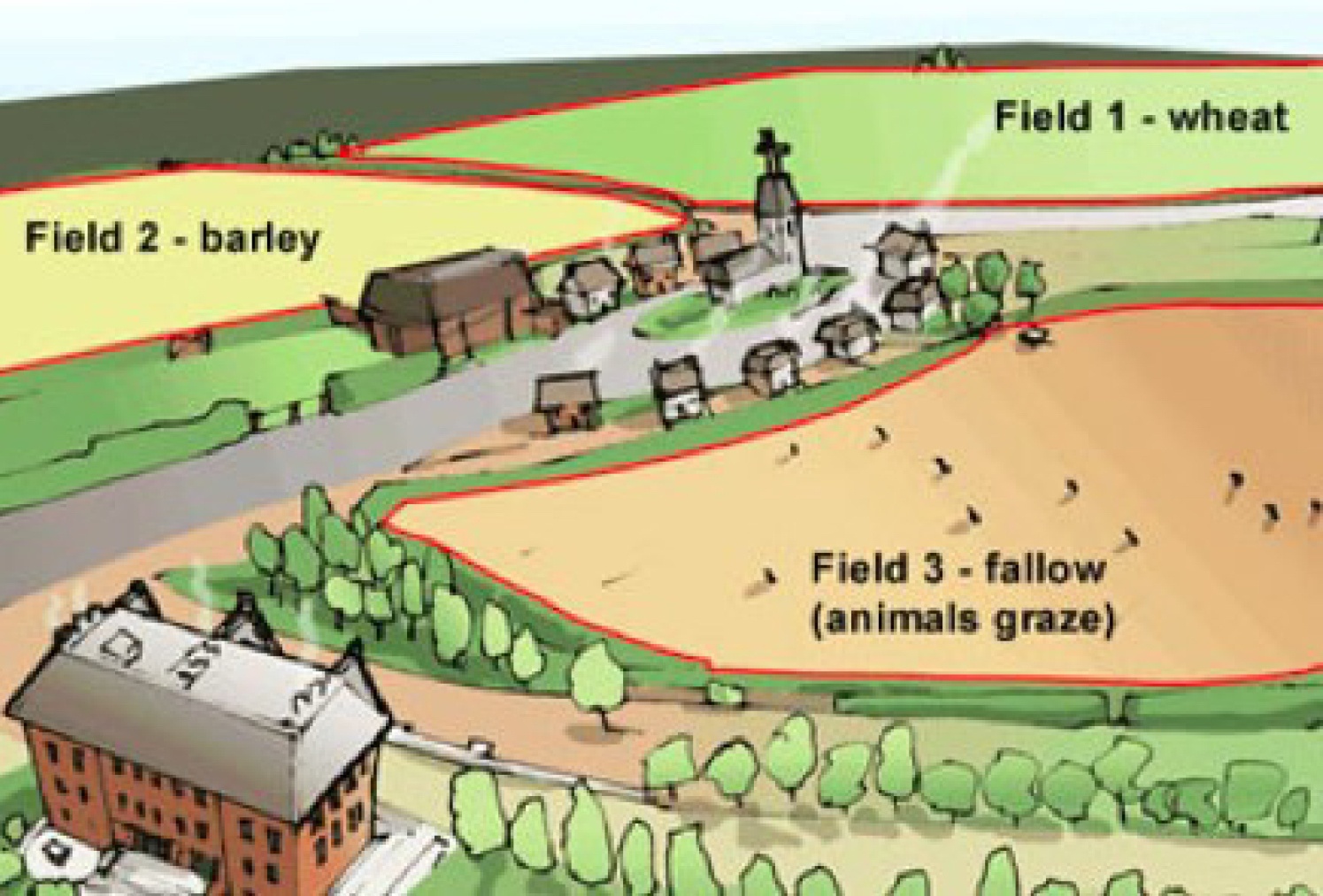
The picture above best describes which medieval farming technique?
a)
Three-field system
b)
Crop rotation
c)
Irrigation
d)
pig farming
6.
Which of the following groups had the MOST political power?
a)
vassals
b)
serfs
c)
lords
d)
knights
7.
_____________ is a political/social system and _____________ is an economic system.
a)
Middle Ages…feudalism
b)
manorialism…feudalism
c)
feudalism…manorialism
d)
Roman Empire…feudalism
8.
Feudalism developed mainly because 
a)
the monarchy was too powerful
b)
the Catholic Church was failing
c)
people needed protection
d)
King John created it
9.
What was a major effect of the Black Death?
a)
trade decreased
b)
it strengthened feudalism 
c)
food prices inflated
d)
manors became overcrowded
10.
The Roman Catholic Church is known for 
a)
creating universities and schools
b)
preserving Greek and Roman knowledge
c)
hand-copying the Bible
d)
all of the above
11.
The Magna Carta's main function was to 
a)
free serfs and peasants
b)
limit the king's power
c)
limit the pope's power
d)
provide money to the king
12.
During feudal times, the majority of people belonged to which social class?
a)
king
b)
nobility
c)
knights
d)
peasants
13.
The land that is granted to a vassal in exchange for his loyalty and service is a 
a)
manor
b)
farm
c)
fief
d)
guld
14.
Knights did all of the following except which one?
a)
were of the noble class
b)
followed the code of chivalry
c)
rode on black horses
d)
trained for 10-15 years
15.
Who was the first King of England?
a)
Henry I
b)
John
c)
William the Conquer
d)
Henry VIII
16.
What is the name of the paper King John was forced to sign?
a)
Declaration of Independence
b)
His death warrant
c)
Bill of Rights
d)
Magna Carta
17.
What is the name of the wars fought between the Christians and the Muslims?
a)
Holy Wars
b)
Hundred Years War
c)
Crusades
d)
Plague
18.
Who is the leader of the Cathoilc Church?
a)
Preist
b)
Monk
c)
Pope
d)
Bishop
19.
Manorialism can best be described as
a)
the process of how a nobleman's son in the middle ages could become a knight
b)
the political relationships between the king or queen, the nobility, and the peasants
c)
the economic ties between the nobles and the peasants who worked on their lands
d)
the land given to monasteries by different governments as a show of loyalty to the Church
20.
Which of the following was an effect of the Plague on Europe?
a)
religion became less of an influence among people
b)
most usable farmland was poisoned or destroyed
c)
surviving peasants gained more economic power
d)
peasants developed greater loyalty to their monarchs
21.
attacks by Vikings and other invaders
weakening of centralized government
decision of nobles to take over local defense
The list above is describing 
a)
the development of social classes during feudalism
b)
the reasons for the development of feudalism
c)
the political relationships under feudalism
d)
the economic consequences of feudalism
22.
Feudalism began as
a)
a way for the military to secure its power over the peasants and landowners
b)
a contract in which land was granted to the peasants in exchange for military service to the nobles
c)
a demand by peasants for better living conditions and for a share in the economic prosperity of the middle ages
d)
a means for the church to collect more taxes for its support of the nobility
23.
The First Crusade had the intended goal of capturing which city?
a)
Jerusalem
b)
Cairo
c)
Mecca
d)
Rome
24.
Which of the following was a lasting effect on Europe as a result of the Crusades?
a)
many Muslims moved to Europe
b)
many Europeans converted to Islam
c)
Europe became more isolated
d)
trade between Europe and the East increased
25.
During the Middle Ages, how did Catholic religious leaders influence the kings and lords of Europe?
a)
the church usually had bishops and cardinals made into kings
b)
the church had control over most of Europe's food supply
c)
the church had an army larger than any other feudal army
d)
the church taught that it had authority over every person
26.
The Middle Ages in Western Europe was characterized by...
a)
The manor system and the importance of land ownership
b)
Absolute monarchies and strong central government
c)
Decreased emphasis on religion in daily life
d)
 Extensive trade with Asia and the Middle East
27.
The person who first unified most of the Christian lands in western Europe after the fall of Rome was...
a)
 Henry VIII
b)
 Charlemagne
c)
 William the Conqueror
d)
Saladin
28.
Which is a characteristic of feudal society?
a)
 Rapid social change
b)
   High literacy rates
c)
   Factory system and the industrial based economy
d)
   Rigid social class structure, social hierarchy
29.
In European feudal society, an individual's social status was generally determined by...
a)
 Birth
b)
     Education and training
c)
     Marriage
d)
     Individual abilities
30.
What conclusion about the effects of the plague can be drawn from the list below?
 ●  Europe and China lost about one third of its population
●  Labor shortages brought higher wages for many workers
●  People blamed God for the plague
●  The manor system collapsed as peasants left their manors to work for set wages in urban areas.
●  Feudalism was weakened
a)
     Major, catastrophic events can trigger huge changes in society
b)
     People seek comfort in traditions in the wake of tragic events
c)
   Societies always grow/flourish during types of disasters and epidemics
d)
     Tragic events always bring people closer to God
31.
After the division of 1054, the names of the two branches of the Christian Church were ...
a)
     Islamic and Eastern Orthodox
b)
   Islamic and Turkish
c)
 Roman Catholic and Eastern Orthodox
d)
   Protestant and Roman Catholic 
32.
Who were the fierce warriors and pirates from Scandinavia?
a)
Vikings
b)
Normans
c)
Byzantines
d)
Monarchs
33.

Many people lost faith in God after the Black Death. As a result, who lost power?

a)

Kings and Queens

b)

The Church

c)

Knights

d)

Serfs

34.

What is the best explanation of the feudal system of the Middle Ages in Western Europe?

a)

A merchant employs villagers to work in his shop.

b)

An apprentice learns a skilled trade and joins a guild.

c)

A king allows peasants to participate in government.

d)

A lord gives land to a vassal in exchange for loyalty and military service.

35.

How was the social order in European society affected by the Black Death?

a)

Most of the upper class was killed by the plague, and peasants were able to buy land.

b)

Kings gave most of their power to the church clergy, so they would pray to stop the plague.

c)

High death tolls reduced the population of workers and weakened the practice of feudalism.

d)

Nobles were able to afford medicine to fight the plague and therefore were not affected by it.

36.
Who was the King to reunite Europe after the Fall of the Roman Empire?
a)
William the Conqueror
b)
Charlemagne
c)
John VIII
d)
Caesar