
 Worksheets
MB Tri 1 Exam Review
Total questions: 56
Worksheet time: 52mins
Name
Class
Date
1.
Water molecules are polar, with
a)
oxygen side slightly + and hydrogen side slightly -
b)
oxygen and hydrogen sides equally charged
c)
oxygen and hydrogen sides both slightly positive
d)
oxygen side slightly - and hydrogen side slightly +
2.
Water molecules sticking to other water molecules is a property known as
a)
adhesion
b)
cohesion
c)
capillary action
3.
This organelle digests food particles, foreign invaders to the cell, and damaged cell parts
a)
chloroplast
b)
mitochondria
c)
lysosome
d)
vesicle
4.

The structure shown here is a
a)
polysaccharide
b)
unsaturated fatty acid
c)
saturated fatty acid
d)
polypeptide
5.
The organelle that makes lipids for the cell is the
a)
ribosome
b)
smooth ER
c)
rough ER
d)
cell membrane
6.
Which is not a job of a cell membrane protein
a)
transport materials
b)
attachment to the extracellular matrix
c)
enzymes
d)
movement of the cell
7.
Which type of transport below is not an example of passive transport?
a)
osmosis
b)
diffusion
c)
facilitated diffusion
d)
exocytosis
8.
A protein that sets up a channel for water to travel through the cell membrane is known as
a)
aquaporin
b)
aquaphor
c)
osmosase
9.
A cell added to this type of solution will swell and may even burst
a)
hypertonic
b)
hypotonic
c)
isotonic
10.
Which is the correct monomer/macromolecule pairing?
a)
nucleic acid, nucleotide
b)
amino acid, protein
c)
monosaccharide, glucose
d)
glycerol, fatty acid
11.

Type of molecule shown here.
a)
steroid
b)
protein
c)
nucleic acid
d)
methyl functional group
12.
Functional group that has nitrogen in it
a)
carbonyl
b)
carboxyl
c)
amino
d)
hydroxyl
13.
Cellulose is
a)
a carbohydrate
b)
a major component of plant cell walls
c)
indigestible by humans
d)
all of the above
14.
Amino acids differ in their
a)
R-groups
b)
Quaternary structure
c)
Double vs single strand
d)
Amount of phosphorus
15.
T/F:
Enzymes raise the activation energy of a reaction
Enzymes raise the activation energy of a reaction
a)
True
b)
False
16.

T/F:
This enzyme will not function at a pH of 7
This enzyme will not function at a pH of 7
a)
True
b)
False
17.

Organelle shown here
a)
Mitochondria
b)
Chloroplast
c)
Lysosome
d)
Centriole
18.
Chlorophyll absorbs a higher percentage of _____ and _______ light.
a)
purple and green
b)
red and blue
c)
black and orange
d)
yellow and green
19.

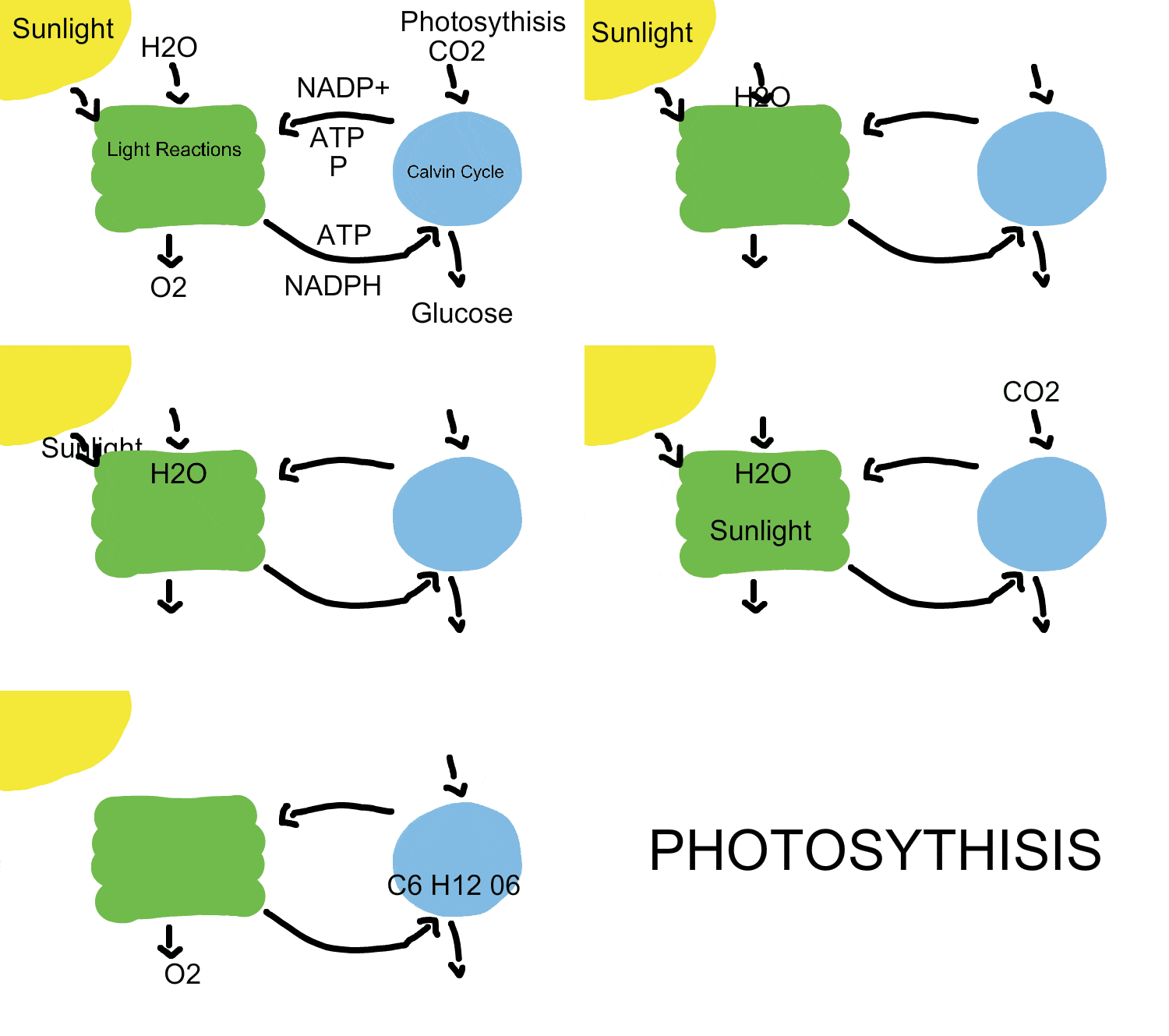
The reactants of photosynthesis are
a)
sugar and water.
b)
sugar and oxygen.
c)
carbon dioxide and water.
d)
carbon dioxide and oxygen.
20.

What pigment absorbs sunlight for photosynthesis?
a)
chloroplast
b)
thylakoid
c)
grana
d)
chlorophyll
21.

Which of the following is the correct equation for PHOTOSYNTHESIS?
a)
6CO2 + 6H2O --> 6O2 + C6H12O6
b)
6CO2 + C6H12O6 + 6H2O --> O2
c)
6O2 + 6H2O --> 6CO2 + C6H12O6
d)
C6H12O6 + 6O2 ---> 6H2O + 6CO2
22.

What is the function of NADPH and ATP?
a)
They absorb light
b)
They power the light-dependent reactions
c)
They are light-reflecting pigments
d)
They are short term energy carriers
23.

Where do the light-dependent reactions occur?
a)
thylakoid membrane
b)
stroma
c)
mesophyll
d)
mitochondria
24.

Which of the following is NOT a product of the light-dependent reactions?
a)
ATP
b)
NADPH
c)
Oxygen
d)
Glucose
25.

What is the primary function of the light-dependent reactions of photosynthesis?
a)
To produce glucose
b)
To produce NADPH and ATP
c)
To use ATP
d)
To produce RuBP
26.

Use the diagram to answer the question. Between which parts of the molecule must the bonds be broken to form an ADP molecule?
a)
A and B
b)
A and C
c)
B and C
d)
C and D
27.

Plants need carbon dioxide from their environment to produce glucose during which stage of photosynthesis?
a)
The light-dependent stage
b)
The light-independent stage (The Calvin Cycle)
c)
The electron transport chain
d)
ATP formation
28.

From which molecule does a plant get most of its mass?
a)
carbon dioxide
b)
water
c)
sunlight
d)
soil
29.

Which of the following is considered a waste product of photosynthesis?
a)
glucose
b)
oxygen
c)
carbon dioxide
d)
sunlight
30.

Light energy is used to
a)
split water into H and O
b)
weld C, H and O together
c)
make water
31.

Contains DNA and RNA
a)
lipids
b)
carbohydrates
c)
proteins
d)
nucleic acids
32.

Contains a phosphate, sugar and nitrogen base
a)
nucleic acid
b)
lipid
c)
carbohydrate
d)
protein
33.

Is found in the cell membrane as a bilayer.
a)
lipids
b)
protein
c)
nucleic acid
d)
carbohydrate
34.

Identify the macromolecule in the picture
*GLUCOSE
*GLUCOSE
a)
lipid
b)
protein
c)
nucleic acid
d)
carbohydrate
35.

Identify the macromolecule in the picture.
* look at the R.....
* look at the R.....
a)
carbohydrates
b)
lipids
c)
proteins
d)
nucleic acids
36.
Which macromolecule stores energy, insulates us, and makes up the cell membrane?
a)
lipids
b)
proteins
c)
carbohydrates
d)
nucleic acids
37.
What is the monomer of proteins?
a)
amino acids
b)
polypeptides
c)
nucleotides
d)
monosaccharides
38.
All organic compounds contain the element
a)
carbon
b)
nitrogen
c)
phosphorus
d)
sulfur
39.
Which is the monomer (building block) for lipids?
a)
fatty acids & glycerol
b)
nucleotide
c)
amino acids
d)
monosaccharide
40.
Why is carbon a good atomic backbone for macromolecules?
a)
It has one valence electron.
b)
It has four valence electrons.
c)
It has extra protons.
d)
It has fewer neutrons.
41.
What is a functional group?
a)
Group of atoms that give specific characteristics to a molecule
b)
Group of molecules that give specific characteristics to an atom
c)
Group of molecules that make up a group of atoms
d)
Group of atoms that give specific characteristics to an element
42.
How is a Carboxyl Group commonly written?
a)
-OH
b)
-COOH
c)
-COH
d)
-CHOH
43.
What functional group is -CH3
a)
Methyl
b)
Hydroxyl
c)
Carboxyl
d)
Carbonyl Ketone
44.
What functional group is -OH
a)
Hydroxyl
b)
Carboxyl
c)
Amino
d)
Carbonyl Ketone
45.

What functional group(s) is/are present on the molecule? (check all that apply)
a)
Hydroxyl
b)
Carboxyl
c)
Methyl
d)
Carbonyl Aldehyde
46.

What Group does this photo represent?
a)
Hydroxyl
b)
Phosphate
c)
Amino
d)
Carboxyl
47.

What is is the functional group found on this molecule?
a)
Hydroxyl
b)
Carboxyl
c)
Amino
d)
Phosphate
48.

Which functional group is present in this molecule?
a)
Hydroxyl only
b)
Hydroxyl and Amino
c)
Carboxyl and Amino
d)
Hyroxyl and Carboxyl
49.

Humans shiver when they are cold to maintain
a)
cytolysis
b)
turgor pressure
c)
limbo
d)
homeostasis
50.
What is an isotonic solution?
a)
When solutions are in equilibrium
b)
When the solution has more solute
c)
When the solution has less solute
d)
Has a greater pressure
51.
What is embedded in the phospholipid bilayer?
a)
proteins
b)
salt
c)
water
52.

Movement of particles through the cell membrane
from high to low
from high to low
a)
diffusion
b)
photosynthesis
c)
mitochandria
53.

Against the concentration gradient
low to high
uses energy/ATP
low to high
uses energy/ATP
a)
facilitated diffusion
b)
osmosis
c)
active transport
54.

Allows certain molecules or ions to pass through it by diffusion and doesn't allow others.
a)
protein
b)
semi-permeable membrane
c)
isotonic
55.

Engulfs large molecules inside the membrane.
uses energy
uses energy
a)
exocytosis
b)
endocytosis
c)
protein channel
56.

Movement of large substances outside of cell.
Uses energy.
Uses energy.
a)
exocytosis
b)
endocytosis
c)
photosynthesis
100 %

