
 Worksheets
Plants for Food and Fibre Quiz
Total questions: 38
Worksheet time: 33mins
Name
Class
Date
1.
They enclose the egg cells inside the ovaries.
a)
ovules
b)
anther
c)
seeds
d)
angiosperms
2.
Brightly colored parts of flowers that attract insects.
a)
petals
b)
pistils
c)
stamen
d)
filaments
3.

The stalk connecting the ovaries and stigmas.
a)
filament
b)
pistil
c)
style
d)
anther
4.
The transfer of pollen, containing the sperm cells, to the female part of the flower.
a)
seed disperal
b)
pollination
c)
germination
d)
fertilization
5.

When a seed sprouts and begins the early growth of a young plant.
a)
germination
b)
pollination
c)
seed dispersal
d)
fertilization
6.
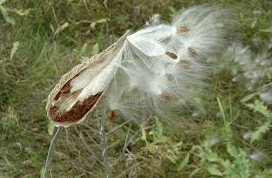
All of the following are examples of seed disbursement except:
a)
wind
b)
volcanic eruptions
c)
physical movement (rolling)
d)
animals feces
7.
Small grains that contain a plant's male reproductive cells.
a)
stamen
b)
pollen
c)
anther
d)
stigma
8.
The stalks in a flower that produce the male reproductive cells
a)
pistil
b)
stamen
c)
filament
d)
stigma
9.
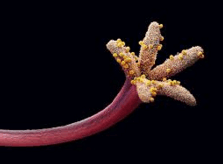
The part of the flower on which the pollen grains land.
a)
pistil
b)
stamen
c)
style
d)
stigma
10.

Small leaf-like structures forming an outer circle at the base of a flower.
a)
petals
b)
sepal
c)
anthers
d)
dicots
11.
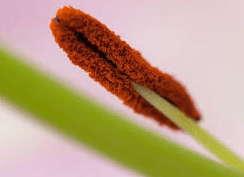
The part of a flower that produces the male reproductive cells.
a)
anther
b)
style
c)
stigma
d)
filament
12.
Which of the following is a PRODUCT of photosynthesis?
a)
sugar
b)
carbon dioxide
c)
water
d)
sunlight
13.
Where does water enter the plant?
a)
stem
b)
leaves
c)
roots
d)
flower
14.
What does the chlorophyll do?
a)
let in carbon dioxide
b)
absorb sunlight
c)
soak up water
15.
Which of the following does NOT come out of photosynthesis?
a)
sugar
b)
water
c)
oxygen
16.
Which of the following does NOT go into respiration?
a)
sugar
b)
carbon dioxide
c)
oxygen
17.
Which of the following does NOT come out of respiration?
a)
water
b)
oxygen
c)
carbon dioxide
d)
energy
18.
Evaporation of water from the leaf is called
a)
photosynthesis
b)
respiration
c)
transpiration
d)
diffusion
19.
In a plant, the roots ___________________.
a)
draw up water and minerals
b)
convert sunlight to enegry
c)
make and store food
d)
perform transpiration
20.
Fibrous roots are made of...
a)
One large, thick root
b)
Many small, thin roots
21.
Taproots have
a)
a tangled mass of roots
b)
one long thick root
22.
Which is not a characteristic of a root
a)
absorb water+nutrients
b)
store water+minerals
c)
anchor plant in ground
d)
transport food after photosynthesis
23.
The only function of the stem is to
carry nutrients
carry nutrients
a)
False
b)
True
24.
Osmosis is the diffusion of _____ across a selectively permeable membrane.
a)
food
b)
air
c)
water
d)
oxygen
25.
During diffusion
a)
substances (things) moves from high to low concentration
b)
water moves when energy is used
c)
large or oddly shaped molecules move across a cell membrane
d)
water moves from high to low concentration
26.

The picture below is an example of _________________.
a)
osmosis
b)
isotonic
c)
diffusion
d)
active transport
27.
The diffusion of water through a semi-permeable membrane is called?
a)
Osmosis
b)
Cell wall
c)
Diffusion
d)
Respiration
28.

Osmosis
a)
diffusion of water molecules through a semi-permeable mebrane from an area of low concentration to an area of high concentration
b)
the diffusion of particles from an area of high concentration to an area of low concentration
c)
diffusion of water molecules through a semi-permeable membrane from an area of high concentration to an area of low concentration
d)
the diffusion of particles from an area of low concentration to an area of high concentration
29.

Which part of a plant is responsible for the majority of photosynthesis?
a)
leaves
b)
stem
c)
roots
d)
stomata
30.
What are the products (what is made) of photosynthesis?
a)
sugar and oxygen
b)
sunlight energy
c)
carbon dioxide and water
d)
chlorophyll
31.
At night, plants take in ____________ and release ____________. This is called ______________.
a)
carbon dioxide, nitrogen, photosynthesis
b)
oxygen, carbon dioxide, photosynthesis
c)
oxygen, carbon dioxide, respiration
d)
carbon dioxide, oxygen, respiration
32.
Growing different crops in succession in the same field. This helps replenish soil nutrients.
a)
clear cutting
b)crop rotation
c)
monoculture
d)
tillage
33.
I have parachute like structures. What is likely my dispersal method?
a)
wind
b)
water
c)
animals
d)
explosive action
34.
I have hooks to cling to animal fur. What is likely my dispersal method?
a)
wind
b)
water
c)
animals
d)
explosive action
35.
Animals disperse seeds by _________.
a)
eating seeds and dropping waste later on
b)
hiding seeds for late and not coming back for them
c)
catching seeds on their fur and carrying them to different places
d)
all of the above
36.
The movement of pollen from one plant to another is called _________.
a)
dispersion
b)
pollination
c)
fruits
d)
seedlings
37.
What does an ovule become when it is pollinated?
a)
an embryo
b)
a seed
c)
a fruit
d)
it stays an ovule
38.
What plant part definition is this?: Supports the leaves and conducts water minerals to them, and other parts of the plant, including the roots.
a)
Roots
b)
Stem
c)
Leaf
100 %

