
 Worksheets
Cell Membranes/Transport
Total questions: 35
Worksheet time: 25mins
Name
Class
Date
1.
Passive transport requires no
a)
concentration gradients
b)
osmosis
c)
motion
d)
energy
2.

The picture is an example of _________________.
a)
osmosis
b)
isotonic
c)
diffusion
d)
active transport
3.
why do cells move things in and out?
a)
they are bored
b)
why not
c)
homeostatis, yo!
d)
kittens
kittens
kittens
4.
A cell in an isotonic solution will
a)
swell
b)
shrink
c)
stay the same size
d)
impossible to tell
5.

This picture represents which type of cellular transport?
a)
passive transport
b)
endocytosis
c)
exocytosis
d)
osmosis
6.
Proteins are moved into the cell by active transport called ________________________.
a)
endocytosis
b)
pinocytosis
c)
exocytosis
d)
osmosis
7.

The cell below is in a _________ solution.
a)
Hypotonic
b)
Hypertonic
c)
Isotonic
8.

The cell below is in a _____________ solution.
a)
Hypertonic
b)
Hypotonic
c)
Isotonic
9.
A cell in a hypotonic solution will
a)
swell
b)
shrink
c)
stay the same size
d)
impossible to tell
10.
What are two types of passive transport?
a)
endo and exocytosis
b)
cookies and milk
c)
active and passive
d)
Osmosis and diffusion
11.
In what direction do particles naturally diffuse?
a)
Up the concentration gradient
b)
Down the concentration gradient
c)
Across the concentration gradient
d)
Over the river and through the woods
12.
What is embedded in the phospholipid bilayer?
a)
proteins
b)
salt
c)
water
d)
trapped animals
13.

Hydrophobic region of the cell membrane?
a)
E
b)
B
c)
C
d)
A
14.

Hydrophilic portion of cell membrane?
a)
A
b)
C
c)
D
d)
E
15.
Osmosis is the movement of _____ across a membrane.
a)
food
b)
energy
c)
oxygen
d)
water
16.
Low to High
a)
Passive Transport
b)
Active Transport
17.
A phospholipid has 2 parts. What are they called?
a)
Hydrophilic Head, Hydrophobic Tail
b)
Hydrophobic Head, Hydrophilic Tail
18.
"Water Loving"
a)
Hydrophobic
b)
Hydrophilic
c)
Hydroelectric
d)
Hydroloric
19.
"Water Fearing"
a)
Hydrophobic
b)
Hydrophilic
c)
Hydroelectric
d)
Hydroloric
20.
___________ have 2 functions in the cell membrane.
1.) They act like gatekeepers, only let certain things in.
2.) Enzyme receptors embedded in the membrane.
1.) They act like gatekeepers, only let certain things in.
2.) Enzyme receptors embedded in the membrane.
a)
Carbohydrates
b)
Proteins
c)
Phospholipids
d)
Cholesterol
21.
___________ form the two layers of the cell membrane.
a)
Carbohydrates
b)
Proteins
c)
Phospholipids
d)
Cholesterol
22.
It forms a boundary between the inside of the cell and the outside of the cell.
a)
Cell Membrane
b)
Lipid Cleric Layer
c)
Membrane Gate
d)
Protein Receptors
23.
Something is ___________ ____________
when some molecules can cross the membrane while others cannot.
when some molecules can cross the membrane while others cannot.
a)
Selectively (or Semi) Permeable
b)
Totally Transparent
c)
Liquid Licorice
d)
Heavily Patrolled
24.
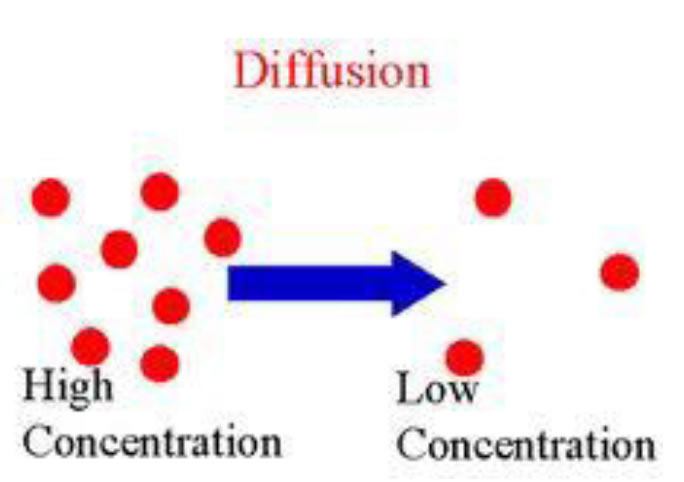
Movement of particles from high to low concentration.
a)
Passive Transport
b)
Active Transport
25.

Which process is shown in the diagram?
a)
protein building
b)
diffusion
c)
gene manipulation
d)
active transport
26.
Which of the following is NOT part of the cell membrane?
a)
Lipids
b)
Carbs
c)
Proteins
d)
Nucleic Acids
27.
How many layers is the lipid bilayer?
a)
1
b)
2
c)
3
d)
4
28.
Which of the following is responsible for getting complex molecules across the cell membrane?
a)
Lipids
b)
Carbs
c)
Proteins
d)
Nucleic Acids
29.
What are the carbohydrates in the cell membrane for?
a)
to form channels and pumps
b)
to help cells identify one another
c)
to make the membrane strong
30.
What forms the channels and pumps in the phospholipid bilayer?
a)
carbohydrates
b)
proteins
c)
hydrophilic heads
d)
lipids
31.
Which of the following is NOT a function of the cell membrane?
a)
Cell recognition
b)
Protection
c)
Cell signaling
d)
cells sticking together to form a tissue
e)
making the cell appear larger
32.

Which concentration is isotonic to the core?
a)
20
b)
0.34
c)
1
d)
0.6
33.
What is concentration?
a)
Amount of a liquid
b)
amount of solute
c)
the ratio between the solute and solvent
34.
When have two solutions reached equilibrium?
a)
When the amount of solute is the same
b)
When the amount of solvent is the same
c)
When the concentration of both sides is the same
35.

Which way will the water go?
a)
to the left
b)
to the right
100 %

