Wayground logo

Free Printable Worksheets

Font size

S
M
L
XL
Worksheets

Atmosphere/Air Pollution/Water Cycle Test Review

Total questions: 50

Worksheet time: 43mins

Name
Class
Date
1.
The air in the troposphere has a greater density than the air in any other layer of the atmosphere,
a)
True
b)
False
2.
What is the percentage of oxygen in Earth's atmosphere?
a)
1%
b)
21%
c)
78%
d)
90%
3.
Which gas in our atmosphere is most abundant?
a)
Argon
b)
Oxygen
c)
Nitrogen
d)
Carbon Dioxide
4.
What is the percentage of nitrogen in Earth's atmosphere?
a)
1%
b)
21%
c)
78%
d)
90%
5.
Which layer of the atmosphere contains the greatest amount of water vapor?
a)
Thermosphere
b)
Troposphere
c)
Mesosphere
d)
Stratosphere
6.
In which layer of the atmosphere does weather occur?
a)
Mesosphere
b)
Thermosphere
c)
Stratosphere
d)
Troposphere
7.
What decreases as you go up in the atmosphere?
a)
Altitude
b)
Atmosphere
c)
Meteors
d)
Air Pressure
8.
What is the lowest main layer of Earth's atmosphere?
a)
Thermosphere
b)
Troposphere
c)
Stratosphere
d)
Mesosphere
9.
Where is the temperature the highest?
a)
1
b)
2
c)
3
d)
4
10.
Where is the air pressure the greatest?
a)
1
b)
2
c)
3
d)
4
11.
Where is the altitude the greatest?
a)
1
b)
2
c)
3
d)
4
12.
What are the 2 most abundant gases in Earth's atmosphere?
a)
carbon dioxide and oxygen
b)
carbon dioxide and nitrogen
c)
nitrogen and oxygen
d)
nitrogen and hydrogen 
13.
This layer is where weather occurs.
a)
troposphere
b)
thermosphere
c)
exosphere
d)
stratosphere
14.
Which layer is the outermost layer?
a)
troposphere
b)
thermosphere
c)
exosphere
d)
mesosphere
15.
As altitude increases, air pressure....
a)
increases.
b)
decreases.
c)
stays the same.
d)
deflects due to the Coriolis Effect.
16.
What type of heat transfer is B?
a)
Radiation
b)
Conduction
c)
Convection
17.
Warm air rises and cooler air falls. This process heats the atmosphere. What process is this?
a)
Photosynthesis
b)
Conduction
c)
Convection
d)
Radiation
18.
The layer of the atmosphere that contains the ozone layer is the....
a)
troposphere
b)
stratosphere
c)
mesosphere
d)
thermosphere
19.
The density of our atmosphere _____________ with an increase in altitude.
a)
Increases
b)
Gets greater
c)
Decreases
d)
Gets heavier
20.
Which layer is the coldest?
a)
Troposphere
b)
Stratosphere
c)
Mesosphere
d)
Thermosphere
21.

In which layer do most airplanes fly?

a)

Troposphere

b)

Stratosphere

c)

Mesosphere

d)

Thermosphere

22.

Which layer has the hottest temperatures?

a)

Thermosphere

b)

Mesosphere

c)

Stratosphere

d)

Troposphere

23.
Meteors begin to burn up in the...
a)
Thermosphere
b)
Mesosphere
c)
Stratosphere
d)
Troposphere
24.
What is the layer of gases that block radiation from the sun?
a)
Greenhouse Layer
b)
Bozo Layer
c)
Ozone Layer
d)
Thermo Layer
25.
How does pollution effect Earth's temperature?
a)
It traps more heat, warming the planet
b)
It cools our planet
c)
It does not effect our temperature
26.
Why does air pressure decrease as you move up in the atmosphere?
a)
Because it gets colder
b)
It doesn't, air pressure increases
c)
Gravity weakens as you get farther away from the Earth's surface
d)
Fewer harmful rays are hitting you
27.
Which of these problems can be caused by air pollution?
a)
Respiratory problems
b)
Reduced food sources for humans
c)
Increased disease for humans
d)
Decrease in global temperatures
28.
Dust, ash and pollen are examples of this air pollutant
a)
Lead
b)
Ground-level ozone
c)
Particulate matter
d)
Nitrogen oxides
29.
The ____________________ protects people from the effects of too much ultraviolet radiation.
a)
ozone layer
b)
smog layer
c)
cloud cover
d)
temperature inversion
30.
2. Acid precipitation is when....
a)
Rain or snow have become acidic from pollution.
b)
When rain or snow have become more basic or alkaline because of pollution.
c)
A type of air mass
31.
What is something that you can do to decrease the carbon dioxide in the environment?
a)
Tear down trees
b)
Recycle
c)
Carpool 
d)
Start forest fires
32.
What kind of heat transfer happens when the sun is heating your body?
a)
Conduction
b)
Radiation
c)
Convection
d)
Density
33.
Warm air rises and the cool air sinks demonstrates this type of heat transfer. 
a)
conduction
b)
convection
c)
radiation
d)
Insolation 
34.
Our atmosphere is ________ % Nitrogen, _________ % Oxygen and  _____% other gases.
a)
78,21,1
b)
75,24,1
c)
21,78,1
d)
50,25, 25
35.
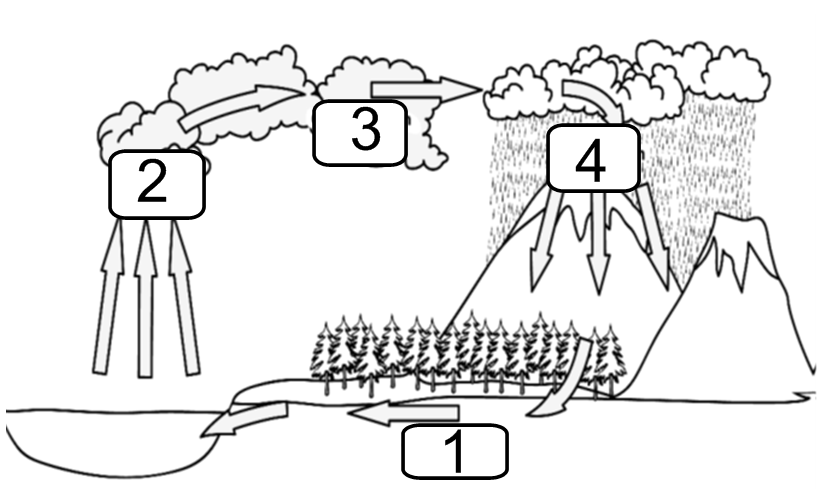
What part of the water cycle does this picture show?
a)
condensation
b)
precipitation
c)
evaporation
36.
What is it called when plants give off water vapor as a waste product?
a)
condensation
b)
evaporation
c)
sublimation
d)
transpiration
37.
Which of these is an example of precipitation?
a)
snow
b)
air
c)
clouds
d)
vapor
38.
What comes after evaporation during the water cycle?
How does this occur?
a)
Water evaporates into water vapor
b)
Water vapor condenses and forms a  cloud
c)
Water precipitates to the ground
d)
Water runs down into the hydrosphere
39.
The ________ is the driving force of the earth's surface.
a)
sun
b)
moon 
c)
stars
40.
Which stage does the #2 show in the diagram?
a)
condensation
b)
evaporation
c)
precipitation
d)
run off
41.
The water cycle is also known as ..........
a)
Hypertonic Solution
b)
Hydrological Cycle
c)
Hyperlogical Cycle
d)
None of these
42.
Which of these sets of three items produce CFCs
a)
cars, factories, and cardboard
b)
spray cans, cardboard, insulation
c)
spray cans, refrigerant, cardboard
d)
spray cans, refrigerant, insulation
43.
What absorbs ultraviolet rays in the atmosphere?
a)
troposphere
b)
stratosphere
c)
ozone layer
d)
greenhouse gases
44.

Where is the "GOOD" ozone located?

a)

troposphere

b)

stratosphere

c)

mesosphere

d)

thermosphere

45.
The Montreal Protocol banned the use of CFCs. What so they hope this will do for the ozone layer?
a)
Deplete it completely
b)
Make the ozone hole smaller
c)
Make the ozone hole larger
d)
Thin the layer to allow more gas to escape
46.

The "BAD" ozone is located in the

a)

troposphere

b)

stratosphere

c)

mesosphere

d)

exosphere

47.

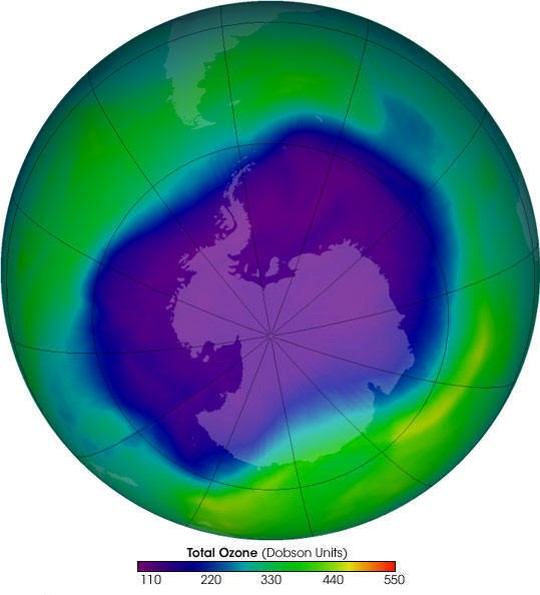
Location of the large whole in the ozone.

a)

Antarctica

b)

Artic

c)

Iceland

d)

Africa

48.

Which of the following best exemplifies global collaboration for a sustainable environment by reducing the impacts of “ozone” ?

a)

The Montreal Protocol

b)

The Antarctic treaty of 1961

c)

The Clean air act of 1972

d)

CERCLA (superfund)

49.

Ground level ozone is created mostly by-

a)

burning fuel for cooking

b)

producing electric power

c)

industrial emissions

d)

motor-vehicle exhaust

50.

As the amount of ozone in the stratosphere decreases

a)

more ultraviolet light is able to reach Earth's surface.

b)

less solar energy is able to reach Earth's surface.

c)

the amount of methane in the atmosphere increases.

d)

the amount of phytoplankton in the ocean increases.