
 Worksheets
Africa pt 2
Total questions: 60
Worksheet time: 3hrs 10mins
Name
Class
Date
1.
Axum owed much of its prosperity to
a)
the city of Meroe.
b)
its gold trade.
c)
its export of salt.
d)
its location along the Red Sea.
2.
Many African societies were matrilineal, meaning
a)
women were the warriors
b)
women could travel alone
c)
descent was traced through the mother
d)
women could vote
3.
In many early African civilizations, music and storytelling were
a)
used to pass along a community's history in the absence of a written language.
b)
disregarded as unworthy occupations south of the Sahara.
c)
considered very holy acts, and only the priests and priestesses were allowed to engage in them.
d)
the highest form of art by the Nok people of the Niger River.
4.
Ancestors were a key element in African religion because
a)
it was believed that one's ancestors became gods after death.
b)
the ancestors were believed to be closer to the gods.
c)
all ancestors could be traced back to one lineage group.
d)
it was believed ancestors could participate in warfare.
5.
The official religion of Axum by around AD 300 was
a)
Islam, which was founded shortly after the Axumite civilization rose to power
b)
Judaism, which was discovered through trade with Israel.
c)
Christianity, which was first brought by shipwrecked Syrians.
d)
the worship of over a hundred gods.
6.
The people of Ghana often traded their gold for
a)
iron, out of which they would fashion highly desired tools and weapons.
b)
salt, which was used to preserve food and improve its taste.
c)
camels, so they did not hav eto rely on the Berbers to transport their goods.
d)
peanuts, from which they made delicious foods.
7.
The Bantu communities were based on
a)
subsitstence farming, which meant they grew crops for personal use, not for trade.
b)
the transport of goods by camel caravans across the deserts between trading cultures.
c)
gold mining.
d)
the fundamentals of Christianity, which they learned from shipwrecked Syrian sailors.
8.
Which of the following is not located in Western and Central Africa?
a)
Nile Basin
b)
Niger Basin
c)
Chad Basin
d)
Congo Basin
9.
southern portion of West Africa has this type of biome
a)
Gallary Forest
b)
Desert
c)
River
d)
Tropical Forest
10.
The Kingdom of Kilwa made their wealth through trading which two items?
a)
Gold and Silver
b)
Gold and Ivory
c)
Gold and Steel
d)
Gold and Jewlery
11.
The Empire of Axum traded which THREE items to gain wealth?
a)
Fish, timber, and Gold
b)
Ivory, Silver, and Sugar
c)
Ivory, Frankincense, and Mrryh
d)
Gold, Silver, and Diamonds
12.
Which Kingdom replaced the Empire of Axum?
a)
Congo
b)
Zimbabwe
c)
Ethopia
d)
Kilwa
13.
Which Empire established Christianity as their official religion?
a)
Axum
b)
Benin
c)
Zimbabwe
d)
Ethopia
14.
Which language was developed in Kilwa?
a)
French
b)
Spanish
c)
Swahili
d)
Germant
15.
The empire of Zimbabwe was named after what?
a)
The man who founded it
b)
The people who lived there
c)
The stone wall that protected the empire
d)
The most common food prepared there
16.
How did the empire of Zimbabwe make their wealth?
a)
By conquering other empires
b)
By selling luxury clothing
c)
By killing all of its citizens
d)
By taxing the gold it produced
17.
The Benin Empire was founded near what river?
a)
Nile
b)
Africa
c)
Congo
d)
Niger
18.
What happened by 1450 in Zimbabwe?
a)
They had used up all their resources
b)
They all were dead
c)
They all decided to move away
d)
They all lived there for 5 million years
19.
The Benin king was called an?
a)
Aba
b)
Eba
c)
Oba
d)
Iba
20.
Which civilization was known for art sculptures made of wood, Bronze and Ivory?
a)
Benin
b)
Axum
c)
Ethopia
d)
Kilwa
21.
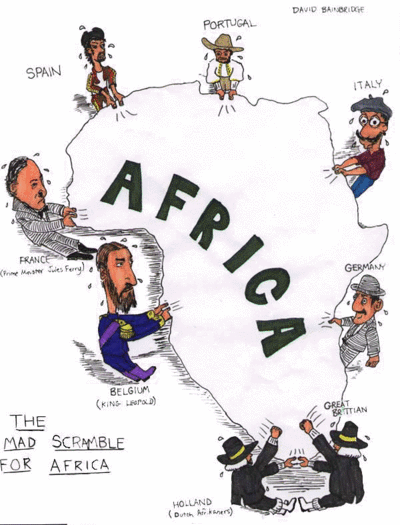
What is imperialism?
a)
Kings ruling over their kingdom
b)
Taking over a country economically, politically, and culturally
c)
The Empire's military
d)
When you think you are better than someone else.
22.

What was apartheid?
a)
equality for all
b)
western-style democracy
c)
constitutional monarcy
d)
segregation of races
23.

What was Nelson Mandela's attitude towards the people who supported apartheid laws in South Africa?
a)
he believed they should be punished for their actions
b)
he wanted to unite all races in South Africa
c)
he wanted to turn over those leaders to the nsUnited Natio
d)
he forced those leaders out of the country
24.
What conference was called to make rules about colonizing Africa?
a)
Munich Conference
b)
Paris Conference
c)
Berlin Conference
d)
London Conference
25.
Person who flees their home, usually due to natural disaster or political upheaval.
a)
Human Migration
b)
Immigrant
c)
Emigrant
d)
Refugee
26.
What is the name of the group of boys that Salva leads to Kenya?
a)
The Lost Boys
b)
The Loners
c)
The Rascals
d)
The Dirt Sleepers
27.
What did the Berlin Conference do?
a)
Divided Africa based on ethnicity
b)
Divided Africa based on resources
c)
Divided India based on resources
d)
Divided Africa based on negotiations with chiefs
28.
Exchange goods without involving money.
a)
borrow
b)
World Bank
c)
coup
d)
barter
29.
A soldier who is paid to fight in a foreign army.
a)
mercenary
b)
militia
c)
guerilla
d)
refugee
30.
Belief that objects, such as plants and stones, or natural events, like thunderstorms and earthquakes, have a discrete spirit and conscious life.
a)
animism
b)
catholism
c)
ancestor worship
d)
buddhism
31.
Honoring ancestors through rituals, such as offering food and wine to the dead.
a)
old people worship
b)
African worship
c)
ancestor worship
d)
ancestor party
32.
The sudden overthrow of a ruler or govenrment.
a)
delta
b)
forage
c)
election
d)
coup
33.
Which European country had control of Central African Republic from 1894 to 1960?
a)
Britain
b)
Germany
c)
Italy
d)
France
34.
The main export in Central African Republic is:
a)
Coffee
b)
Diamonds
c)
Peanuts
d)
Jujubes
35.
Which of the following are human rights issues in Central African Republic?
a)
child labour
b)
human trafficking
c)
discrimination against women
d)
ALL of the options
36.
What is slash-and-burn farming?
a)
burning oil runoff on rivers
b)
cutting the GDP of a country to promote economic growth
c)
clearing trees/vegetation and burning them to create a fertilizing layer of ash for the soil
37.
What region in Africa is most vulnerable to desertification?
a)
Sahel
b)
Savanna
c)
Sahara
d)
Tropical Rainforest
38.
Which region in Africa is most vulnerable to deforestation?
a)
Sahel
b)
Sahara
c)
Savanna
d)
tropical rainforest
39.
Apartheid began in:
a)
1919
b)
1939
c)
1948
d)
1951
40.

What was the Boer War?
a)
A series of conflicts that took place between the wild pigs and hogs of South Africa.
b)
A conflict that resulted in the British taking control of South Africa.
c)
The informal name of the worker strikes that occurred in the gold mines of South Africa.
d)
A war that took place between the blacks and whites of South Africa.
41.

What does the term Afrikaner refer to?
a)
A term for a black person who is living in the white controlled areas of South Africa.
b)
The type of sailing ship used by Portuguese explorers who originally charted the coast South Africa.
c)
Native farmers who work the arid land of South Africa. Known for their ability to travel long distances.
d)
South African ethnic group that is descended from European colonists.
42.
Lesotho and Swaziland, two counties located inside of South Africa are known as:
a)
Cities
b)
Enclaves
c)
Islands
d)
Isthmus
43.

The domestication of the camel....
a)
increased trade across the Sahara desert
b)
decreased trade across the Sahara desert
c)
provided a source of protein in the African diet
d)
gave horses a vacation
44.

The grasslands that cover about 40 percent of Africa’s land area
a)
Sahara
b)
Swahili
c)
savanna
d)
plateau
45.

A sailboat with special triangle shaped sails used by Muslim traders to sail along the east coast of Africa
a)
dhow
b)
pontoon
c)
speedboat
d)
dinghy
46.

Describe the Swahili culture
a)
A religion and language mixed with african and hindu
b)
A religion and language mixed with african and buddhism
c)
A religion and language mixed with african and Islam
d)
A religion and language mixed with just african culture
47.
What is a society based upon the bonds of tribe or kinship in Africa called?
a)
Trading states
b)
civilizations
c)
griots
d)
stateless societies
48.
What Arab traveler wrote about the glories of King Sundiata of Mali?
a)
Ibn Battuta
b)
Ibn Kaldun
c)
Mansa Musa
d)
Sudan
49.
What was the great city of Mali that had a mosque, a university and was a great trading center?
a)
Sunni Ali
b)
Songhay
c)
Timbuktu
d)
Hausa
50.
The Boers were independent ____________.
a)
carpenters
b)
roofers
c)
blacksmith
d)
farmers
51.
Two issues that South Africa has to deal with now are....
a)
Gold Rush and mining
b)
Ebola and lions
c)
technology and recession
d)
diseases and recession
52.
The discovery of what changed South Africa's economy?
a)
iron and silver
b)
water and oil
c)
diamonds and gold
d)
copper and mercury
53.

Who were the first Europeans to interact with South Africa?
a)
Portuguese explorer Bartolomeu Dias, who sailed around the Horn of Africa in search of a trade route to India.
b)
Dutch traders who established coastal trade cities and began to farm the land.
c)
Great Britain, which began to conquer South Africa after the discovery of gold.
d)
Belgian slave traders that began to capture and export the South African people.
54.

What was the importance of the Sharpeville Massacre?
a)
Allowed the British to gain the military advantage during the Boer War.
b)
After their worst loss in South African history, the Sharpeville rugby team finally allowed blacks to join the team.
c)
Brought attention to the racial inequalities in South Africa.
d)
African natives massacred the first Portuguese explorers who arrived in South Africa, convincing them to not colonize the area for over 100 years.
55.

Who was Hendrik Verwoerd?
a)
Fought against apartheid and was put into prison. First black president of South Africa.
b)
South African college professor and prime minister of South Africa. Creator of apartheid.
c)
South African president who ended apartheid. Freed many blacks who were imprisoned for protesting the apartheid government.
d)
South African Rugby Team Captain. Became a symbol of unity between the blacks and whites of South Africa.
56.

Who was F. W. de Klerk?
a)
Fought against apartheid and was put into prison. First black president of South Africa.
b)
South African college professor and prime minister of South Africa. Creator of apartheid.
c)
South African president who ended apartheid. Freed many blacks who were imprisoned for protesting the apartheid government.
d)
South African Rugby Team Captain. Became a symbol of unity between the blacks and whites of South Africa.
57.

Who was Francois Pienaar?
a)
Fought against apartheid and was put into prison. First black president of South Africa.
b)
South African college professor and prime minister of South Africa. Creator of apartheid.
c)
South African president who ended apartheid. Freed many blacks who were imprisoned for protesting the apartheid government.
d)
South African Rugby Team Captain. Became a symbol of unity between the blacks and whites of South Africa.
58.

What does ANC stand for?
a)
African National Convention - meeting where South African leaders and politicians gather every year to discuss ways to heal the racial divide.
b)
Association of Native Cultures - a cultural festival that celebrates the different ethnic groups that were present in South Africa before Europe controlled it.
c)
African National Congress - a political party formed in 1911 to give blacks a voice in the South African government.
d)
Awesome New Contagion - a recently discovered bacterial infection that causes projectile vomiting in students who don't pay attention in social studies class.
59.

What is Cape Town?
a)
A town that serves as a safe haven from the wild boars that routinely rampage across the countryside.
b)
A European controlled town that served as a slave fortress, and exported tens of thousands of Africans to South America. After slavery was abolished, it became the colonial capital.
c)
A classification or type of town that commonly arose along the Cape of Africa to mine the gold deposits discovered there. Were commonly used as centers of law and administration.
d)
A city that arose along the coast as a result of European trade. Became a center for the anti-apartheid movement. Capital of South Africa when it was a colony.
60.

What is Johannesburg?
a)
Means "John's Home," the capital building and personal residence of the president of South Africa. Similar to the White House.
b)
A city that was established in 1886 following the discovery of gold in the area. Location of the 1995 Rugby World Cup Final.
c)
A rural farming community that became a center of anti - apartheid activity in the mid 1900's.
d)
A coastal trade town that was established by Bartolomeu Dias in 1488.
100 %

