wayground logo

Free Printable Worksheets

NEW

Font size

S
M
L
XL
Worksheets

Y8 Reactivity

Total questions: 48

Worksheet time: 30mins

Name
Class
Date
1.
In an exothermic reaction, heat is ...
a)
taken in or absorbed
b)
given out or released
2.
In an endothermic reaction, heat is ...
a)
taken in or absorbed
b)
given out or released 
3.
Exothermic reactions...
a)
Absorb energy
b)
Release energy
c)
Release Color
d)
Absorb Color
4.
If a chemical reaction is EXOTHERMIC, the temperature would....
a)
Stay the same
b)
Increase
c)
Decrease
5.
In any chemical reaction, the mass of the products is always:
a)
slightly less than the mass of the reactants
b)
much less than the mass of the reactants
c)
the same as the mass of the reactants
d)
greater than the mass of the reactants
6.
How do chemical reactions turn substances into new substances?
a)
with burning acid
b)
the molecules mix together and create new substances
c)
the atoms break apart and combine back together in new ways
d)
the ionic compounds mix in water to form solutions
7.
metal + acid →
a)
salt + hydrogen gas
b)
salt
c)
salt + water
d)
no reaction is formed
8.
In an equation, the chemicals you start with (left side) are called ________.
a)
products
b)
reactants
9.
In an equation, the chemicals you end with (right side) are called ________.
a)
products
b)
reactants
10.
How are metal oxides formed?
a)
When metals react with oxide.
b)
When metals react with water.
c)
When metals react with air.
d)
When metals react with oxygen.
11.
Which of the following reactions produces calcium oxide?
a)
calcium and oxide
b)
calcium and water
c)
calcium and air
d)
calcium and oxygen
12.
Which of the following defines oxidation?
a)
A chemical reaction where a substance gains oxygen.
b)
A chemical reaction where a substance loses oxygen.
c)
A chemical reaction where a substance loses a metal.
d)
A chemical reaction where a substance gains a metal.
13.
Metals feel heavy for their volume (space they take up)
a)
Low density
b)
High density
c)
Conductivity
d)
Malleability
14.
The blue elements are called 
a)
metals
b)
nonmetals
c)
metalloids
d)
noble gases
15.
Which is a property of a metal?
a)
It is brittle
b)
It is a good insulator
c)
It has a dull appareance
d)
It is malleable
16.
How easily electricity or heat passes through an object is
a)
ductility
b)
malleability
c)
conductivity
d)
brittle
17.
Steel is a mixture of iron and ...
a)
Copper
b)
Cobalt
c)
Carbon
d)
Chromium
18.
The elements argon, krypton, and xenon are all non-metals. What property would these elements have in common?
a)
Good conductor of thermal energy
b)
Poor conductor of electricity
c)
Shiny, lustrous surface
d)
Soft and malleable
19.
Which property means that a substance breaks easily in its solid state?
a)
Malleable
b)
Ductile
c)
Brittle
d)
Conductor
20.
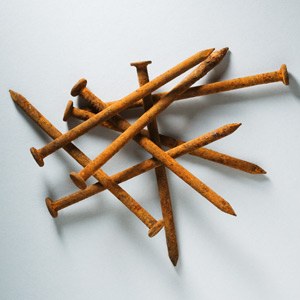
This is an example of .................
a)
Corrosion: rusting
b)
Corrosion, but not rusting
c)
Corundum
d)
Radicalisation
21.
Which element rusts?
a)
carbon
b)
iron
c)
manganese
d)
potassium
22.
Which one of the following would result in a displacement reaction?
a)
iron with magnesium chloride
b)
magnesium with iron chloride
c)
iron with zinc sulphate
d)
gold with silver nitrate
23.
A displacement reaction will occur when...
a)
A more reactive metal displaces a less reactive metal from its compound.
b)
A less reactive metal displaces a more reactive metal from its compound
c)
Displacement only occurs when two of the same metals are reacted 
d)
Displacement reactions will only occur in metals above iron in the reactivity series
24.
calcium + zinc nitrate →
a)
Calcium + zinc nitrate 
b)
Zinc + calcium nitrate
c)
there will be no reaction
d)
Zinc + calcium chloride
25.
What is made when magnesium reacts with hydrochloric acid?
a)
magnesium nitrate and hydrogen gas
b)
magnesium sulfate and hydrogen gas
c)
magnesium oxide and oxygen gas
d)
magnesium chloride and hydrogen gas
26.
Which of the following will not undergo reaction?
a)
iron metal  +  zinc oxide 
b)
iron metal  +  copper oxide
c)
zinc metal +  iron oxide
d)
magnesium  +  iron oxide
27.
Metals that react quickly/strongly with water and acids are called?
a)
Reactive
b)
Unreactive
c)
Dangerous
d)
Corrosive
28.
Which gas is required for something to burn?
a)
Carbon dioxide 
b)
Hydrogen 
c)
Oxygen 
d)
Water 
29.
What environmental element assists rusting?
a)
nitrogen
b)
carbon
c)
oxygen
d)
hydrogen
30.
When joining railway tracks, which element could be added to iron oxide to cause a displacement reaction that produces molten iron?
a)
iron powder
b)
copper powder
c)
aluminium powder
d)
lead powder
31.

The positive gas test result for a lit splint in hydrogen is:

a)

a squeaky pop

b)

the flame will reignite

c)

the flame will extinguish

d)

no change

32.

Which acid is used to produce the salt copper sulphate?

a)

hydrochloric acid

b)

sulphuric acid

c)

nitric acid

d)

acetic acid

33.
Which of the following is not a compound?
a)
HCl
b)
Cl
c)
NaCl
d)
CO2
34.

A chemical combination of two or more elements

a)

element

b)

liquid

c)

solid

d)

compound

35.

Carbon is considered an element, while carbon dioxide is considered a compound. This is because carbon dioxide is ---

a)

a gas at room temperature.

b)

made of two different elements.

c)

given off by green plants.

d)

useful to human beings

36.
Is sugar (C12H22O11) an element or a compound?
a)
Element
b)
Compound
37.

What is the difference between Co and CO?

a)

CO is an element but Co is a compound

b)

Nothing is different. They are the same thing.

c)

CO is two elements and Co is only one element

d)

Co is not a pure substance

38.

Products of a neutralisation reaction are always

a)

an acid and a base

b)

an acid and a salt

c)

salt and water

d)

salt and base

39.

The reaction between an acid and an alkali

produces salt and water. This reaction is called

a)

acidication

b)

neutralisation

c)

alkalisation

40.

Sulphuric acid + potassium hydroxide --> ........................ + water

a)

potassium sulphate

b)

potassium sulphurate

c)

potassium nitrate

d)

magnesium hydroxide

41.
products of a neutralisation reaction are always
a)
an acid and a base
b)
an acid and a salt
c)
salt and water
d)
salt and base
42.

Which of the following is the most reactive in dilute acid

a)

magnesium

b)

calcium

c)

aluminum

d)

zinc

43.
Which metal is more reactive than calcium?
a)
magnesium
b)
potassium
c)
silver
d)
aluminum
44.

Will silver react with magnesium chloride solution?

a)

yes

b)

no

45.
Which of the following is NOT a clue that a chemical change has occurred?
a)
change in color
b)
production of gas
c)
change in termperature
d)
change in shape
46.
Complete the equation below. 
Iron + Oxygen --> 
a)
Iron oxygen
b)
Iron oxide
c)
Iron oside
d)
Ion oxide
47.

What are the two non-metals that are included in the reactivity series of metals?

a)

Hydrogen and iron

b)

Oxygen and lead

c)

Tin and carbon

d)

Carbon and hydrogen

48.

Which metal reacts slowest with acid?

a)

Copper

b)

Iron

c)

Zinc

d)

Magnesium