wayground logo

Free Printable Worksheets

Font size

S
M
L
XL
Worksheets

relative age, absolute age, and geologic time

Total questions: 86

Worksheet time: 1hrs 24mins

Name
Class
Date
1.
In order for an event to affect a rock, the rock must exist first.
a)
True
b)
False
2.
Geologic features, such as faults, and igneous intrusions are younger than the rocks they cut because the events like folding and faulting must occur first before a rock can exist.
a)
True
b)
False
3.
The shorter the timespan that species existed, the more precisely the index fossil reflects the age of the rock.
a)
True 
b)
False
4.
If one rock body contains fragments of another rock body, it must be younger than the fragments of rock it contains.
a)
True
b)
False
5.
What does a disconformity in a sedimentary rock sequence represent?
a)
A. Gap in the rock record
b)
B. Volcanic Eruption
c)
C. Duplicated strata in the rock record
d)
D. Flood event
6.
Which of the following happened most recently?
a)
A. Deposition of Unit C
b)
B. Deposition of Unit B
c)
C. Deposition of Unit F
d)
D. Tilting of C, D, E, and F
7.
a)
A-D-C-B-E
b)
B-E-C-D-A
c)
A-B-E-C-D
d)
A-C-B-E-D
8.
a)
C-E-D-B-A
b)
A-B-D-E-C
c)
A-D-B-E-C
d)
D-A-B-E-C
9.
According to the law of superposition, which layer is the youngest?
a)
A
b)
B
c)
C
10.
Which rock layer in the diagram seems to be the oldest?
a)
F
b)
E
c)
B
d)
A
11.
According to the law of superposition, the oldest fossils are found 
a)
At the top of the rock layers
b)
Near the bottom of the rock layers
c)
In the middle of the rock layers
d)
Somewhat near the surface
12.
If an index fossil is found in two rock layers that are separated by an ocean, what do you know about the relationship between the two rock layers?
a)
they are about the same age
b)
both areas were dry
c)
the are made of the same kind of rock
d)
the rock layers are unrelated
13.
Gaps in rock layers caused by erosion are called.
a)
law of superposition
b)
unconformities
c)
uniformitarianism
d)
relative dating
14.
The process by which running water, wind, or ice carry away bits of broken-up rock
a)
weathering
b)
sedimentation
c)
erosion
d)
cementation
15.
A break in the Earth's crust 
a)
fault 
b)
mountain
c)
plate
d)
fossil 
16.
What geological feature is being shown?
a)
fault with folding
b)
contact metamorphism
c)
nonconformity
d)
angular unconformity
17.
Older rocks contained within newer rocks are called...
a)
intrusions
b)
inclusions
c)
fossils
d)
faults
18.
The Principle of Cross-Cutting Relationships states that an igneous intrusion is 
a)
always younger than the layers it cuts across
b)
always older than the layers it cuts across
c)
the same age as the rock it melted
d)
none of the answers are correct
19.
The statement that the oldest layer will be at the bottom in an undisturbed sequence of rock layers is called the Principle of ....
a)
Inclusions
b)
Unconformities
c)
Cross-Cutting Relationships
d)
Superposition
20.
_______________ is the idea that older rock layers can be found below younger rock layers in undisturbed geologic columns.
a)
principal of original horizontality
b)
principal of superposition
c)
principal of cross-cutting relationships
d)
principal of unconformities
21.
Which of the following is an index fossil?
a)
brachiopods
b)
tyrannosaurus rex
c)
coprolites
d)
trilobites
22.
Which comes first a mold or a cast fossil?
a)
mold
b)
cast
23.
___________ states that the earth has changed gradually over long periods of time.
a)
uniformitarianism
b)
catrastorphism
c)
superposition
d)
disconformities
24.
Most fossils are found in __________ rock layers
a)
metamorphic
b)
sedimentary
c)
igneous
25.
_________ fossils can be found in tar, amber, deserts, and ice.
a)
trace
b)
original remains
c)
petrified
d)
cast
26.
A fault is always _________ than the layers of sedimentary rock it cuts through.
a)
older than
b)
younger than
c)
the same age as
27.
___________ are scientists that study fossils to determine Earth's history.
a)
archeologists
b)
biologists
c)
botanists
d)
paleontologists
28.
As the number of half-lives pass the amount of parent material ________.
a)
remains constant
b)
increases
c)
decreases
29.
Which of the following is a false statement about why the fossil record is incomplete?
a)
most organisms never become fossilized
b)
many fossils have never been found
c)
all fossils are of dinosaurs
d)
only the hard parts of organisms are easily fossilized
30.
What makes using radioactive material useful for dating rock layers?
a)
it is dangerous to be near
b)
it decays at a constant rate
c)
sedimentary rock layers don't have radioactive material
d)
it can only be found in metamorphic rock
31.
Different versions of an element formed with various numbers of neutrons are called
a)
daughter material
b)
radioactive elements
c)
isotopes
d)
parent material
32.
14C dating is formally known as
a)
radiocarbon dating
b)
dendrochronology
c)
isotopic decay dating
d)
relative-age dating
33.
14C decays radioactively because it has 8 neutrons and 6 protons.  It converts one of its neutrons into a proton and becomes
a)
13C
b)
15C
c)
14N
d)
15N
34.
If an organism is to be fossilized, which of the following would help provide idea conditions?
a)
quick burial of the organism
b)
warm climate
c)
humid climate
d)
lack of hard parts
35.
Certain fossils existed all over the world, but only for a short period of geologic time.  If a geologist finds this fossil in a layer of rock, he/she will be able to tell how old that rock layer is.  These are called
a)
casts
b)
imprint fossils/ molds
c)
index fossils
d)
radiometric fossils
36.
What type of fossil will form if this scenario takes place? Organic material is buried. Then silicate minerals slowly invade the material and replace the cell walls and membranes.
a)
cast
b)
mold/imprint fossil
c)
index fossil
d)
petrified organism
37.
What is it called when organic material is squeezed under pressure and the gases and liquids from the organic material leave a thin carbon residue on the rock?
a)
imprint fossils/molds
b)
casts
c)
carbonization
d)
index fossils
38.
The amount of time it takes for 50% of the remaining radioactive parent material to decay into stable daughter material is called
a)
radiocarbon dating
b)
radioactive decay
c)
half-life
d)
successive decay time
39.
What are the remains of once living things called?
a)
amber
b)
fossils
c)
species
d)
extinct
40.
What do you call hardened tree sap?
a)
amber
b)
species
c)
mutation
d)
anthropology
41.
This is when living species can no longer can be found or died off?
a)
mutation
b)
species
c)
amber
d)
extinct
42.
In order for a fossil to form, which of the following events must happen FIRST?
a)
Slowly, minerals in the water replace the bone.
b)
Sediment covers the bone.
c)
An animal dies.
d)
The bone is no longer a bone, but a rock copy.
43.
What type of fossil is this?
a)
Trace fossil
b)
Mold
c)
Cast
d)
Carbon film
44.
The __________ tells the history of life, past environments on Earth, and how different organisms have changed over time.
a)
fossil record
b)
law of superposition
c)
absolute age
d)
relative dating
45.
The first step in developing the geologic time scale was studying layers and index fossils worldwide.
a)
true
b)
false; the geologic time clock
46.
According to scientists, both Earth and the moon are
a)
about 1.6 billion years old
b)
about 4.6 billion years old
c)
about 9.6 billion years old
d)
about 14 billion years old
47.
The Triassic, Jurassic, and Cretaceous periods occurred in the ___________ Era.
a)
Paleozoic
b)
Cenozoic
c)
Mesozoic
48.
The earliest form of life known on Earth was 
a)
leafy plants
b)
bacteria
c)
fossils
d)
one-celled organisms
49.
During which Era appeared the earliest reptiles?
a)
Cenozoic
b)
Paleozoic
c)
Mesozoic
d)
Precambrian
50.
During which Era appeared the earliest dinosaurs?
a)
Cenozoic
b)
Paleozoic
c)
Mesozoic
d)
Precambrian
51.
During which Era appeared the earliest Humans?
a)
Cenozoic
b)
Paleozoic
c)
Mesozoic
d)
Precambrian
52.
When the Mesozoic Era begin?
a)
65 million years ago
b)
in 65 million years
c)
225 million years ago 
d)
Actually it hasn't began yet
53.
The Cenozoic Era: When did it start?
a)
125 million years ago
b)
65 million years ago
c)
A long time ago
d)
4.5 billion years ago
54.
What time Era do we live in?
a)
Triassic
b)
Cenozoic
c)
Paleozoic
d)
Tertiary
55.
Which of the Eras lasted for the longest period of time? 
a)
Paleozoic
b)
Precambrian
c)
Mesozoic
d)
Cenozoic
56.
Which of these choices is an example of the way a geologist would use relative dating?
a)
determining the minerals that make up rocks
b)
placing rock layers in order of oldest to youngest
c)
classifying rocks as igneous, sedimentary, or metamorphic 
d)
using radioactive isotopes to determine the exact age of rock samples 
57.
Which of the following provides the most useful information for determining the absolute ages of rocks?
a)
Half life of radioactive elements
b)
Relative positions of rock layers 
c)
Measurements of fossil bones 
d)
Chemical analysis of crystals 
58.
The idea that the same geologic processes that slowly shape Earth today have always shaped Earth. 
a)

Change Theory 

b)

Uniformitarianism 

c)

Catastrophism 

d)

Predictability 

59.
Which of the following correctly lists the layers in order from oldest to youngest?
a)
A, B, C, D, E
b)
E, B, C, D, A
c)
E, D, C, B, A
d)
C, B, A, D, E
60.
Trilobites are good index fossils because.... (pick the best answer).
a)
abundant, large
b)
abundant, widespread geographically, and only lived a short time
c)
only lived for a short time period
d)
were large
carbonized
61.
This type of fossil forms when sediments bury an organism and then sediments change into rock; the organism decays leaving a cavity in the shape of the organism.
a)
mold
b)
cast
c)
petrified
d)
trace
62.
A woolly mammoth or ancient hominid might be found in frozen tundra such as the arctic circle. This type of fossil would be
a)
preserved or original remains
b)
permineralized or petrified
c)
carbonized or carbon film
d)
trace
63.
Remains of animals can be preserved by preventing them from decaying. What substances might help preserve parts or a whole animal
a)
tar, amber, ice
b)
ice, carbonization, trace
c)
rock, amber, ice
d)
tar, carbonization, rock
64.
This type of fossil is formed from dung or waste materials and allows scientists to infer the feeding habits of ancient animals.
a)
gastroliths
b)
coprolites
c)
halites
d)
chemo-synthesis
65.
Most fossils are found in __________ rock layers
a)
metamorphic
b)
sedimentary
c)
igneous
66.

Pangaea refers to a...

a)

large supercontinent

b)

Greek superhero

c)

Tropical fern

d)

Mass extinction

67.
The Geologic Time Scale is a record of what?
a)
old geologists
b)
sweet geology music
c)
the known history of rocks and fossils
d)
a list of every living thing ever
68.
What type of fossil is pictured? 
a)
cast
b)
petrified fossil
c)
preserved remains
d)
trace fossil
69.
What word do we use to describe a species which has no members still living?
a)
endangered
b)
extinct
70.
The soft parts of organisms are most likely to become fossils. 
a)
True
b)
False
71.
2. Which type of fossil is this?
a)
Body Fossil
b)
Trace Fossil
72.

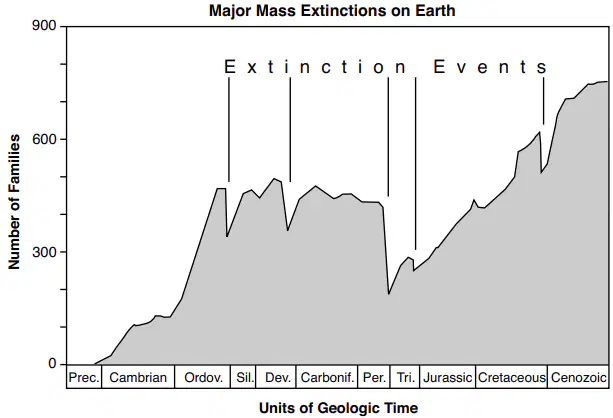
The graph shows the number of families (groups of closely related species) represented in the fossil record and five major mass extinction events in Earth’s history. Which group of living organisms survived all five major mass extinctions?

a)

ammonoids

b)

graptolites

c)

brachiopods

d)

trilobites

73.

What is a group of organisms that reproduces only with other members of their own groups called?

a)

Spaces

b)

People

c)

Species

d)

Animals

74.

What is an eon?

a)

longest subdivision in the geologic time scale that is based on the abundance of certain types of fossils and is subdivided into eras, periods, and epochs

b)

longest subdivision in the geologic time scale that is based on the abundance of certain types of rocks and is subdivided into eras, periods, and epochs

c)

longest subdivision in the geologic time scale that is based on the abundance of certain types of rivers and is subdivided into eras, periods, and epochs

d)

longest subdivision in the geologic time scale that is based on the abundance of certain types of geologic structures and is subdivided into eras, periods, and epochs

75.

What is the Mesozoic Era?

a)

Era that is known as "Middle era" of Earth's history

b)

Era of the Dinosaur

c)

Era when Pangaea broke apart

d)

All of the above

76.

Longest part of Earths history (it contained 90% of Earth's history)

a)

Cambrian

b)

Precambrian

c)

Phaenorozoic

d)

Cenozoic

77.

Largest extinction in Earth's history

a)

Cambrian

b)

Ordovician

c)

Devonian

d)

Permian

78.

Largest time division in Earth's history- Hadean was the first and we live during the Phanerozoic

a)

Epoch

b)

Era

c)

Eon

d)

Period

79.

A major division of geologic time, our Phanerozoic Eon is divided into three of these

a)

Epoch

b)

Eon

c)

Era

d)

Period

80.

All the geologic time before the start of the Cambrian Period in the Paleozoic Era.

a)

Cambrian

b)

Precambrian

c)

Proterozoic

d)

Phanerozoic

81.

Numerous fishes, other sea life; many plants, first trees; wingless insects appeared when?

a)

Ordovician

b)

Devonian

c)

SIlurian

d)

Cretaceous

82.

Oldest and longest geologic time period

a)

Hadean

b)

Phanerozoic

c)

Precambrain

d)

Jurassic

83.

Subdivisions of eras

a)

Eon

b)

Epoch

c)

Period

84.

What are the two characteristics necessary for a fossil to be classified as an index fossil?

a)

lived for a short amount of time and was widespread

b)

lived for a long amount of time and was widespread

c)

lived for a short amount of time in a small area

d)

lived for a long amount of time in a small area

85.

A period of rapid change on Earth when the ancestors of most animal groups emerged; marked the start of the Paleozoic era.

a)

Animal explosion

b)

Primordial explosion

c)

Mesozoic explosion

d)

Cambrian explosion

86.

During which era were dinosaurs the dominant land animals?

a)

Precambrian

b)

Paleozoic

c)

Mesozoic

d)

Cenozoic