
 Worksheets
Test Review
Total questions: 60
Worksheet time: 1hrs 16mins
Name
Class
Date
1.
Where you will find the ozone layer.
a)
stratosphere
b)
thermosphere
c)
exosphere
d)
mesosphere
2.
Where weather occurs.
a)
stratosphere
b)
thermosphere
c)
troposphere
d)
mesosphere
3.
The only layer that contains water vapor and carbon dioxide.
a)
stratosphere
b)
thermosphere
c)
troposphere
d)
mesosphere
4.
Where we live.
a)
stratosphere
b)
thermosphere
c)
troposphere
d)
mesosphere
5.
Considered to be a part of the thermosphere.
a)
ionosphere
b)
thermosphere
c)
troposphere
d)
mesosphere
6.
The coldest layer.
a)
troposphere
b)
thermosphere
c)
exosphere
d)
mesosphere
7.
The hottest layer.
a)
troposphere
b)
thermosphere
c)
exosphere
d)
mesosphere
8.
Where satellites orbit.
a)
troposphere
b)
thermosphere
c)
exosphere
d)
mesosphere
9.
Where you will find Aurora Borealis (Northern Lights)
a)
troposphere
b)
ionsophere
c)
exosphere
d)
mesosphere
10.
The most common gas in the atmosphere (78%).
a)
Nitrogen
b)
Oxygen
c)
Carbon Dioxide
d)
Trace gases
11.
Which order is correct from the earth to space?
a)
thermosphere
troposphere
exosphere
mesosphere
stratosphere
ionosphere
troposphere
exosphere
mesosphere
stratosphere
ionosphere
b)
thermosphere
troposphere
stratosphere
exosphere
mesosphere
ionosphere
troposphere
stratosphere
exosphere
mesosphere
ionosphere
c)
exosphere
ionosphere
thermosphere
mesosphere
stratosphere
troposphere
ionosphere
thermosphere
mesosphere
stratosphere
troposphere
d)
troposphere
thermosphere
troposphere
stratosphere
exosphere
mesosphere
thermosphere
troposphere
stratosphere
exosphere
mesosphere
12.
What two gases are found throughout all layers of the atmosphere?
a)
Nitrogen and carbon dioxide
b)
Nitrogen and oxygen
c)
Oxygen and carbon dioxide
d)
Trace gases and water vapor
13.
What does the earth's atmosphere do?
a)
help to regulate the temperature on Earth
b)
Help UV rays to reach the Earth's surface
c)
Creates meteors in the sky
d)
Keep ocean waters cold
14.
What happens to the air pressure the higher up in space you go?
a)
the air pressure increases
b)
the air pressure decreases
c)
the air pressure stays the same
d)
there is no air pressure
15.
Which statement is true?
a)
The troposphere has the highest temperature because of the distance from the Sun
b)
The troposphere has the highest pressure because gravity keeps the air down.
c)
The exosphere has the highest temperature because of the distance from the Sun
d)
The exosphere has the highest pressure because gravity keeps the air down.
16.
As you go higher in the troposphere, the temperature _______________.
a)
decreases
b)
increases
c)
stays the same
17.
As you go higher in the stratosphere, the temperature _______________.
a)
decreases
b)
increases
c)
stays the same
18.
As you go higher in the mesosphere, the temperature _______________.
a)
decreases
b)
increases
c)
stays the same
19.
As you go higher in the thermosphere, the temperature _______________.
a)
decreases
b)
increases
c)
stays the same
20.
What gas is important for weather to occur in the troposphere?
a)
Argon
b)
water vapor (H2O)
c)
nitrogen (N)
d)
trace gases
21.
What is the function of the ozone layer?
a)
to allow UV rays to get to Earth
b)
to block UV rays from getting to Earth
c)
To keep oxygen in
d)
to allow meteors to get to Earth
22.
Which phenomenon can be seen only in the ionosphere?
a)
ozone layer
b)
Aurora Borealis
c)
Highlands
d)
water vapor
23.
Where I find clouds.
a)
thermosphere
b)
stratosphere
c)
troposphere
d)
ionosphere
24.
Which layer has the highest pressure?
a)
thermosphere
b)
stratosphere
c)
troposphere
d)
ionosphere
25.
Which of these layers is closest to Earth?
a)
thermosphere
b)
stratosphere
c)
mesosphere
d)
ionosphere
26.
Which of these layers is farthest from Earth?
a)
thermosphere
b)
stratosphere
c)
mesosphere
d)
exosphere
27.
Found in the stratosphere.
a)
ozone
b)
carbon dioxide
c)
clouds
d)
water vapor
28.
Why are some layers warmer than others?
a)
they get hotter the higher up you go
b)
some layers contain gases that can absorb the sun's energy
c)
some layers closer to the sun are hotter
d)
there is no wind in the upper atmosphere
29.
Which layer is the outermost layer?
a)
troposphere
b)
thermosphere
c)
exosphere
d)
mesosphere
30.
Which of these layers has the lowest pressure?
a)
thermosphere
b)
stratosphere
c)
troposphere
d)
mesosphere
31.

This is the symbol for a...
a)
Cold Front
b)
Warm Front
c)
Stationary Front
d)
Occluded Front
32.

This is the symbol for a...
a)
Occluded Front
b)
Stationary Front
c)
Warm Front
d)
Cold Front
33.

This is the symbol for a...
a)
Stationary Front
b)
Occluded Front
c)
Cold Front
d)
Warm Front
34.

This is the symbol for a...
a)
Stationary Front
b)
Occluded Front
c)
Cold Front
d)
Warm Front
35.

Identify the type of front that is shown in the image.
a)
Occluded Front
b)
Cold Front
c)
Stationary Front
d)
Warm Front
36.

Identify the type of front that is shown in the image.
a)
Occluded Front
b)
Cold Front
c)
Stationary Front
d)
Warm Front
37.

Identify the type of front that is shown in the image.
a)
Occluded Front
b)
Cold Front
c)
Stationary Front
d)
Warm Front
38.

Identify the type of front that is shown in the image.
a)
Occluded Front
b)
Cold Front
c)
Stationary Front
d)
Warm Front
39.
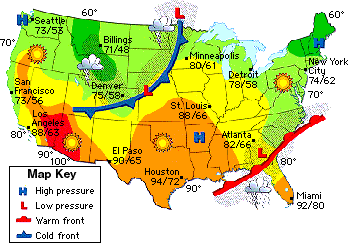
A low pressure system is located over Georgia. What type of weather will they have?
a)
clear, sunny skies
b)
cloudy and rainy
40.
A high pressure system is located north of New York City. What type of weather will be experienced there?
a)
clear, sunny skies
b)
cloudy and rainy
41.
True or False. Scientist classify climates according to temperature and precipitation.
a)
True
b)
False
42.
Which climate has many rainy days and frequent afternoon thunderstorms.
a)
Tropical Wet
b)
Tropical Wet-and-Dry
43.
Which climate has slightly less rain than areas with tropical wet climates?
a)
Tropical Wet
b)
Tropical Wet-and-Dry
44.
What are forests in which large amounts of rain fall year-round?
a)
rain forests
b)
savannas
c)
steppe
d)
deserts
45.
What is the name for a tropical grassland?
a)
savannas
b)
rain forests
c)
steppe
d)
deserts
46.
What is the weather conditions in an area over a long period of time?
a)
climate
b)
temperature
c)
elevation
d)
precipitation
47.
Warm ocean currents generally come from
a)
The North Pole
b)
The South Pole
c)
The Equator
d)
Both A and B
48.
Cold ocean currents generally come from
a)
The North Pole
b)
The South Pole
c)
The Equator
d)
Both A and B
49.
El Nino occurs when the tropical ocean waters are warmer in which ocean?
a)
Atlantic
b)
Indian
c)
Pacific
d)
Arctic
50.
What causes La Nina?
a)
cooling of water in the Atlantic Ocean off the coast of South America
b)
cooling water off the Atlantic coast of the US
c)
cooling water in the Pacific Ocean off the coast of South America
d)
warm water in the Pacific Ocean off the coast of South America
51.
Which climate zone would be hot and rainy with dense forests?
a)
Polar Climate Zone
b)
Cold Temperate Climate Zone
c)
Tropical Climate Zone
d)
High Mountain Climate Zone
52.
Which climate zone is very cold all year, and the ground is covered in ice and snow?
a)
Polar Climate Zone
b)
Tropical Climate Zone
c)
Humid Temperate Climate Zone
d)
Desert Climate Zone
53.
_______________ is a type of large ecosystem with similar life forms and climates.
a)
Rotation
b)
Revolution
c)
Latitude
d)
Biome
54.
A temperate climate is?
a)
consistently cool
b)
consistently warm
c)
consistently moderate
d)
warm and cool
55.
Increasing quantities of CO2 in the atmosphere will likely cause surface air temperatures to be _____.
a)
warmer
b)
cooler
56.
Industrialization is a contributing factor to climate change.
a)
True
b)
False
57.
The two largest fuel sources are?
a)
wood and coal
b)
wood and natural gas
c)
oil and nuclear power
d)
coal and oil
58.
Which of the following is not a greenhouse gas?
a)
Carbon dioxide
b)
Methane
c)
Water vapour
d)
Nitrogen
59.
Some greenhouse gases are naturally present in the Earth's atmosphere
a)
True
b)
False
60.
What is the name of the portion of the atmosphere that protects us against harmful UV radiation?
a)
Stratosphere
b)
Troposhere
c)
Ozone Layer
d)
CFC Layer
100 %

