
 Worksheets
States of Matter Review
Total questions: 50
Worksheet time: 33mins
Name
Class
Date
1.
Which of the following terms identifies the change from a liquid to gas?
a)
Vaporization
b)
Condensation
c)
Deposition
d)
Sublimation
2.
Which of the following terms identifies the change from a liquid to solid?
a)
Melting
b)
Condensation
c)
Vaporization
d)
Freezing
3.
When the temperature of matter increases the particles...
a)
speed up and move closer
b)
speed up and move farther apart
c)
slow down and move closer together
d)
slow down and move farther apart
4.
No Definite Shape and No Definite Volume
a)
Gas
b)
Liquid
c)
Solid
5.
Definite shape and a definite volume.
a)
Gas
b)
Liquid
c)
Solid
6.
No definite shape, but has a definite volume
a)
Gas
b)
Liquid
c)
Solid
7.
Phase change from a solid to a gas.
a)
sublimation
b)
deposition
c)
condensation
d)
evaporation
8.
Phase change from a solid to a liquid.
a)
melting
b)
sublimation
c)
boiling
d)
condensation
9.
Phase change from a liquid to a gas that only happens at the surface.
a)
evaporation
b)
boiling
c)
sublimation
d)
melting
10.
When the temperature of matter increases the particles...
a)
speed up and move closer
b)
speed up and move farther apart
c)
slow down and move closer together
d)
slow down and move farther apart
11.
The opposite phase of melting is
a)
freezing
b)
sublimation
c)
condensation
d)
deposition
12.

What phase of matter is illustrated in "C"
a)
solid
b)
liquid
c)
gas
d)
melting
13.

What is labelled "B" on the graph?
a)
solids
b)
liquids
c)
gases
d)
a phase change
14.

What is happening at "D" on the graph?
a)
Water is boiling
b)
water is evaporating
c)
water is melting
d)
the sublimation of water
15.

Why does the graph have two flat lines at "b" and "d"?
a)
Those are times when we took the water off the hot plate
b)
Those are phase changes where temperature doesn't change while adding heat
c)
The line is flat because the water is all in the solid or gas phase
d)
The line is flat because temperature increases the most at those locations
16.
Why does water NOT change temperature during phase changes?
a)
Because the molecules of water take in all the heat to their nucleus
b)
Because heat is not the same thing as temperature
c)
Because adding heat doesn't ever change the temperature of water
d)
Because all of the energy is used to overcome the attraction of molecules
17.
What do we call the different forms or state of the same substance?
a)
phase
b)
change
c)
not the same
d)
weird
18.
What do we call the energy that an object has because it is moving?
a)
kinetic energy
b)
electrical energy
c)
potential energy
d)
temperature
19.

How long does it take this substance to completely change from a liquid to a gas?
a)
1 minute
b)
2 minutes
c)
10 minutes
d)
15 minutes
20.

At what point does the substance begin turning from a solid to a liquid?
a)
B
b)
C
c)
D
d)
E
21.

When a puddle of water dries up this process is called...
a)
Condensation
b)
Evaporation
c)
Melting
d)
Boiling
22.
All changes in the state of matter of a substance requires...
a)
vibration
b)
water
c)
permission
d)
energy
23.

Which phase change does this image show?
a)
Freezing
b)
Melting
c)
Condensation
d)
Evaporation
24.
What happens to particle movement/speed when energy is added to a phase?
a)
Particles slow down
b)
Particles go faster
c)
Particles don't move
d)
Particles stay the same speed
25.

In an exothermic reaction, heat is ...
a)
taken in or absorbed
b)
given out or released
26.
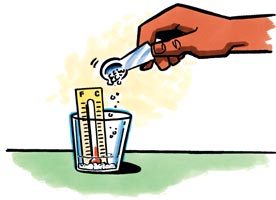
In an endothermic reaction, heat is ...
a)
taken in or absorbed
b)
given out or released
27.
When you freeze water, it turns to ice. What kind of change is this?
a)
Physical
b)
Chemical
28.
Evaporation is what kind of change?
a)
Endothermic
b)
Exothermic
29.
Which of the following has the greatest amount of movement at a given temperature?
a)
Gas
b)
Liquid
c)
Solid
d)
They all have the same movement
30.
What will happen to the volume of a gas under constant temperature if the pressure increases?
a)
Increase
b)
Decrease
c)
Nothing
d)
Explosion!
31.
If you increase the pressure of a constant volume of gas, what will happen to the temperature?
a)
Increase
b)
Decrease
c)
Stay the same
d)
It will Blow Up
32.
What is 0.00 degrees Kelvin known as
a)
No such thing
b)
Very cold
c)
Freezing point of Water
d)
Absolute Zero
33.
How are pressure and volume related?
a)
Directly
b)
Indirectly
c)
They aren't related
34.
You have a gas that has a pressure of 2 ATM and a volume of 10L. What would be the new volume if the pressure was changed to 1 ATM?
a)
5 L
b)
20 L
c)
It would stay at 10L
d)
1 L
35.
What does Boyle's law relate to?
a)
Temperature and Volume
b)
Volume and Pressure
c)
Temperature and Pressure
36.
Boyle's law : The pressure and volume of a gas show a _____ relationship.
a)
No relationship
b)
Direct
c)
Inverse
d)
Equal
37.
What type of relationship is Charles' Law?
a)
Inverse
b)
Direct
c)
Not enough information
d)
#goals
38.

What happens to the average kinetic energy of matter when it is heated?
a)
It increases
b)
It decreases
c)
It doesn't change
d)
It cannot be determined
39.
What is the constant in Charles' Law?
a)
Temperature
b)
Pressure
c)
Volume
d)
None of the above
40.
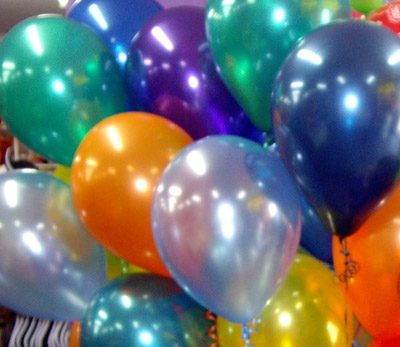
If a balloon is cooled what will happen to the volume?
a)
Volume will increase
b)
Volume will decrease
c)
Volume will not change
41.

Which variable is held constant when using Boyle's Law?
a)
Temperature
b)
Pressure
c)
Volume
d)
number of moles
42.
What is 50 C in Kelvin?
a)
223
b)
323
c)
100
d)
50
43.
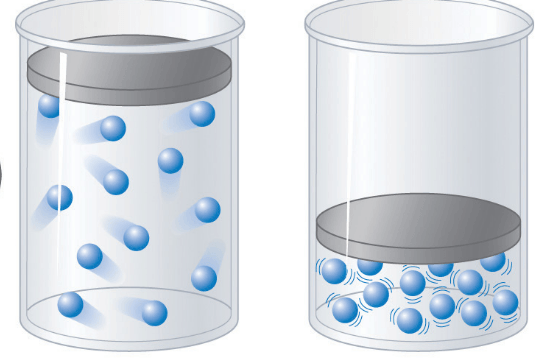
Which container will have a lower pressure?
a)
left
b)
right
c)
they both have the same pressure
d)
I don't know
44.
What happens when my glass of water is sitting in the sun and disappears into a gas?
a)
evaporation
b)
burning
c)
melting
d)
freezing
45.
My glass of ice water is sitting in the sun and has droplets of water on the outside of the glass. What is happening?
a)
condensation
b)
evaporation
c)
melting
d)
freezing
46.

Which of the following statements is NOT true of all different types of matter?
a)
They are made of atoms and molecules
b)
The particles are always in motion
c)
The particles always move at the same speed
d)
They are made of particles that are too small to see
47.
The resistance of a liquid to flow is called what?
a)
Viscosity
b)
Varsity
c)
Volume
d)
Variables
48.
True or false: melting and freezing occur at the same temperature!
a)
True
b)
False
c)
I don't know
49.
True or false: melting and freezing occur at the same temperature!
a)
True
b)
False
c)
I don't know
50.

What is the boiling point of water?
a)
80 degrees Celsius
b)
27 degrees Celsius
c)
90 degrees Celsius
d)
100 degrees Celsius
100 %

