
 Worksheets
The Rock Cycle
Total questions: 28
Worksheet time: 2hrs 20mins
Name
Class
Date
1.
What locations on Earth would create the conditions to form metamorphic rocks?
a)
subduction zones, near magma, convergent continental boundaries
b)
hotspots, volcanic eruptions, mid ocean ridges
c)
oceans, lakes, rivers
d)
near the surface, areas that have been uplifted, colliding continental plates
2.
What locations on Earth would create the conditions to form igneous rocks?
a)
subduction zones, near magma, convergent continental boundaries
b)
hotspots, volcanic eruptions, mid ocean ridges
c)
oceans, lakes, rivers
d)
near the surface, areas that have been uplifted, colliding continental plates
3.
What locations on Earth would create the conditions to form sedimentary rocks?
a)
subduction zones, near magma, convergent continental boundaries
b)
hotspots, volcanic eruptions, mid ocean ridges
c)
oceans, lakes, rivers
d)
near the surface, areas that have been uplifted, colliding continental plates
4.

This rock was formed by lots of fossils that settled on top of each other over time. What type of rock is this?
a)
Sedimentary
b)
Igneous
c)
Metamorphic
d)
rock cycle
5.
What do you call the process by which natural forces (wind, water, glaciers, gravity, animal activity) moves weathered rock and soil from one place to another.
a)
weathering
b)
erosion
c)
deposition
d)
cementation
6.
The process by which water, wind, ice, and changes in temperature break down rock into fragments called sediments.
a)
Deposition
b)
Erosion
c)
Weathering
d)
Igneous Rock
7.
Rock that forms when minerals evaporate from solution or sediment from older rocks are compacted and cemented together.
a)
Sedimentary Rock
b)
Metamorphic Rock
c)
Igneous Rock
d)
Rock Cycle
8.
Rock that forms when pressure, temperature, or chemical processes change existing rock.
a)
Igneous Rock
b)
Sedimentary Rock
c)
Metamorphic Rock
d)
Rock Cycle
9.
An igneous rock can become ______.
a)
metamorphic
b)
sedimentary
c)
igneous
d)
all of these
10.
A metamorphic rock can become ______.
a)
igneous
b)
metamorphic
c)
sedimentary
d)
all of these
11.
The process by which igneous rocks are formed...
a)
heat and pressure
b)
melting and cooling
c)
compaction and cementation
12.
The process by which metamorphic rocks are formed...
a)
heat and pressure
b)
compaction and cementation
c)
melting and cooling
13.
What do you call the smaller pieces of rock and pebbles that are broken down from larger rocks?
a)
texture
b)
weathering
c)
sediment
d)
erosion
14.
What do you call rock that cools slowly deep in the earth. This rock is coarse grained or has large crystals.
a)
intrusive igneous
b)
extrusive igneous
c)
foliated metamorphic
d)
nonfoliated metamorphic
15.

What do you call a rock that cools quickly on the surface of the Earth? This rock has a glassy or fine grain texture.
a)
intrusive igneous
b)
extrusive igneous
c)
foliated metamorphic
d)
nonfoliated metamorphic
16.
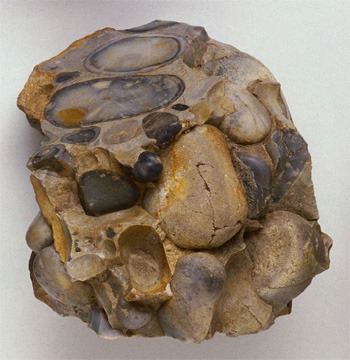
This rock was formed by smaller pieces of rock that settled at the bottom of a lake millions of years ago. What type of rock is this?
a)
Sedimentary
b)
Igneous
c)
Metamorphic
17.

These rocks were exposed to extreme heat and pressure creating ribbon like layers or banding.
a)
intrusive igneous
b)
extrusive igneous
c)
foliated metamorphic
d)
nonfoliated metamorphic
18.
How is mechanical weathering different from chemical weathering?
a)
Chemical weathering happens over much shorter time frame than mechanical weathering.
b)
Chemical weathering changes the chemical composition of rocks; mechanical weathering changes the shape or size.
c)
Chemical weathering occurs only in tropical climates; mechanical weathering occurs only in cool climates.
d)
Chemical weathering occurs only in the mountains; mechanical weathering occurs only on flat land.
19.

These rocks were broken apart from the continuous freeze/ thaw of water in the cracks of the rocks. This is an example of:
a)
ice wedging
b)
acid rain
c)
permeability
d)
abrasion
20.

This diagram shows how rocks change from one kind to another. What do we call this process?
a)
rock cycle
b)
erosion
c)
sedimentation
d)
metamorphism
21.
Igneous and metamorphic rocks go through ____________________________ to become sediment.
a)
weathering and erosion
b)
heat and pressure
c)
melting and cooling
d)
compacting and cementing
22.
What is the major cause of weathering and erosion to form canyons?
a)
wind
b)
ice
c)
glaciers
d)
moving water
23.
All of the following are causes of physical weathering EXCEPT...
a)
plant growth
b)
wind
c)
acid rain
d)
running water
24.
What happens when a metamorphic rock melts?
a)
It becomes sediment
b)
It becomes an igneous rock
c)
It becomes magma
d)
It becomes a sedimentary rock
25.

Which type of rock is most likely to be found inside a cave?
a)
Igneous rocks
b)
Metamorphic rocks
c)
Sedimentary rocks
d)
rock cycle
26.
What are the 3 major types of rock classifications?
a)
Igneous, Metamorphic, Sedimentary
b)
Metamorphic, Igneous, Cementation
c)
clastic, organic, foliated
d)
intrusive, organic, non foliated
27.
Deltas forming at the mouths of rivers is caused by?
a)
Weathering
b)
Erosion
c)
Deposition
28.
What kind of metamorphic rock has its minerals grains arranged in a random pattern? Marble and quartzite would be examples of this type of metamorphic rock.
a)
extrusive igneous
b)
foliated metamorphic
c)
non-foliated metamorphic
d)
intrusive igneous
100 %

