
 Worksheets
Biles Axial Skeletal System Review
Total questions: 113
Worksheet time: 2hrs 54mins
Name
Class
Date
1.

Identify bone 1.
a)
Parietal
b)
Temporal
c)
Occipital
d)
Mandibular
2.

Identify bone 8.
a)
Mandible
b)
Zygomatic
c)
Occipital
d)
Temporal
3.

Identify bone 4.
a)
Parietal
b)
Sphenoid
c)
Temporal
d)
Zygomatic
4.
How many cervical vertebrae are in the spine?
a)
7
b)
12
c)
5
d)
4
5.
There are ___ lumbar vertebrae.
a)
12
b)
5
c)
7
d)
6
6.
The first vertebrae (C1) that supports the head and allows for movement of the head up and down is the
a)
atlas
b)
axis
c)
transverse process
d)
sacrum
7.
the tailbone; bears body weight when sitting; formed by the fusion of 3 to 5 vertebrae during adolescence;
a)
Axis
b)
Sacral
c)
Atlas
d)
Coccyx
8.
Second vertebrae; allows the skull to rotate left and right;
a)
axis
b)
atlas
c)
coccyx
d)
spinous process
9.
Bones of the thoracic cage that articulate directly to the sternum and vertebrae
a)
true ribs
b)
false ribs
c)
floating ribs
d)
strong ribs
10.
A cleft palate forms when the ___ bones fail to fuse correctly.
a)
nasal
b)
temporal
c)
zygomatic
d)
palatine
11.

Identify bone 9.
a)
zygomatic
b)
frontal
c)
temporal
d)
ethmoid
12.

There are five groups of bones that make up the spine. This is an example of one of those groups. How many of these are there?
a)
7
b)
12
c)
5
d)
1
13.
True ribs are pairs
a)
1-7
b)
8-12
c)
1-4
d)
12-14
14.

Type of vertebrae
a)
Cervical
b)
Thoracic
c)
Lumbar
d)
Axis
15.
Which of the following would be found in the lower back?
a)
C4
b)
T5
c)
L3
d)
L10
16.
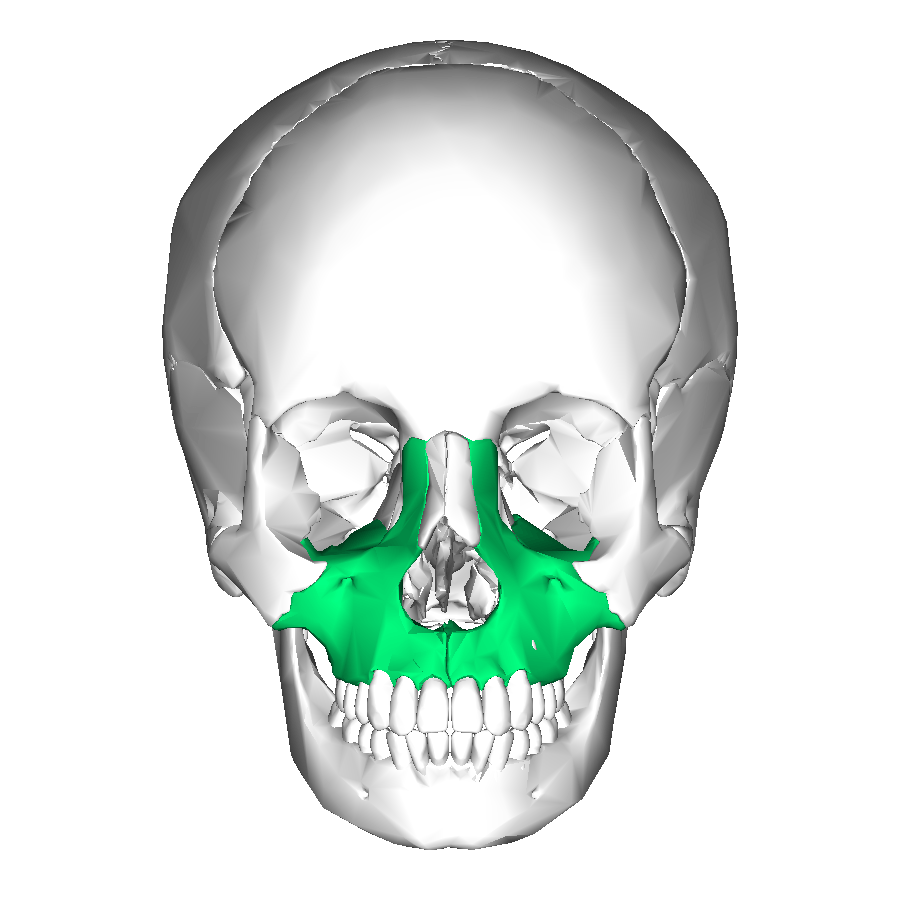
What is this?
a)
Mandible
b)
Maxillae
c)
Zygomatic
d)
Lacrimal
17.
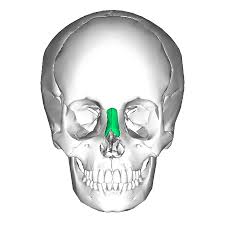
What is this?
a)
Nasal
b)
Lacrimal
c)
Ethmoid
d)
Vomer
18.
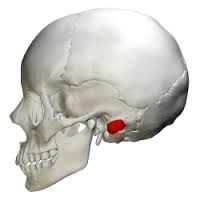
What is this?
a)
Mastoid Process
b)
Styloid Process
c)
External Acoustic Meatus
d)
Zygomatic Process
19.
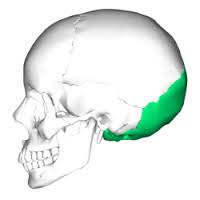
What is this?
a)
Parietal
b)
Occipital
c)
Frontal
d)
Temporal
20.
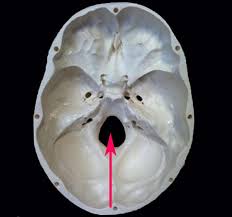
What is this?
a)
Foramen Magnum
b)
Jugular Foramen
c)
Carotid Canal
d)
External Acoustic Meatus
21.
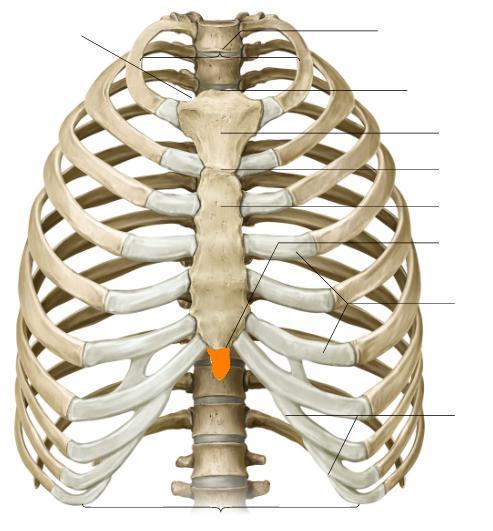
What is this?
a)
Manubrium
b)
Xiphoid Process
c)
Body
d)
Costal Cartilage
22.
There are 12 of these and they articulate with ribs
a)
Thoracic vertebrae
b)
Cervical Vertebrae
c)
Lumbar Vertebrae
d)
Sacral vertebrae
23.
Largest vertebral region that articulates with the pelvis
a)
Sacrum
b)
Coccygeal
c)
C1
d)
L5
24.
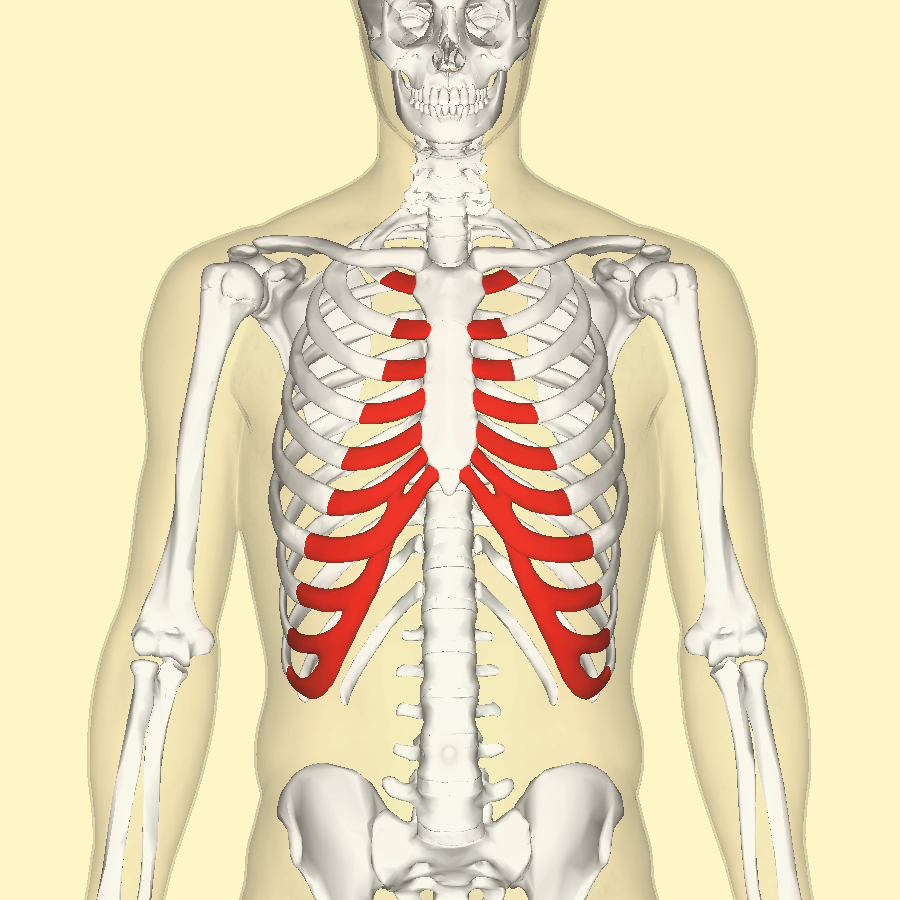
What is this?
a)
Costal Cartilage
b)
True Ribs
c)
False Ribs
d)
Sternum
25.

Is this the axial or appendicular skeleton?
a)
Axial
b)
Appendicular
26.

Which bone is not part of the axial skeleton
a)
Ribs
b)
Sacrum
c)
Clavicle
d)
Vertebrae
27.

What is this?
a)
Frontal
b)
Mandible
c)
Occipital
d)
Parietal
28.

Name the bone indicated by the arrow.
a)
Maxilla
b)
Mandible
c)
Parietal
d)
Occipital
29.
Bony expansion on a narrow neck
a)
Head
b)
Trochanter
c)
Line
d)
Process
30.
A narrow slit-like opening
a)
fissure
b)
foramen
c)
meatus
d)
ovale
31.
A very large, blunt, irregularly shaped surface
a)
tubercle
b)
trochanter
c)
tuberosity
d)
meatus
32.
A round or oval opening through a bone
a)
meatus
b)
foramen
c)
fissure
d)
trochanter
33.
sinus
a)
A cavity within a bone, filled with air and lined with mucus membrane
b)
a slit like opening
c)
a cavity within a bone lined with connective tissue
34.
Epiphysis
a)
The shaft of a bone
b)
a bone cell
c)
the end of the bone
d)
the cavity filled with bone marrow
35.
Periosteum
a)
the connective tissue covering of the bone cavity
b)
the connective tissue covering of a bone
c)
the shiny, articulating cartilage on the ends of a bone
d)
the blood vessels inside a bone
36.
Rounded process
a)
fontanel
b)
condyle
c)
facet
d)
fossa
37.
small, nearly flat articular surface
a)
condyle
b)
fossa
c)
facet
d)
fontanel
38.
tube-like passageway
a)
tubercle
b)
trochanter
c)
spine
d)
meatus
39.
A small, rounded projection
a)
trochanter
b)
tubercle
c)
meatus
d)
fissure
40.
Armlike bar of bone
a)
Crest
b)
Fossa
c)
Groove
d)
Ramus
41.
Raised area above a condyle
a)
Epicondyle
b)
Notch
c)
Spine
d)
Tubercle
42.
Sharp, slender projection
a)
Notch
b)
Line
c)
Spine
d)
Groove
43.
Any bony prominance
a)
Process
b)
Facet
c)
Fissure
d)
Meatus
44.
Narrow ridge of bone (on interior of a bone)
a)
Head
b)
Line
c)
Foramen
d)
Groove
45.
Shallow, basinlike depression
a)
Fissure
b)
Facet
c)
Foramen
d)
Fossa
46.

Letter A represents...
a)
Yellow Marrow
b)
Red Marrow
c)
Endosteum
d)
Periosteum
47.

Letter E represents....
a)
Periosteum
b)
Endosteum
c)
Medullary Cavity
d)
Spongy Bone
48.

Letter D represents...
a)
Compact bone
b)
Spongy Bone
c)
Endosteum
d)
Periosteum
49.
Which is NOT a function of bone?
a)
blood cell production
b)
triglyceride storage
c)
mineral homeostasis
d)
hormone synthesis
50.
What are the two most abundant minerals in bone?
a)
calcium and nitrogen
b)
sodium and magnesium
c)
calcium and magnesium
d)
calcium and phosphorus
51.
Where does hemopoiesis occur?
a)
red blood marrow
b)
yellow blood marrow
c)
Epiphyseal line
d)
Endosteum
52.
What is hemopoiesis?
a)
blood cell production
b)
fat production
c)
bone production
d)
all the above
53.
What is the name of the process in which mineral salts are deposited and as a result bone is hardened?
a)
ossification
b)
calcification
c)
osteon
d)
radification
54.
The hardest, most dense part of the bone tissue is the
a)
periosteum
b)
spongy bone
c)
osteoblast
d)
compact bone
55.
Osteoblasts' function is to...
a)
signal to osteocytes when to secrete more bone matrix
b)
mature into osteoclasts
c)
break down old bone matrix
d)
secrete bone matrix
56.
Which type of bone cells are responsible for dissolving old bone matrix?
a)
Osteoblasts
b)
Osteoclasts
c)
Osteocytes
d)
Osteons
57.
What is the formal name for bone?
a)
Osseous Tissue
b)
Opossemous Tissue
c)
Proper Bone
d)
Cartilage
58.
What is the formal name for bone?
a)
Osseous Tissue
b)
Opossemous Tissue
c)
Proper Bone
d)
Cartilage
59.
The organization of compact bone is centered around the _____________.
a)
osteon
b)
osteocyte
c)
osteoclast
d)
osteoblast
60.
A mature bone cell is called a _________.
a)
osteon
b)
osteocyte
c)
osteoclast
d)
osteoblast
61.
Which of these is not a major part of bone tissue?
a)
Collagen
b)
Osteocytes
c)
Calcium Crystals
d)
Magnesium Crystals
62.
Which of these give bone a bit of flexibility?
a)
Collagen
b)
Elastin
c)
Calcium Crystals
d)
Magnesium Crystals
63.
The continuous breakdown and reforming of bone tissue is called ______.
a)
remodeling
b)
rebuilding
c)
rehabituation
d)
renewl
64.
Which is not a function of the skeletal system?
a)
Protect Organs
b)
Site for muscle Attatchment
c)
Store Minerals
d)
Make Hormones
65.
The gradual change of cartilage or connective tissue into bone is called ___________.
a)
ossification
b)
remodeling
c)
osteolysis
d)
osteogenesis
66.
What is the main mineral that is added to bone tissue in ossification?
a)
Calcium
b)
Magnesium
c)
Sodium
d)
Potassium
67.
The type of bone marrow that creates red and white blood cells is __________ marrow.
a)
Red
b)
White
c)
Yellow
d)
Black
68.
The type of bone marrow that stores fat for energy is __________ marrow.
a)
Red
b)
White
c)
Yellow
d)
Black
69.
A fracture that occurs when the bone doesn't break all the way through is called a _______.
a)
greenstick
b)
open
c)
closed
d)
comminuted
70.
The knobby end of a long bone is called a __________.
a)
ephiphysis
b)
diaphysis
c)
ephinium
d)
diaphinum
71.
The long shaft of a long bone is called a __________.
a)
ephiphysis
b)
diaphysis
c)
ephinium
d)
diaphinum
72.

a)
long bone
b)
short bone
c)
irregular bone
d)
flat bone
73.

a)
long bone
b)
short bone
c)
irregular bone
d)
flat bone
74.

a)
long bone
b)
short bone
c)
irregular bone
d)
flat bone
75.
Canaliculi are for
a)
providing protection
b)
housing osteocytes
c)
providing nourishment
d)
holding bone together
76.
An osteocyte "lives" in __.
a)
lacunae
b)
lamellae
c)
Haversian canals
d)
Volkmann's canals
77.

Which fracture is where the bone is visible through the skin?
a)
Compound Fracture
b)
Stable Fracture
c)
Kevin Ware
d)
Horse
78.
Osteons, also known as __________, are made up of rings called ________.
a)
Haversian systems, lacunae
b)
Haversian systems, lamellae
c)
osteocytes, lamellae
d)
osteoblasts, papillae
79.
The type of bone marrow that creates red and white blood cells is __________ marrow.
a)
Red
b)
White
c)
Yellow
d)
Black
80.
The type of bone marrow that stores fat for energy is __________ marrow.
a)
Red
b)
White
c)
Yellow
d)
Black
81.
A raised portion of osseous tissue on the outside of a healed fracture is called a ____________.
a)
callus
b)
calcus
c)
cactus
d)
calcanus
82.
How many bones are there in the human body?
a)
208
b)
126
c)
206
d)
80
83.

What Are The Skeletal System's Two Minor Jobs?
a)
To Store Blood Cells and Make Calcium
b)
To Make Blood Cells and Store Calcium
c)
To Take Away The Body's Extra Blood Cells and Calcium
d)
To Help The Body Process and Digest Food With Calcium In It
84.
Ribs are examples of ___________bones.
a)
long
b)
short
c)
flat
d)
sesamoid
85.
The only movable bone in the skull is the
a)
nasal bone
b)
mandible
c)
maxilla
d)
vomer
86.
Air-filled cavities in the cranial bones are called
a)
foramens
b)
sinuses
c)
fontanels
87.

WHAT IS #2
a)
ATLAS
b)
AXIS
c)
LUMBAR
d)
THORACIC
88.
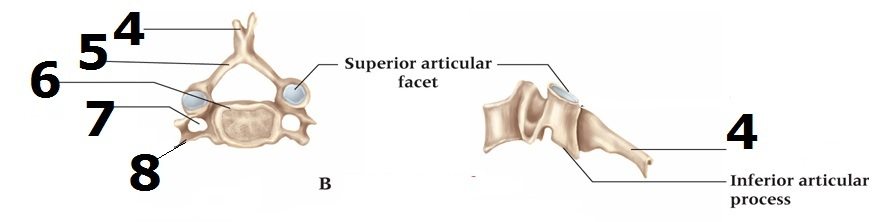
WHAT IS #6
a)
SPINOUS PROCESS
b)
BODY
c)
TRANSVERSE PROCESS
d)
LAMINA
89.
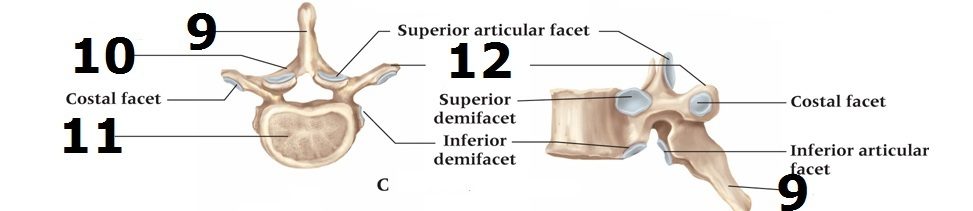
WHAT IS #9
a)
SPINOUS PROCESS
b)
BODY
c)
TRANSVERSE PROCESS
d)
LAMINA
90.
WHAT MOTION IS THE ATLAS RESPONSIBLE FOR?
a)
NO (CERVICAL ROTATION)
b)
YES (CERVICAL FLEXION AND EXTENSION)
c)
CIRCUMDUCTION
d)
LATERAL FLEXION
91.
WHAT MOTION IS THE AXIS RESPONSIBLE FOR?
a)
NO (CERVICAL ROTATION)
b)
YES (CERVICAL FLEXION AND EXTENSION)
c)
CIRCUMDUCTION
d)
LATERAL FLEXION
93.
After you fracture a bone, blood filled swelling, or a ____________ will form around the break
a)
callus
b)
scab
c)
fibroma
d)
hematoma
93.
After you fracture a bone, blood filled swelling, or a ____________ will form around the break
a)
callus
b)
scab
c)
fibroma
d)
hematoma
94.
PTH is released when a person is
a)
Hypercalcemic
b)
Hypocalcemic
95.

What bone is this?
a)
Ethmoid
b)
Sphenoid
c)
Temporal
d)
Frontal
96.

The suture indicated by #14 is the
a)
coronal suture
b)
sagittal suture
c)
lamdoid suture
d)
squamous suture
97.

The suture indicated by #15 is the
a)
coronal suture
b)
sagittal suture
c)
lamdoid suture
d)
squamous suture
98.

a)
Maxilla
b)
Frontal
c)
Mandible
d)
Sphenoid
99.

a)
Occipital
b)
Parietal
c)
Temporal
d)
Sphenoid
100.

a)
Zygomatic
b)
Temporal
c)
Parietal
d)
Lacrimal
101.

a)
Zygomatic
b)
Vomer
c)
Ethmoid
d)
Lacrimal
102.

a)
Zygomatic
b)
Vomer
c)
Ethmoid
d)
Lacrimal
103.

a)
Occipital Condyle
b)
Vomer
c)
Occipital
d)
Frontal
104.

What suture is shown by arrow A?
a)
Coronal suture
b)
Squamous suture
c)
Lambdoidal suture
d)
Temporo-mandibular joint
105.

What suture is shown by arrow B?
a)
Coronal suture
b)
Squamous suture
c)
Lambdoidal suture
d)
Temporo-mandibular joint
106.

What suture is shown by arrow C?
a)
Coronal suture
b)
Squamous suture
c)
Lambdoidal suture
d)
Temporo-mandibular joint
107.
located on the sides of the head; houses the internal portion of the ear
a)
temporal bone
b)
occipital bone
c)
zygomatic bone
d)
frontal bone
108.
Lower jaw bone; connects to the skull in front of the ears;
a)
Mandible
b)
Maxillae
c)
Zygomatic
d)
Parietal
109.
Upper jaw; holds the upper teeth; forms portions of the orbital, nasal and oral cavities.
a)
mandible
b)
maxillae
c)
zygomatic
d)
occipital
110.
What are the membranous area between cranial bones of a fetal skull
a)
sutures
b)
foramina
c)
areolas
d)
fontanelles
111.
What is the suture that connects the two parietal bones together
a)
coronal
b)
sagittal
c)
squamous
d)
lamboidinal
112.
Osteogenesis is the process of
a)
bone destruction
b)
making cartilage
c)
making collagen
d)
bone formation
113.
What tissue is the forerunner of long bone in the embryo?
a)
elastic connective
b)
hyaline cartilage
c)
dense connective
100 %

