
 Worksheets
1st semester final review
Total questions: 108
Worksheet time: 9hrs 0mins
Name
Class
Date
1.
An isotope is:
a)
Elements with the same number of neutrons and different numbers of protons
b)
Elements with the same number of protons, but different numbers of electrons
c)
Elements with the same number of protons, but different numbers of neutrons
d)
Elements with the same number of protons, but different numbers of electrons
2.
Name the following ionic compound: LiNO3
a)
lithium nitrate
b)
lithium III nitrate
c)
lithium nitride
d)
lithium oxide
3.
Name the following ionic compound: Cr(NO2)3
a)
chromium nitrite
b)
chromium nitride
c)
chromium III nitride
d)
chromium III nitrite
4.
Which of the following will have a larger radius than Zinc?
a)
Gallium
b)
Aluminum
c)
Magnesium
d)
Strontium
5.
Which of the following will have a higher electronegativity than arsenic (As)?
a)
Carbon (C)
b)
Neon (Ne)
c)
Antimony (Sb)
d)
Germanium (Ge)
6.
Which of the following will have a lower ionization energy than Scandium (Sc)?
a)
Helium (He)
b)
Titanium (Ti)
c)
Calcium (Ca)
d)
Magnesium (Mg)
7.
As you move down the periodic table atoms get bigger. This is because ____________.
a)
The atoms have more mass.
b)
The atoms have more protons.
c)
The atoms have more energy levels
d)
The atoms have more neutrons
8.
As you move across the periodic table atoms tend to get smaller because, ______________.
a)
the atoms have more mass.
b)
the atoms have less mass
c)
the atoms have more protons.
d)
the atoms have less electrons.
9.
Electronegativity is...
a)
the ability of an atom to attract/ accept electrons
b)
the ability of an atom to lose electrons
c)
the energy required to remove an electron from a specific atom
d)
how easy it is to make friends.
10.
Ionization energy is...
a)
the energy required to add an electron to a specific atom
b)
how much energy it takes to remove an electron from an atom
c)
the energy required to shield the outer electrons from the nucleus
d)
a measure of the ability of an atom to attract electrons
11.
Metals have the largest -
a)
atomic radius and electronegativity
b)
electronegativity and ionization energy
c)
atomic radius only
d)
ionization energy and atomic radius
12.
The polarity of a bond between two elements can be best determined by
a)
The difference in electronegativity between the elements
b)
The difference in first ionization energy between the elements
c)
The number of electrons shared in the bond
d)
The difference in atomic radius between the elements
13.

a)
Metals
b)
Nonmetals
14.
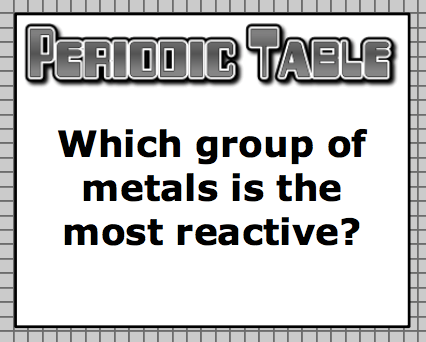
a)
Alkali Metals
b)
Alkaline Earth Metals
c)
Transition Metals
d)
Metalloids
15.
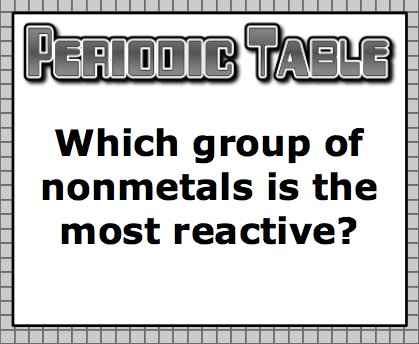
a)
noble gasses
b)
halogens
c)
metalloids
d)
chalcogens
16.
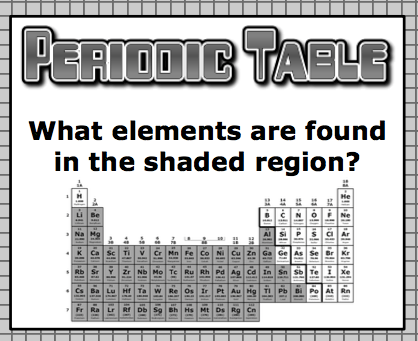
a)
Metals
b)
Nonmetals
c)
Metalloids
17.
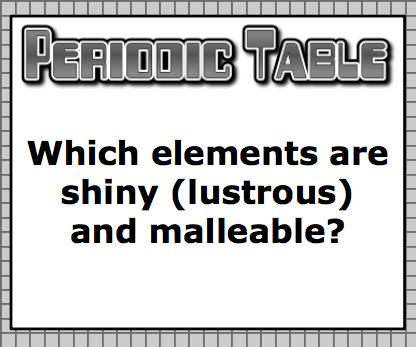
a)
Metals
b)
Nonmetals
c)
Metalloids
18.
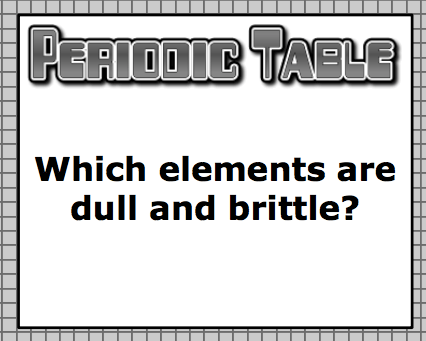
a)
Metals
b)
Nonmetals
c)
Metalloids
19.
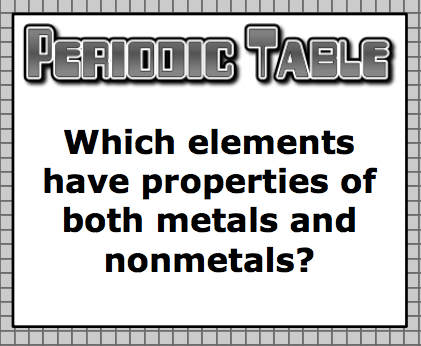
a)
Metals
b)
Nonmetals
c)
Metalloids
20.
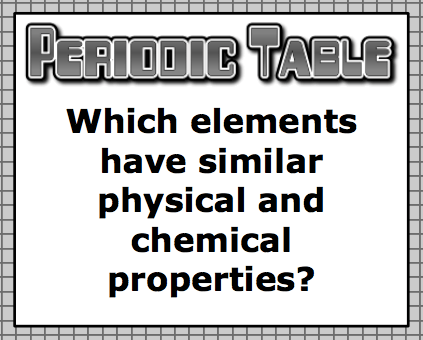
a)
Same group
b)
Same period
21.
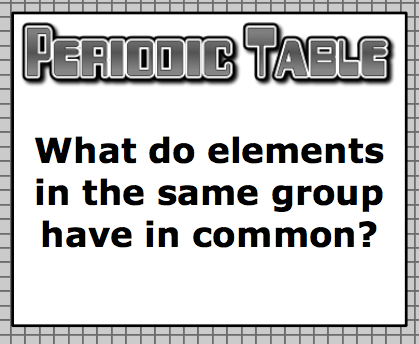
a)
energy levels
b)
valence electrons
c)
protons
d)
neutrons
22.
The tendency of an atom to attract electrons and acquire a negative charge
a)
electronegativity
b)
charge
c)
bonding ability
d)
electron configuration
23.
According to the Periodic Table of the Elements, which set of elements has similar properties?
a)
H, C, I
b)
He, H, Al
c)
He, Ne, Ar
d)
Na, Ca, Al
24.
The electron configuration of an atom is 1s22s22p6. The number of electrons in the atom is
a)
3
b)
6
c)
8
d)
10
25.
What atom matches this electron configuration?
1s22s22p63s23p64s23d10
1s22s22p63s23p64s23d10
a)
Zinc
b)
Copper
c)
Nickel
d)
Germanium
26.
What is the noble gas shorthand electron for Sulfur atom?
a)
[Ar] 3p4
b)
[He] 3s23p4
c)
[Ne] 3s23p4
d)
[Na] 3s23p4
27.

What is the electron configuration for this atom?
a)
1s22s22p6
b)
1s22s22p5
c)
1s22s22p3
d)
2s22p3
28.

Which element is depicted from this atomic orbital diagram?
a)
Carbon
b)
Nitrogen
c)
Oxygen
d)
Phosphorus
29.

Which element is depicted from this orbital diagram
a)
Fluorine
b)
Neon
c)
Chlorine
d)
Argon
30.
What kind of bond do you have: F and Cl
a)
Non-polar covalent
b)
Polar covalent
c)
ionic
d)
James Bond
31.
What kind of bond do you have: K and Br
a)
Non-polar covalent
b)
Polar covalent
c)
ionic
d)
James Bond
32.
What kind of bond do you have: H and H
a)
Non-polar covalent
b)
Polar covalent
c)
ionic
d)
James Bond
33.
What kind of bond do you have: Mg and F
a)
Non-polar covalent
b)
Polar covalent
c)
ionic
d)
James Bond
34.
Covalent Bonds are generally ________ than ionic bonds and have ______ melting points.
a)
stronger ; lower
b)
stronger ; higher
c)
weaker ; lower
d)
weaker ;
35.
Which of these would have a positive pole?
a)
HCl
b)
H2
c)
F2
d)
None of these
36.
An uneven sharing of electrons in a covalent bond due to differences in electronegativity is a:
a)
Polar
b)
Non-Polar
c)
Ionic
d)
NA
37.
All diatomic bonds are:
a)
Polar covalent
b)
Nonpolar covalent
c)
Ionic
d)
Metal
38.
Atoms create bonds to _______ their potential energy, therefore becoming _______ stable.
a)
lower ; less
b)
lower ; more
c)
increase ; less
d)
increase ; more
39.
Metals and nonmetals form which kind of bond?
a)
Polar covalent
b)
Ionic
c)
Non-polar covalent
d)
Metallic
40.
What is the formula for calcium iodide?
a)
CaI
b)
Ca2I
c)
CaI2
d)
Ca2I3
41.
What is the name for SiCl4 ?
a)
silicon tetrachloride
b)
silicon quadchloride
c)
monosilicon tetrachloride
d)
silicon chloride
42.
Which of the following is the correct formula for magnesium and chlorine?
a)
Mg2Cl
b)
MgCl
c)
MgCl2
d)
Mg2Cl2
43.
Name the compound AlBr3
a)
aluminum bromide
b)
aluminum tribromide
c)
aluminum bromine
d)
monoaluminum tribromide
44.
Name the compound MgF2
a)
magnesium fluoride
b)
manganese Phosphide
c)
magnesium(III) fluoride
d)
magnesium fluoride(II)
45.
iron(II) oxide
a)
FeO
b)
FeO2
c)
Fe2O
d)
Fe2O2
46.
What is the formula for Tetraphosphorus decoxide
a)
(PO4)4O2
b)
P4O2
c)
P4O10
d)
none of the above
47.
What is the formula for phosphorus trichloride?
a)
KCl3
b)
PCl3
c)
K3Cl
d)
P3Cl
48.
The proper formula for aluminum nitrate:
a)
AlNO3
b)
Al2(NO3)3
c)
Al(NO3)3
d)
Al3NO3
49.
How many atoms are in the formula NH4NO3?
a)
9
b)
8
c)
7
d)
4
50.
When naming an ionic compound with a ______ metal needs a Roman Numeral after its name.
a)
Alkali
b)
Alkaline-Earth
c)
Transition
d)
Metalloid
51.
How do the following two elements bond together?
Al3+ O2-
Al3+ O2-
a)
AlO
b)
Al2O3
c)
Al3O6
d)
Al3O2
52.
How do the following two elements bond together?
Pb4+ O2-
Pb4+ O2-
a)
PbO
b)
Pb2O3
c)
PbO2
d)
Pb3O2
53.
Name the following ionic compound: BeCl2
a)
beryllium chlorine
b)
beryllium II chloride
c)
beryllium chloride
d)
beryllium dichloride
54.
Name the following ionic compound: MgSO4
a)
magnesium sulfoxide
b)
magnesium sulfide
c)
magnesium sulfate
d)
magnesium oxide
55.
Intermolecular forces are the forces
a)
within molecules
b)
between molecules
56.
Intramolecular forces are broken in
a)
physical changes (changes of states of matter)
b)
chemical changes (new compounds are formed)
57.
Weak Bonds
a)
Ionic
b)
Covalent
58.
Does not normally conduct Electricity
a)
Ionic
b)
Covalent
59.
Hard & Brittle
a)
Ionic
b)
Covalent
60.
Low Melting & Boiling Points
a)
Ionic
b)
Covalent
61.
Which type of bond has one pair of electrons shared between atoms?
a)
ionic
b)
single covalent
c)
metallic
d)
double covalent
62.
Person who developed the periodic table is
a)
Boyle
b)
Newton
c)
Joe Periodic
d)
Mendeleev
63.
Which of the elements are exceptions to the octet rule?
a)
Oxygen & Carbon
b)
Hydrogen & Helium
c)
Nitrogen & Argon
d)
Krypton & Iron
64.
The octet rules states that the atom is most stable when its valence electrons number is equal to
a)
32
b)
18
c)
12
d)
8
65.
What does malleable mean?
a)
able to be shaped
b)
will break easily
c)
can be used for wire
d)
is shiny
66.
Which of the following is NOT a property of ionic compounds?
a)
They conduct electricity when molten
b)
They conduct electricity when in solution
c)
They have high boiling points
d)
They are insoluble in water
67.
Which of the following is a characteristic property of ionic compounds?
a)
They form hard, brittle crystals with characteristic shapes
b)
They have low melting points
c)
They have low boiling points
d)
They contain no charged particles
68.
which types of elements become cations?
a)
nonmetals
b)
all metals
c)
only transition metals
d)
some metals and some metalloids
69.
The oxidation number for copper in Cu2S:
a)
+1
b)
+2
c)
-1
d)
-2
70.
What type of bond is AlCl3?
a)
ionic
b)
covalent
c)
metallic
71.
What type of bond is NaCl?
a)
ionic
b)
covalent
c)
metallic
72.
What type of bond is O2?
a)
ionic
b)
nonpolar covalent
c)
metallic
d)
polar covalent
73.
What type of bond is H2O?
a)
ionic
b)
polar covalent
c)
metallic
d)
nonpolar covalent
74.
What type of bond is CO2?
a)
ionic
b)
covalent
c)
metallic
75.
The reaction shows that
X + ZY --> ZX + Y
X + ZY --> ZX + Y
a)
Z replaced X
b)
Y is more reactive than X
c)
X is more reactive than Y.
d)
Y has changed into a new compound.
76.

Based on the activity series, which metal could X represent in the reaction below?
X + Ca (NO3)2 --> Ca + X (NO3)2
a)
Li
b)
Fe
c)
Mg
d)
Zn
77.
What will be the result if a less reactive metal is added in a solution with more reactive metal compound?
a)
vigorous reaction
b)
fizzing gas produced
c)
burns moderately
d)
no reaction
78.
What will be the result of the following:
Br2 + NaF ->
a)
bromine will replace Na
b)
Na will replace Br
c)
Br will replace F
d)
no reaction will occur because Bromine is less reactive than Fluorine
79.
What will be the result of the following:
Li + NaF ->
Li + NaF ->
a)
Li will replace F
b)
Na will replace Li
c)
Li will replace Na
d)
no reaction will occur
80.
What will be the result of : Zn + AuCl2->
a)
ZnCl2 +Au
b)
ZnAu + Cl2
c)
no reaction
d)
ClAu + Zn
81.
A displacement (single replacement) reaction will occur when...
a)
a more reactive metal displaces a less reactive metal from its compound.
b)
A less reactive metal displaces a more reactive metal from its compound
c)
Displacement only occurs when two of the same metals are reacted
d)
Displacement reactions will only occur in metals above iron in the reactivity series
82.
Which one of the following would result in a single replacement (displacement) reaction?
a)
Iron with magnesium chloride
b)
magnesium with iron chloride
c)
Iron with Zinc Sulphate
d)
gold with silver nitrate
83.
Is NaCl soluble or insoluble?
a)
Soluble
b)
Insoluble
c)
Neither
d)
Soluble and Insoluble
84.
Is AgCl soluble or insoluble?
a)
Soluble
b)
Insoluble
c)
Neither
d)
Both
85.
Is MgO soluble or insoluble?
a)
Soluble
b)
Insoluble
c)
Neither
d)
Both
86.
What is the state of matter symbol for an insoluble compound?
a)
(s)
b)
(aq)
c)
(g)
d)
(l)
87.
What is a precipitate?
a)
A solid formed from a single replacement reaction
b)
An aqueous compound formed from single replacement reaction
c)
An aqueous compound formed from double replacement reaction
d)
A solid formed from a double replacement reaction
88.
What are the products formed in this double replacement reaction: Na2S + 2HCl
a)
Na2H + SCl2
b)
ClNa + SH2
c)
2NaCl + 2HS
d)
2NaCl + H2S
89.
What is the generic equation for a double replacement reaction?
a)
AB + CD ---> AD + CB
b)
AB + CD ---> DA + CB
c)
AB + CD ---> A + BC
d)
AB + CD ---> D + CBA
90.
How do you determine the states of matter of the products in a double replacement reaction?
a)
Oxidation Number
b)
Activity Series on formula chart
c)
Solubility Rules on formula chart
d)
Ionic Charges
91.
What is a double replacement?
a)
Two compounds react to form two new compounds.
b)
One compound reacts to form two separate elements.
c)
Two elements reacting to form a single compound.
d)
A hydrocarbon and
92.
In a covalent bond, the force of attraction results from both atoms wanting to stay close to the shared electron pair.
a)
True
b)
False
93.
Oxygen usually exists as O2 in nature. What kind of bonds are present in this molecule?
a)
Ionic
b)
Nonpolar Covalent
c)
Metallic
d)
Polar Covalent
94.
In what form can an ionic compound conduct electricity?
a)
when dissolved in water
b)
as a solid
c)
as a crystal
d)
when warmed slightly
95.

What happens to the electrons in a Nonpolar Covalent bond
a)
transferred from one atom to another
b)
shared equally between 2 atoms
c)
shared unequally between 2 atoms
d)
mobile
96.

A nonpolar covalent bond is...
a)
less
b)
greater
c)
unequal
d)
equal
97.

What kinds of elements are most likely to form an ionic bond?
a)
Nonmetal+Nonmetal
b)
Metalloid+Metalloid
c)
Metal+Nonmetal
d)
Metalloid+Nobel Gas
98.

A group of atoms bonded together by pairs of shared electrons
a)
ion
b)
molecule
c)
alloy
d)
metal
99.
Flexible
a)
ionic
b)
covalent
c)
metallic
100.

Electrolytes
a)
ionic
b)
covalent
c)
metallic
101.
Of these 3 molecules, which has polar covalent bonding?
a)
O2
b)
NaI2
c)
HBr
d)
MgO
102.
Which of these molecules has nonpolar covalent bonding?
a)
H2O
b)
HCl
c)
I2
d)
NaCl
103.
Are atoms more stable when they are bonded together or when they are alone?
a)
Bonded Together
b)
Alone
104.
How strongly an atom attracts electrons is called....................
a)
Ionization energy
b)
Electronegativity
105.
Which of the following contains a polyatomic ion?
a)
Cu2CO3
b)
MnO
c)
CrN
d)
BeCl2
106.
What is a polar molecule?
a)
One that has a partial negatitive on one end and a partial positive on the other
b)
a molecule with little vibration
c)
an ionic compound
d)
the nonpolar bonds are arranged sequentially
107.
In general, substances with stronger intermolecular forces have ___________ boiling points than those with weaker intermolecular forces
a)
higher
b)
lower
108.
Intermolecular forces are the forces
a)
within molecules
b)
between molecules
100 %

