
 Worksheets
Chemistry Midterm Review
Total questions: 108
Worksheet time: 4hrs 44mins
This is a type of mixture where one substance dissolves into another
Solution
Miscibility
Compound
Solubility

Two substances have been combined physically and appear the same throughout is called a.........
A homogeneous mixture
A heterogeneous mixture
An element
A compound
Solutions has ______________ sized particles, colloids have _________________ sized particles, and suspensions have _________________________ sized particles.
small, medium, large
large, medium, small
medium, small, large
medium, large, small
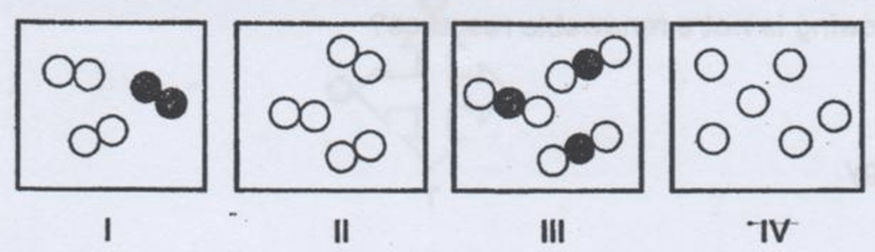
In the diagrams provided, the circles of different colors represent the atoms of different elements. Which diagram represents a mixture?
I
II
III
IV

Which diagram represents an element?
Diagram (a)
Diagram (b)
Diagram (c)
None of the diagrams represent the parts of an element.

What type of matter is shown in this particle diagram?
Element
Compound
Mixture of Elements
Mixture of Compounds
Mixture of Elements and Compounds

What is the mass number?
the number of protons in the nucleus
the number of protons and neutrons in the nucleus
the number of neutrons in the nucleus
the number of protons and electrons in the atom
An atom has 10 protons, 15 neutrons and 10 electrons what is its mass number.
20
10
35
25


What does the number 1 in "1s" stand for?
energy level
s orbitals
p orbitals
the number of electrons
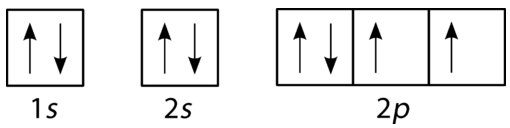
Choose the s orbital


Each p subshell contains _____ orbitals
1
3
5
7
How many electrons can fit in one orbital?
1
2
8
18
Choose the p orbital

Isotopes of an element have a different number of...
Protons
Neutrons
Electrons
Mass

How many neutrons are in this isotope?
20
41
61
21

How many electrons will be in the 1st shell, 2nd shell, 3rd shell, and or 4th shell? (electrons = 20)
2, 8, 8, 3
2, 8, 8, 0
2, 8, 8, 1
2, 8, 8, 2
How many electrons would a Nitrogen ion gain/lose? If it has 5 valence electrons.
lose 5
gain 5
lose 3
gain 3
A Bromine ion gains 1 electron, which of the following is the correct symbol for a Bromine ion?
Br-1
Br+1
Br+7
Br-7
If an element has 3 valence electrons, what charge will likely form on its ion ?
+3
+5
-3
-5
What is the total sum of oxidation numbers in the following compound Li3PO4?
+2
-1
0
+5
What is the charge, or oxidation number, for elements in Group 2?
-2
+2
-3

Which model of the atom is this?
Billiard Ball
Plum Pudding
Planetary (Bohr)
Electron Cloud
Rutherford (nuclear)
A chemical compound always has the same proportion of elements by mass
Law of Definite Proportions
Law of Multiple Proportions
Definitive Law of Proportions
Proportion Law
What part of Dalton's atomic theory is wrong?
Atoms cannot be subdivided
All matter is composed of atoms
Atoms are combined separated or rearranged in chemical reactions
Atoms are identical in mass
Which of the following is the ground-state configuration for the atoms of a transition element?
1s22s22p53s23p54s23d3
1s22s22p63s23p64s23d5
1s22s22p62d103s24s23p5
1s22s22p63s23p5
In covalent bonding, atoms ______________ electrons.
When magnesium gets the same electron configuration as Ne it has a _______ charge.
Molecules with 5 atoms, like CH4, will have a ___________________ shape.
The VSEPR theory stands for the ________________________________________ theory.
Ar and Cl-1 have the same electron configuration, so they are ___________________ with each other.
Ionic compounds will not conduct an electric current in the ___________ state.
___________________ is the only element in group 1 to bond covalently.
The difference between the trigonal planar and pyramid shapes is that the ____________________ shape has an unshared pair of electrons on the central atom.
In a ___________________ covalent bond, electrons are shared unequally.
Match the following
CH4
Tetrahedral
SiS2
Linear
Br2
Linear
SeCl2
Bent
SbI3
Pyramidal
Organize these options into the right categories:


What does Pauli exclusion principle state ?
states that each electron occupies the lowest energy orbital available
states that -no two electrons in the same orbital can have the same spin
states that single electrons electrons with the same spin must occupy each-energy orbital before additional electrons with opposite spins can occupy the same orbitals
Light is emitted when electrons ...
return from high energy state to low energy state
jump from low energy state to high energy state
either of these
none of these

List the following atoms in order of increasing ionization energy: Li, Na, C, O, F.
Li<Na<C<O<F
Na<Li<C<O<F
F<O<C<Li<Na
Na<Li<F<O<C
Na<Li<C<F<O

Which of the atoms pictured would have the lower ionization energy and why?
Atom A because it it bigger
Atom A because the outer electrons are not "held" as tightly as those in atom B
Atom B because it is smaller
Atom B because the outer electrons have a greater attraction for the nucleus.
Mendeleev arranged the periodic table by ___.
proton number
atomic mass
atomic number
neutrons
Identify the element: 4 valence electrons, 3 energy levels
Si
Ga
Be
Al
What is the second ionization energy?
energy to required to remove an electron.
energy required to remove the 2nd electron.
energy required to de-energize the 2nd electron.
I don't know.
Using electron configuration and your knowledge of ionization energy, which would you expect to have a higher second ionization energy: Na or Mg?
Na
Mg
Both would be expected to have the same second ionization energy
Cannot be determined
Successive ionization energies for an element in Period 4 were determined experimentally and found to be: IE1=600 kJ/mol, IE2=1800 kJ/mol, IE3=2700 kJ/mol, IE4=11,600 kJ/mol and IE5=15,000 kJ/mol. What element is this?
germanium
selenium
gallium
silicon
phosphorous
Which is larger:
P or P-3 ?
P because it is the neutral atom.
P-3 because it lost 3 electrons.
P-3 because it gained 3 electrons.
They are the same size since they are both P.
A sodium atom (Na) loses an electron to form a sodium ion (Na+1). Which statement is correct in regards to describing the ionic radius.
The sodium ion (Na+1) has a larger radius than the neutral sodium atom (Na).
The sodium ion (Na+1) has a smaller radius than the neutral sodium atom (Na).
The sodium ion (Na+1) and the neutral sodium atom (Na) are the same size because they are both sodium.
The sodium ion (Na+1) has twice the radius of the neutral sodium atom (Na).
What is the name of the chemical with the formula: MgSO4 ?
Magnesium sulfide
Magnesium sulfur
Magnesium sulfate
Manganese sulfide
What is the name for Li2O ?
Lithium oxygen
Lithide oxide
Dilithium oxide
Lithium oxide
What is the formula for an ionic compound made from aluminum and oxygen?
Al3O2
AlO
Al2O3
O3Al2
What is the correct formula for a compound named Lithium sulfide ?
Li2S
LiS
Li2SO4
LiSO4
FeCl3
What is the name of the following formula: Cu3N
copper nitride
copper (iii) nitride
copper (i) nitride
copper (iii) nitrogen (i)
What is the formula for tin (II) nitride?
(a)
H3PO4
hydrophsophorus acid
phosphoric acid
hydrogen phosphorous
phosphori hydroxide
How many significant digits are there in "8.20 x 104"?
1
2
3
4
Subtract and round to the appropriate number of significant digits. 65.76−11.3
54.46
54.4
54.5
54
23.91 x 12.861 = 307.50651
65 ÷ 10.01= 6.4935064
(9.4 x 10⁶)(3.2 x 10⁵)
Pure gold has a density of 19.32 g/cm3. How large would a piece of gold be if it had a mass of 318.97 g?
6,163 cm3
16.51 cm3
0.6057 cm3
299.7 cm3
0.02 moles of potassium atoms has a mass of
5.11 g
39.098 g
0.782 g
6.022 x 10²³ g
If you are given 500g of Ag3PO4, how many moles does your sample contain?
418.58 mol
0.02 mol
1.19 mol
5.32 mol
How many moles are in 8.30 X 10²³ molecules of H2O?
1.38 X 10²³ moles H2O
1.38 moles H2O
2 moles H2O
1 mole H2O
How many atoms would be contained in 454 grams of iron (Fe)?
6.02 x 10²³ atoms
8.14 atoms
4.90 x 1024 atoms
55.85 x 10²³ atoms
Calculate the number of atoms in 0.0340 g Zn.
5.20 x 10⁻⁴ atoms Zn
3.13 x 10²³ atoms Zn
3.13 x 10²⁰ atoms Zn
2.05 x 10²² atoms Zn
What is the empirical formula for C4H6?
CH
CH3
C2H3
C4H6
What is the molecular formula if the empirical formula is CH2O and the molecular molar mass is 180.18?
CH2O
C2H4O2
C4H8O4
C6H12O6
C3H9O3
Conducts electricity when dissolved in water:
ionic
covalent
metallic
none of these
Very low melting points:
ionic
covalent
metallic
none of these
Never dissolves in water:
ionic
covalent
metallic
none of these
Forms formula units:
ionic
covalent
metallic
none of these
Brittle solids:
ionic
covalent
metallic
none of these
Mostly liquids, gases or low melting point solids:
ionic
covalent
metallic
none of these
Bonds with the greatest electronegativity difference:
ionic
covalent
metallic
none of these

