
 Worksheets
Zoology 1st Semester Review
Total questions: 75
Worksheet time: 59mins
Name
Class
Date
1.
Organisms that spend their adult lives attached to one spot are referred to as
a)
heterotrophs
b)
flagellated
c)
sessile
d)
symmetric
2.
Asexual reproduction in sponges can produce capsules that are resistant and can survive harsh conditions. These cells are called
a)
choanocytes
b)
gemmules
c)
spongocoel
d)
gametes
3.
The most complex sponge body form, the __________, is characterized by multiple oscula and a complex canal system where choanocytes reside in small chambers.
a)
Leucon
b)
Ascon
c)
Sycon
d)
Polyp
4.
Which part of the sponge body is the central cavity lines with collar cells?
a)
Ostia
b)
Mesenchyme
c)
Spongecoel
d)
Osculum
5.
The hard "skeleton" structures in a sponge are called...
a)
Spongin
b)
Spicules
c)
Amebocytes
d)
Pinococytes
6.
What layer of the sponge body wall is consider to be the non-cellular gelatinous like layer composed of archaeocytes, spicules, and spongin?
a)
mesoglea
b)
mesohyl
c)
epidermis
d)
endodermis
7.
What class of sponges has spicules with 6 rays composed of silica?
a)
Class Demospongiae
b)
Class Hexactinellida
c)
Class Calcarea
8.
Sponges belong in which phylum?
a)
Cnidaria
b)
Porifera
c)
Chordata
d)
Arthropoda
9.
The spongin and spicules make up what in sponges?
a)
digestive tract
b)
skin
c)
stomach
d)
skeleton
10.
Which cells in sponges are responsible for nutrient transport and transporting a sperm to an egg?
a)
porocytes
b)
pinacocytes
c)
choanocytes
d)
amoebocytes
11.
Asexual reproduction of freshwater and some marine sponges involves the formation of capsules called
a)
larva
b)
cytes
c)
gemmules
d)
lococytes
12.

What skeleton type?
a)
Asconoid
b)
Leuconoid
c)
Syconoid
13.
Cells with flagella that line the interior of a sponge are __
a)
spongin
b)
cnidocytes
c)
choanocytes
d)
sessile
14.
Describes an animal that does not move as an adult
a)
hermaphrodite
b)
sessile
c)
filter feeder
d)
spongin
15.
What type of symmetry do cnidarians have
a)
asymmetrical
b)
bilateral
c)
radial
16.
Which of the following is a correct description of the Cnidarian digestive tract?
a)
A complete digestive tract consisting of two openings.
b)
A complete digestive tract consisting of one opening
c)
An incomplete digestive tract consisting of two openings.
d)
An incomplete digestive tract consisting of one opening.
17.
Which of the following is the correct description of the nervous system of Cnidarians?
a)
individual cellular response
b)
concentration of nerve cells at one end
c)
cerebral ganglia connected to a nerve cord
d)
a nerve net with sense organs for light detection and balance
18.
Which of the following is a correct description of the polyp body form?
a)
It is sessile and the tentacles and mouth point downward.
b)
It is sessile and the mouth and tentacles point upward.
c)
It is mobile and the tentacles and mouth point downward.
d)
It is mobile and the tentacles and mouth point upward.
19.
What are the organelles inside the stinging cells that inject paralyzing toxins into their prey?
a)
pinacocytes
b)
lysomatocyts
c)
choanocytes
d)
nematocysts
20.
Instead of a brain or central nervous system, jelly fish have what in place to help them respond to the environment.
a)
Stinging Cells
b)
Nerve Net
c)
Internet
d)
Chloroplast
21.

What form is this organism? (Image 1)
a)
Polyp
b)
Medusa
22.

Which Phylum does this animal belong?
a)
Phylum Porifera
b)
Phylum Cnidaria
23.
True jellies belong to the class _______.
a)
Staurozoa
b)
Anthozoa
c)
Cubozoa
d)
Scyphozoa
24.
Anemones and corals belong in ______.
a)
Staurozoa
b)
Anthozoa
c)
Cubozoa
d)
Scyphozoa
25.
Which structure serves as a trigger in Cnidarians?
a)
cnidae
b)
cnidocil
c)
cnidoblast
d)
cnightmares
26.

What is this organism? What Class does it belong to?
a)
jellyfish:scyphozoa
b)
Portuguese man-of-war:hydrozoa
c)
hydra:hydrozoa
d)
coral:anthozoa
27.

Stinging cells of a Cnidarian are called:
a)
Collar cells
b)
Choanocytes
c)
Cnidocytes
d)
Gonads
28.
acoelomate
a)
innermost layer of tissues; tissues lining gut cavity
b)
outermost tissue layer of an animal; tissues forming the outer covering an animal's body
c)
specific name given to the tissue filling the acoelomate animal's body between the endoderm & ectoderm; mostly muscle tissue
d)
animal that lacks a true coelom; simplest animals to display bilateral symmetry, have organs, & display cephalization
29.
Name a parasitic roundworm
a)
leach
b)
hookworm
c)
tapeworm
d)
worm
30.
Which phylum includes hookworms, pinworms, and heart worms?
a)
Platyhelminthes
b)
Nematoda
c)
Annelida
31.

What is the proglottid on a tapeworm?
a)
Clusters of nerve cells that serve as a brain
b)
Continuous sheet of fused cells that covers the external surface
c)
The body section that contains the male and female reproductive structures
d)
The end of a tapeworm where things exit
32.
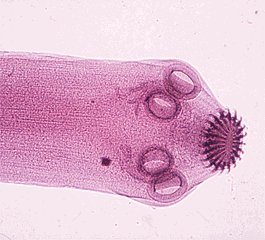
What is the function of the scolex of a tapeworm?
a)
To attach to the intestinal wall of the host
b)
To reproduce
c)
To get rid of waste
d)
To carry the eggs
33.

Planaria
a)
Phylum Platyhelminthes
b)
Phylum Nematoda
c)
Phylum Annelida
34.

What class?
a)
Class Cestoda
b)
Class Trematoda
c)
Class Turbellaria
d)
Class Monogenea
35.
Animals that live and feed off other animals are called ________
a)
planarians
b)
parasites
c)
proglottids
d)
teguments
36.
The body segments of tapeworms are called _______
a)
teguments
b)
proglottids
c)
planarians
d)
nematodes
37.
Which phylum do roundworms belong to?
a)
Turbellaria
b)
Cestoda
c)
Nematoda
d)
Porifera
38.
What phylum do flatworms belong to?
a)
platyhemithes
b)
nematoda
c)
planarian
d)
cnidaria
39.
Concentration of nerves and other sensory organs on the anterior (front) end of the body is called____
a)
acoelmate
b)
cestoda
c)
cephalization
d)
tegument
40.
blind gut cavity with a single opening for both food and waste products; forms the intestines of flatworms
a)
flame cells
b)
sub-epidermal nerve plexus
c)
gastrovascular cavity
d)
statocysts
41.
flatworm class consisting of endoparasitic flukes with flat, leaf-like bodies; complicated life cycle; infection sites include lung, liver, or bloodstream
a)
Class Turbellaria
b)
Class Trematoda
c)
Class Cestoda
d)
Class Monogenea
42.
class of flatworms consisting of tapeworms; parasitic in digestive track of all vertebrates; have proglottids that break off to disperse eggs; scolex attaches them to their vertebrate host's intestines
a)
Class Turbellaria
b)
Class Trematoda
c)
Class Cestoda
d)
Class Monogenea
43.
only free-living class of flatworms; mostly marine, some freshwater, and a few are terrestrial; marine forms are very colorful
a)
Class Turbellaria
b)
Class Trematoda
c)
Class Cestoda
d)
Class Monogenea
44.
life cycle that requires multiple hosts in order to continue to the next stage of development and become sexually mature
a)
direct life cycle
b)
complicated life cycle
c)
intermediate host species
d)
metamorphosis
45.
host species in which a parasite larvae undergoes a portion of its development; larvae may reproduce asexually inside this host
a)
direct life cycle
b)
complicated life cycle
c)
intermediate host species
d)
metamorphosis
46.
parasitic flukes that are dioecious and live in the veins near the intestines or bladder; larvae enters human host by penetrating skin (hair follicles); schistosomes
a)
Chinese liver
b)
blood flukes
c)
beef tapeworm
d)
rat lung fluke
47.
specialized organ used to attach a tapeworm to a host; can have suckers, hooks, or tentacles
a)
scolex
b)
ocelli
c)
gastrovascular cavity
d)
chemoreceptors
48.
light sensitive eye spots
a)
scolex
b)
ocelli
c)
gastrovascular cavity
d)
chemoreceptors
49.
having both male and female parts in one individual
a)
monoecious
b)
dioecious
c)
diploblastic
d)
triploblastic
50.
males and females are separate individuals
a)
monoecious
b)
dioecious
c)
diploblastic
d)
triploblastic
51.
invertebrate that carries a disease-causing organism from one host to another host
a)
dead-end host
b)
intermediate host
c)
invertebrate vector
d)
final host
52.
Most common roundworm infection in the US is caused by the
a)
pinworm
b)
heartworm
c)
roundworm
d)
whipworm
53.
Which of these is a common way that parasitic worms can be transmitted?
a)
fecal-oral contact
b)
arthropod vectors
c)
consuming contaminated food or water
d)
all of these are ways you can get worms!
54.
Elephantiasis and heartworm are both caused by _______________ worms.
a)
flat
b)
filarial
c)
tape
d)
marine
55.
Which of these is a common vector of filarial worms?
a)
mosquitos
b)
flies
c)
crustaceans
d)
ticks
56.
Causes cysts in brain and results in blindness, serious neurological symptoms, or death
a)
pork tapeworm
b)
beef tapeworm
c)
dog tapeworm
d)
Schistosoma (blood fluke)
57.
Blood fluke
a)
Schistosoma
b)
Chlonorchis sinensis
c)
Taenia saginatus
d)
Diplidium caninum
58.
Which class of Mollusks include clams, oysters, and mussels?
a)
Gastropoda
b)
Bivalvia
c)
Cephalopoda
d)
Polyplacophora
59.
Which class of Mollusks include squid, cuttlefish and octopus?
a)
Gastropoda
b)
Bivalvia
c)
Cephalopoda
d)
Polyplacophora
60.
Which class of Mollusks includes snails, slugs, or nudibranches?
a)
Cephalopoda
b)
Bivalvia
c)
Gastropoda
d)
Polyplacophora
61.
Which part of the Mollusk body is the tissue covering the body and secretes the shell?
a)
Mantle
b)
Trochophore
c)
Foot
d)
Visceral Mass
62.
Which class of Mollusks include organisms that have camera-like eyes similar to humans?
a)
Gastropoda
b)
Bivalvia
c)
Cephalopoda
d)
Polyplacophora
63.
Which class of Mollusks have the most advanced nervous system?
a)
Gastropoda
b)
Bivalvia
c)
Cephalopoda
d)
Polyplacophora
64.
Which of the following is the kidney-like structure used by Mollusks for excretion?
a)
gills
b)
nephridia
c)
mantle
d)
visceral mass
65.
Which class of Mollusks have a closed circulatory system?
a)
Gastropoda
b)
Bivalvia
c)
Cephalopoda
d)
All of the classes
66.

Mollusk's tongue-like strip covered with teeth that point backward is called the ____
a)
mantle
b)
radula
c)
gills
d)
visceral mass
67.
The phylum_____________ includes many soft bodied organisms such as snails, slugs, squids, clams, and octopods.
a)
Porifera
b)
Cnidaria
c)
Mollusca
d)
Ctenophora
68.
The small body cavity found in mollusks that surround the heart, gonads, and nephridia is called a ______
a)
coelom
b)
gastrovascular cavity
c)
triploblast
d)
radula
69.
What are the 2 main regions of a mollusks body?
a)
head-foot and visceral mass
b)
visceral mass and shell
c)
mantle and head-foot
d)
visceral mass and mantle
70.
The _____ of mollusks is responsible for secreting the shell.
a)
mantle
b)
radula
c)
visceral mass
d)
veliger
71.
The rasping structure used for feeding in mollusks is called the
a)
veliger
b)
radula
c)
odontophore
d)
protostyle
72.
The space between the mantle and the foot of a mollusk is called the
a)
mantle cavity
b)
gastrovascular cavity
c)
coelom
d)
radula
73.

An octopus uses its siphon (aka funnel) to
a)
force water out so it can take off like a rocket
b)
filter food from the water
c)
pick up clams and lobsters
d)
hide
74.
Which of these cephalopods has an external shell?
a)
cuttlefish
b)
squid
c)
octopus
d)
nautilus
75.

The cells in skin of cephalopods that allow them to change colors are called
a)
pigmentocytes
b)
chromatophores
c)
dermatophores
d)
branchiocytes
100 %

