
NEW
Font size
S
M
L
XL
 Worksheets
1st Semester Final Exam Review
Total questions: 65
Worksheet time: 3hrs 12mins
Name
Class
Date
1.
Which of these layers is ALL solid iron and nickel?
a)
inner core
b)
outer core
c)
lithosphere
d)
mesosphere
2.
Where does the heat come from that drives this convection current in the mantle?
a)
The sun
b)
The crust
c)
the mantle
d)
the core
3.
What are the two types of crust?
a)
continental and oceanic
b)
ocean and upper
c)
lower and upper
d)
pizza and subway
4.
Earthquakes and volcanoes are most likely found at which locations?
a)
At plate boundaries
b)
in oceans
c)
in the middle of continents
d)
in the middle of plates
5.

The Himalayan Mountains in Asia are an example of what type of plate boundary?
a)
Divergent
b)
Continent-to-Continent Convergent
c)
Ocean-to-Continent Convergent
d)
Transform
6.

What is the name of the plate boundary that slides past each other?
a)
Divergent
b)
Convergent
c)
Transform
d)
Mr. C the Slide Man
7.
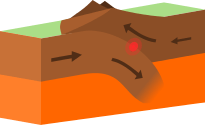
What type of plate boundary is this?
a)
Convergent - continental to oceanic collision
b)
Divergent
c)
Convergent - continental to continental collision
d)
Transform
8.

Which kind of plate boundary is this?
a)
divergent boundary
b)
transform boundary
c)
convergent boundary (ocean to continent)
d)
convergent boundary (continent to continent)
9.

Which kind of plate boundary is this?
a)
divergent boundary
b)
transform boundary
c)
convergent boundary (ocean to continent)
d)
convergent boundary (continent to continent)
10.
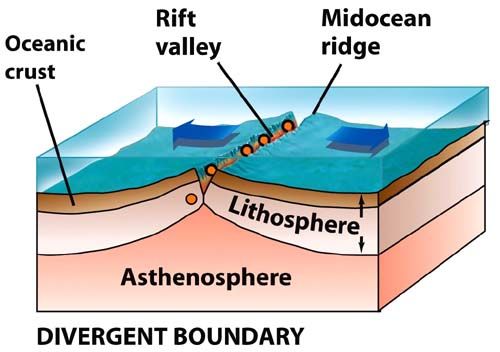
What kind of plate boundary is shown here?
a)
divergent
b)
convergent
c)
transform
d)
strike slip
11.
How does any rock become metamorphic?
a)
heat and pressure
b)
compaction and cementation
c)
melting and cooling
d)
weathering and erosion
12.
How does any rock become igneous?
a)
heat and pressure
b)
melting and cooling
c)
compaction and cementation
d)
weathering and erosion
13.
The name rock is given when it is broken down into smaller pieces.
a)
texture
b)
weathering
c)
sediment
d)
erosion
14.

This rock cooled on the outside of a volcano and contained air bubbles when it was forming. What type of rock is this?
a)
Sedimentary
b)
Intrusive Igneous
c)
Extrusive Igneous
d)
Metamorphic
15.

This rock was another type of rock that was heated and put under pressure over time. What type of rock is this?
a)
Sedimentary
b)
Intrusive Igneous
c)
Metamorphic
d)
Extrusive Igneous
16.

This rock was formed by smaller pieces of rock that settled at the bottom of a lake millions of years ago. What type of rock is this?
a)
Sedimentary
b)
Intrusive Igneous
c)
Metamorphic
d)
Extrusive Igneous
17.

By definition, a mineral has which of the following characteristic(s)?
a)
chemical composition
b)
crystalline structure
c)
natural
d)
all of the above
18.
A mineral is an organic object.
a)
True
b)
False
19.

Which mineral property is being shown here?
a)
luster
b)
hardness
c)
cleavage
d)
streak
20.
Which of the following is NOT true of minerals?
a)
They are liquids
b)
They are formed in nature
c)
They are inorganic
d)
They have crystalline structure
21.
Which of the following properties does the Mohs scale measure?
a)
Luster
b)
Hardness
c)
Density
d)
Streak
22.
___________ is the color of powder that a mineral leaves behind.
a)
Luster
b)
Streak
c)
Fracture
d)
Cleavage
23.
___________ describes how a mineral reflects light.
a)
cleavage
b)
magnetic
c)
luster
d)
streak
24.

What percentage of our energy use comes from fossil fuels?
a)
25%
b)
45%
c)
61%
d)
86%
25.
Which of the following is an example of a NONRENEWABLE RESOURCE?
a)
water
b)
wind
c)
coal
d)
biomass
26.
Why are fossil fuels considered nonrenewable resources if they are still forming beneath the surface today?
a)
They are being formed as a type of methane which we cannot use.
b)
They are being formed too far beneath the surface.
c)
The fossil fuels are being broken down by a natural process.
d)
We are using the fossil fuels much faster than they can form.
27.
Some power plants pump water down deep holes into hot rock. The hot rock heats the water, which turns the water into steam. The steam rushes back to Earth’s surface and is used to make electricity. This plant is generating which alternative/renewable energy resource?
a)
biomass
b)
wind
c)
solar energy
d)
geothermal energy
28.
Which of the following is the BEST example of conserving a RENEWABLE resource?
a)
Turning off the water between washing dishes.
b)
Turning on the water between washing dishes.
c)
Taking long showers.
d)
Riding a bike to school.
29.
Deposition is the dropping off or settling down of sediment. Which of the following does NOT cause deposition to occur?
a)
Moving water in a river
b)
High temperatures in the area
c)
Strong winds blowing
d)
Waves crashing on the shore
30.
Where do earthquakes and volcanoes happen MOST often?
a)
In the middle of countries
b)
In the middle of oceans
c)
At plate boundaries
d)
At continental boundries
31.
All of the following are tests that can be done to identify a mineral except for which one?
a)
Luster
b)
Streak
c)
Hardness
d)
Length
32.
Which of the following processes breaks down rock and causes the mineral composition of rocks to change?
a)
Erosion
b)
Deposition
c)
Chemical Weathering
d)
Mechanical Weathering
33.
A fish fossil was found at the top of the tallest mountain on Earth. What is this fossil evidence of?
a)
Fish once lived on the tops of the tallest mountains without water
b)
The crust of the mountain was once oceanic crust and is now continental crust.
c)
Oceans can form wherever they want.
d)
Mountain dwelling people bury their fish bones in mountains.
34.
Which layer of the Earth is the thinnest?
a)
Crust
b)
Mantle
c)
Outer Core
d)
Inner Core
35.
Which layer of the Earth is the thickest and is made of magma?
a)
Crust
b)
Mantle
c)
Outer Core
d)
Inner Core
36.
Which layer of the Earth is liquid iron and nickel?
a)
Crust
b)
Mantle
c)
Outer Core
d)
Inner Core
37.
Which layer of the Earth is solid iron and nickel?
a)
Crust
b)
Mantle
c)
Inner Core
d)
Outer Core
38.
Which of the following BEST shows the relationship between erosion and deposition?
a)
The dropping of sand on a beach.
b)
Rocks in a river hitting each other and breaking down.
c)
Waves crashing on the shore and breaking apart rock.
d)
Ocean currents carrying sediment and dropping it to create a barrier island.
39.
Which of the following is the BEST example of weathering?
a)
Waves crashing against a rock and breaking it into smaller pieces.
b)
Ocean waves dropping sediment on a beach.
c)
Wind moving sediment through the air.
d)
Water moving pebbles down a stream.
40.
Which of the following is an example of conserving a RENEWABLE resource in your home?
a)
Keeping the water on while you brush your teeth.
b)
Taking long showers.
c)
Using the washing machine only when you have a full load of laundry.
d)
Turning off the lights when you leave a room.
41.
As you dig into the Earth, what happens to density, pressure, and temperature as you move towards the core?
a)
They all increase
b)
They all decrease
c)
They all stay the same
d)
Temperature increases while density and pressure decreases
42.
What is the relationship between rocks and minerals?
a)
Rocks are made of minerals.
b)
Minerals are made of rocks.
c)
Rocks are not minerals.
d)
Minerals and rocks are both organic.
43.
Which student explains convection currents correctly?
Student A - The core heats up the mantle, and warm, less dense magma begins to rise. Once it reaches the top of the mantle, the magma cools off, becoming more dense and sinks.
Student B - The core heats up the mantle, and cool, more dense magma begins to rise. Once it reaches the top of the mantle, the magma heats up, becoming less dense and sinks.
Student C - The mantle heats up the core, and warm, less dense magma begins to rise. Once it reaches the top of the core, the magma cools off, becoming more dense and sinks.
Student D - The mantle heats up the core, and cool, more dense magma begins to rise. Once it reaches the top of the core, the magma heats up, becoming less dense and sinks.
Student A - The core heats up the mantle, and warm, less dense magma begins to rise. Once it reaches the top of the mantle, the magma cools off, becoming more dense and sinks.
Student B - The core heats up the mantle, and cool, more dense magma begins to rise. Once it reaches the top of the mantle, the magma heats up, becoming less dense and sinks.
Student C - The mantle heats up the core, and warm, less dense magma begins to rise. Once it reaches the top of the core, the magma cools off, becoming more dense and sinks.
Student D - The mantle heats up the core, and cool, more dense magma begins to rise. Once it reaches the top of the core, the magma heats up, becoming less dense and sinks.
a)
Student A
b)
Student B
c)
Student C
d)
Student D
44.
Which of the following contributed the MOST to a rise in global temperatures in the past 100 years?
a)
Wind farms producing energy for a town
b)
Using solar panels to power your house
c)
Using biomass to power a farm
d)
Burning fossil fuels in a factory
45.

The geologic event in this image was created by the rapid movement of sediment down the side of a mountain. What is this image showing?
a)
River
b)
Landslide
c)
Volcano
d)
Mid-Ocean Ridge
46.

Which of the following will most likely form at a divergent boundary?
a)
Mountain
b)
Mid-Ocean Ridge
c)
Island Arc
d)
Volcanic Mountain
47.
Which layer has the most humus?
a)
Topsoil
b)
Subsoil
c)
Parent Material
d)
Bedrock
48.
You have decided to stop depending on fossil fuels in your everyday life. What question would be the BEST in helping you make this life change?
a)
What renewable resources are available in your area?
b)
What nonrenewable resources are available in your area?
c)
How many times do you use technology in one day?
d)
How many people live in your house?
49.
How will we use renewable and nonrenewable resources in the future?
a)
We will use nonrenewable resources ONLY.
b)
We will use renewable resources ONLY
c)
We will use both types of resources
50.
Describe what causes an earthquake.
a)
Convection currents in the asthenosphere speed up which cause the plates to move fast and shake.
b)
Convection currents in the asthenosphere stop, which cause the plates to stop moving, which causes an earthquake.
c)
Convection currents in lithosphere stop, which cause the plates to stop moving, which causes an earthquake.
d)
Convection currents in the asthenosphere move the the plates. This causes the plates to get stuck. When they get unstuck, this causes an earthquake.
51.
What is a non-renewable resource?
a)
Paper
b)
You can`t reuse them
c)
A plastic bottle
d)
You can reuse
52.
Which of the answer choices below shows the CORRECT tests that are used to identify minerals?
a)
Luster, streak, color, hardness
b)
Luster, color, state of matter, shape
c)
Color, hardness, state of matter, length
d)
Streak, hardness, length, magnetic
53.
A scientist found fossils of ferns in Antarctica. These plants are tropical. How has Antarctica's climate changed over time?
a)
Antarctica has always been in its current position on Earth and has always been cold.
b)
Antarctica was once closer to the equator and had a warmer climate. It moved due to plate tectonics.
c)
Antarctica was closer to the North Pole and had a colder climate. It moved due to plate tectonics.
d)
Fossil evidence tells us nothing about past climate of the world.
54.
Which of the following will cause the MOST erosion?
a)
Planting a garden in your backyard
b)
Planting trees at your school
c)
Picking up trash by the highway
d)
Chopping down all of the trees in a forest to build a mall.
55.
Which question would BEST help to determine if a resource is renewable or nonrenewable?
a)
Does the resource take up more space than other resources?
b)
Does the resource cost more than other resources?
c)
Can the resource be replaced as fast as it is consumed (used)?
d)
Can the resource cause pollution?
56.
Why is coal considered a nonrenewable resource?
a)
It is nonrenewable because it takes millions of years to replace.
b)
It is nonrenewable because it can be replaced easily.
c)
It is nonrenewable because it creates carbon dioxide.
d)
It is nonrenewable because it came from something that was once living.
57.

Which answer choice BEST describes how this geologic feature formed?
a)
Ocean waves carried sediment to the mouth of the river and dropped it, creating a delta over time.
b)
Ocean waves carried sediment to the mouth of the river and dropped it , creating a mountain over time.
c)
The river carried sediment to the ocean and dropped it, creating a delta.
d)
The river carried sediment to the ocean and dropped it, creating a barrier island.
58.
A farmer wants to conserve the nutrients in her soil by switching the crops that she plants in the fields each year. During the 1st year, she plants corn in field 1 and potatoes in field 2. In the 2nd year, she plants potatoes in field 1 and corn in field 2. What is this soil conservation practice known as?
a)
Terracing
b)
Contour Plowing
c)
Cover Crop
d)
Crop Rotation
59.
Explain how mountains form on Earth.
a)
1 oceanic and 1 continental plate separate at divergent boundaries due to convection currents in the mantle.
b)
2 oceanic plates collide at convergent boundaries due to convection currents in the mantle.
c)
2 continental plates collide at convergent boundaries due to convection currents in the mantle.
d)
2 continental plates collide at divergent boundaries due to convection currents in the mantle.
60.
What is the composition (made of) of soil?
a)
Just organic stuff
b)
Just rocks
c)
Just inorganic stuff
d)
Weathered rocks and organic stuff
61.
Which of the following is an example of water conservation?
a)
Repairing leaky faucets
b)
Turning off faucets while brushing your teeth
c)
Using rainwater to water your grass
d)
All of the above
62.
What is a renewable resource?
a)
An object you can reuse
b)
An object you cannot reuse
c)
Fossil fuels
d)
Oil
63.
List the names of the soil profile from top to bottom.
a)
topsoil, bedrock, subsoil
b)
subsoil, topsoil, bedrock
c)
topsoil, subsoil, bedrock
d)
bedrock, subsoil, topsoil
64.
How have weathering, erosion, and deposition shaped the Grand Canyon over the years?
a)
Weathering has moved the rock, erosion has broken down the rock, and deposition has dropped the rock off and created new landforms.
b)
Weathering has broken down rock, erosion has moved the rock, and deposition has dropped the rock and created new landforms.
c)
Weathering has dropped the rock and created new landforms, erosion has moved the rock, and deposition has broken down the rock.
d)
Weathering has broken down the rock, erosion has dropped the rock and created new landforms, and deposition has moved the rock.
65.
You collected layers of soil and placed them in a jar. Are the following layers correct?
1. Humus
2. Partly weathered rock
3. Clay
4. Bedrock
1. Humus
2. Partly weathered rock
3. Clay
4. Bedrock
a)
No - Clay is supposed to be above partly weathered rock because it is more broken down than weathered rock.
b)
No - clay is supposed to be above partly weathered rock because it is less broken down than weathered rock.
c)
Yes - because the soil horizons are layered from most broken down to least broken down
d)
Yes - because the soil horizons are layered from least broken down to most broken down
Reset

