
 Worksheets
Science Fusion Grade 5 Unit 4
Total questions: 37
Worksheet time: 1hrs 14mins
Name
Class
Date
1.
Short plants that grow in damp area are most likely....
a)
small
b)
tall
c)
muscular
d)
nonvascular
2.
Vascular plants transport
a)
paper
b)
water
c)
people
d)
liquid
3.
To germinate means to...
a)
shrink
b)
remove
c)
grow
d)
end
4.
An example of a nonvascular plant is
a)
moss
b)
rose
c)
grass
d)
vine
5.
Plants that are able to grow tall are most likely...
a)
angiosperm
b)
vascular
c)
xylem
d)
muscular
6.
Which of the following describes a dichotomous key?
a)
A chart with many choices that guide you to the correct identification or classification of a thing
b)
a guide to the six kingdoms of life
c)
a long list of questions with yes or no answers
d)
a ranking of classifications starting with a broad domains and ending with species
7.
Which of the following best states the purpose of a dichotomous key?
a)
To group things by the number of arms or legs it has
b)
To group things by similarities
c)
To identify one type of thing as unique from other types
d)
to ask yes or no
8.
What is the purpose of vascular tissue in plants?
a)
To allow the plant to absorb sunlight for making food
b)
To allow fertilization of an egg so the plant can reproduce
c)
To absorb nutrients and water from the environment like a sponge
d)
To allow the movement of water, nutrients, and sugars across a distance
9.
Mosses, liverworts, and ferns all use which of the following to reproduce?
a)
pollen
b)
spores
c)
angiosperm
d)
gymnosperm
10.
Sue planted two bean seeds in the same kind of soil. She gave them equal amounts of sunlight and water, but she kept the seeds at different temperatures. Each day she recorded whether or not the seeds had germinated. What was the variable?
a)
amount of water
b)
type of soil used
c)
amount of sunlight
d)
temperature of the seed
11.
Which of the following best explains what an adaptation is?
a)
An adjustable life cycle
b)
A trait that an organism inherits from its parents
c)
A trait that helps an individual or species survive in its environment
d)
An ability of an organism to get matter, energy, and protection from its environment.
12.
Mrs. Friske's class was identifying different species of plants. Which of the following best describes a species?
a)
the next more specific classification following an order
b)
a group in which organisms of different kinds are closely related
c)
a unique kind of organism
d)
another name for a family or genus
13.
Mrs. Vlasak's class was studying vertebrates. What are vertebrates?
a)
animals with body parts in segments
b)
animals with spiny skin
c)
animals with backbones
d)
animals without backbones
14.
Which of the following describes the process called incomplete metamorphosis?
a)
newborn-toddler-child-adult
b)
egg-nymph-adult
c)
egg-larva-pupa-adult
d)
egg-hatchling-adult
15.
Mrs. Hefner's class was studying vertebrates. Which of the following are vertebrates?
a)
ferns, conifers, mosses
b)
brittle stars, sea stars, basket stars
c)
camels, falcons, frogs
d)
crabs, grasshoppers, jellyfish
16.
Which of these terms names male reproduction structures of a flowering plant?
a)
petal, fruit
b)
ovary, ovules
c)
anther, pollen
d)
stigma, nectar
17.
Which of the following is a list of invertebrate groups?
a)
amphibians, fish, reptiles
b)
sloths, spiders, sea urchins
c)
frogs, salamanders, sea turtles
d)
mollusks, arthropods, echinoderms
18.
What is the broadest category of classification?
a)
genus
b)
species
c)
phylum
d)
kingdom
19.
What is the most specific category of classification?
a)
genus
b)
class
c)
species
d)
kingdom
20.
What are animals with backbones called?
a)
invertebrates
b)
vertebrates
c)
mammals
d)
amphibians
21.
What are animals without backbones called?
a)
vertebrates
b)
mammals
c)
reptiles
d)
invertebrates
22.
Brightly colored parts of flowers that attract insects.
a)
petals
b)
pistils
c)
stamen
d)
filaments
23.
They enclose the egg cells inside the ovaries.
a)
ovules
b)
anther
c)
seeds
d)
angiosperms
24.
The transfer of pollen, containing the sperm cells, to the female part of the flower.
a)
seed disperal
b)
pollination
c)
germination
d)
fertilization
25.
This occurs after a tube grows down from the pollen grain through the style to the ovary.
a)
pollination
b)
germination
c)
fertilization
d)
seed dispersal
26.
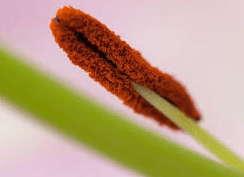
The part of a flower that produces the male reproductive cells.
a)
anther
b)
style
c)
stigma
d)
filament
27.
All plants produce flowers.
a)
True
b)
False
28.
Which of the following, in order, shows the steps in the life cycle of a seed?
a)
germination, pollination, seed dispersal, flowering
b)
germination, growth, maturity, seed formation
c)
seed formation, growth, germination, maturity
29.

The joining of an egg and a sperm cell is called _______
a)
life cycle
b)
pollination
c)
fertilization
d)
seed dispersal
30.

What is the life cycle of seed plants?
a)
germination, growth, maturity, seed formation
b)
growth, maturity, seed formation, seed dispersal
c)
germination, pollination, fertilization,
31.
What attracts insects for pollination?
a)
anther
b)
ovary
c)
stigma
d)
petals
32.
What is a flowering plant that has seeds protected by fruits? (pg. 133)
a)
A) angiosperm
b)
B) gymnosperm
c)
C) spore
d)
D) both A and C
33.
What are angiosperms?
a)
Plants that produces seeds in flowers or fruits.
b)
Plants that produce seeds that are not surrounded by a fruit.
34.
What are gymnosperms?
a)
Plants that produce seeds that are not surrounded by a fruit.
b)
Plants that produces seeds in flowers or fruits
35.
What is complete metamorphosis?
a)
newborn, toddler, child, adult
b)
egg, larva, pupa, and adult.
c)
egg, nymph, adult
d)
egg, hatchling, adult
36.
What is incomplete metamorphosis?
a)
newborn, toddler, child, adult
b)
egg, larva, pupa, and adult.
c)
egg, nymph, adult
d)
egg, hatchling, adult
37.
Which of these terms names male reproduction structures of a flowering plant?
a)
anther and pollen
b)
ovary and ovules
c)
petal and fruit
d)
stigma and nectar
100 %

