
 Worksheets
First Semester Review 8th Grade
Total questions: 91
Worksheet time: 1hrs 6mins
Name
Class
Date
1.
CaCO3 represents a chemical
a)
Symbol
b)
Formula
c)
Subscript
d)
Reaction
2.
In chemical reactions, what does the principle of conservation of mass mean?
a)
Matter is not created or destroyed.
b)
The total mass of the reactants is greater than the total mass of the products.
c)
The total mass of the reactants is less than the total mass of the products.
d)
Matter is not changed.
3.
How many Oxygen (O) atoms are in 2C2HO8Cl2
a)
2
b)
16
c)
8
d)
5
4.
How many Hydrogen (H) atoms are in NH3O5
a)
3
b)
4
c)
5
d)
1
5.
A molecule is________
a)
A cool mole
b)
smaller than an atom
c)
a rat like creature that burrows
d)
more than one atom bonded together
6.
How many elements are in C6H12O6?
a)
1
b)
2
c)
3
d)
4
7.

The reactants in this reaction are Vinegar and Baking Soda. What are the products from this reaction?
a)
Water and Helium
b)
Water and Vinegar
c)
Water and Carbon Dioxide
d)
Carbon and Vinegar
8.

In this image, what are the information in red is called the_______.
a)
Product
b)
Reactant
c)
Chemical Subscript
9.

In this image, what are the information to the right of the arrow (in black) is called the_______.
a)
Product
b)
Reactant
c)
Chemical Subscript
10.
What is the arrow in a chemical equation...
H2 + O --> H2O
H2 + O --> H2O
a)
Reactants
b)
Products
c)
Yields
d)
Chemical Equation
11.
What is the little number after an element in a chemical equation called.
Example: H2
Example: H2
a)
Coefficient
b)
Subscript
c)
Atom
d)
Equation
12.
Balance this equation...
H2 + Cl2 --> HCl
H2 + Cl2 --> HCl
a)
It is balanced
b)
3H2 + Cl2 --> 6H2Cl
c)
H2 + Cl2 --> 2HCl
d)
I don't know! Oh well.
13.
Is this balanced?...
Fe + S --> FeS
Fe + S --> FeS
a)
YES!
b)
NO!
14.
At the end of chemical reactions, what is the total mass of the reactants compared to the total mass of the products?
a)
the product is doubled
b)
the product is half the mass of the reactants
c)
the mass is the same
d)
the mass changes depending on the reaction
15.
The principle that states matter is not created nor destroyed. The atoms present at the beginning of the equation, are present at the end.
a)
law of conversation of Jello
b)
law of conservation of atoms
c)
law of conservation of reactants
d)
law of conservation of mass
16.
chemical equation with the same number of atoms of each element on both sides of the equation
a)
chemical equation
b)
chemical reaction
c)
balanced chemical equation
17.
Which particle has a positive charge?
a)
electron
b)
orbital
c)
proton
d)
neutron
18.
Choose the particle that has no charge.
a)
nucleus
b)
neutron
c)
proton
d)
electron
19.
This causes the mass of the nucleus to increase.
a)
adding an electron
b)
adding a neutron
c)
more orbitals
d)
adding negatively charged particles
20.
An electron has a _____ charge.
a)
negative
b)
positive
c)
neutral
21.
Describe an Electron Cloud?
a)
the mist outside of an atom
b)
home of the protons
c)
where electrons are located
d)
nucleus
22.
What are the maximum number of electrons that go on the first 3 energy levels?
a)
2,4,16
b)
2,8,18
c)
4,8,12
d)
3,4,6
23.
What are valence electrons?
a)
electrons on the first orbital always
b)
nucleus
c)
the outermost shell
d)
the number of electrons on the outermost orbital
24.
Which particles make up the nucleus of an atom?
a)
protons and neutrons
b)
electrons and protons
c)
electrons, protons, and neutrons
d)
electrons and neutrons
25.
The subatomic particle that determines the identity of an element.
a)
neutron
b)
proton
c)
electron
d)
outer shell
26.
What charge does the nucleus have and why?
a)
positive - the neutrons do not have a charge
b)
positive - the neutrons and protons are positively charged particles
c)
neutral - the neutral charge dominates the positive charge
d)
neutral - electrons cancel out the positive charge of the atom
27.
What is the mass number and name of an element with 8 protons and 8 neutrons?
a)
16 - Carbon
b)
16 - Oxygen
c)
24 - Oxygen
d)
8 - Neon
28.
An element with a mass number of 10 and an atomic number of 6 has how many protons?
a)
5
b)
8
c)
6
d)
10
29.
An atom has 10 protons, 15 neutrons and 10 electrons what is its mass number.
a)
20
b)
10
c)
5
d)
25
30.
Elements on the periodic table increase by...
a)
atomic mass
b)
size
c)
mass number
d)
atomic #
31.
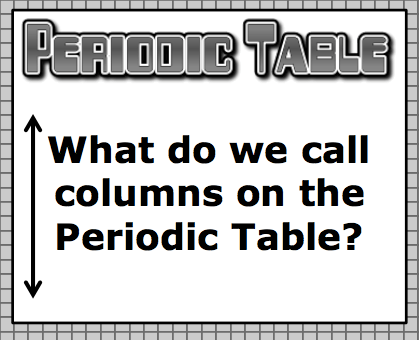
a)
Periods
b)
Groups
32.
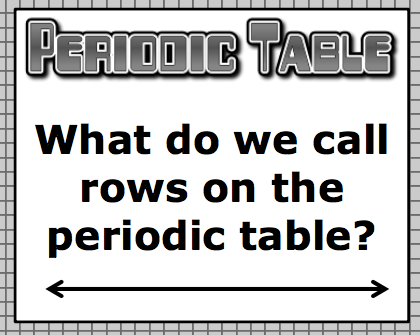
a)
Periods
b)
Groups
33.
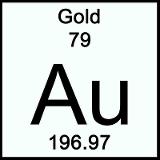
Which number is the atomic mass?
a)
79
b)
196.97
34.
Which group of the periodic table is composed of inert (not reactive) gases?
a)
alkali metals
b)
alkaline earth metals
c)
halogens
d)
noble gases
35.

The atoms along the staircase are called
a)
metals
b)
nonmetals
c)
metalloids
d)
noble gases
36.
Elements on the left side of the periodic table are
a)
metals
b)
nonmetals
c)
metalloids
d)
noble gases
37.

What are the first two elements on the periodic table?
a)
hydrogen and helium
b)
hydrogen and lithium
c)
hydrogen and carbon
d)
nitrogen and helium
38.

In what section would Transition Metals be found?
a)
orange
b)
light blue
c)
blue
d)
white
39.

Which two families on the periodic table react aggressively?
a)
noble gases and alkali metals
b)
alkali metals and halogens
c)
noble gases and halogens
d)
metals and halogens
40.
Which of the following is not a property of metals?
a)
brittle
b)
malleable
c)
lustrous
d)
conductive
41.

The atomic number of this pictured element is
a)
28
b)
58.6934
c)
Ni
d)
Nickel
42.

Which section are the metals in?
a)
dark blue
b)
light blue
c)
purple
d)
pink
43.
True or False: Elements in a group have the same number of electrons in their outer shell.
a)
true
b)
false
44.
Metalloids can be described as...
a)
same as nonmetals
b)
bad conductors
c)
characteristics of metals and nonmetals
d)
same as metals
45.
Which is an alkali metal?
a)
Magnesium
b)
Iron
c)
Sodium
d)
Europium
46.
Which is a halogen?
a)
Helium
b)
Chlorine
c)
Oxygen
d)
Neptune
47.
What law is best described by inertia?
a)
1st
b)
2nd
c)
3rd
48.
Object at rest stays at rest.
a)
1st
b)
2nd
c)
3rd
49.
F = MxA
a)
1st
b)
2nd
c)
3rd
50.
Objects attraction to one another - like us to earth.
a)
Friction
b)
Inertia
c)
Force
d)
Gravity
51.

A person not paying attention while skateboarding hits a rock. The skateboard stops...they don't.
a)
The Law of Inertia
b)
The Law of Acceleration
c)
The Law of Conservation of Momentum
52.

A soccer ball accelerates more than a bowling ball when thrown with the same force.
a)
Law of Inertia
b)
Law of Acceleration
c)
Law of Conservation of Momentum
53.

When you step on a Lego. You push on the Lego and the Lego pushes back on you.
a)
Newton's 1st Law
b)
Newton's 2nd Law
c)
Newton's 3rd Law
54.
Which type of force(s) will cause a change in an object's motion?
a)
gravity
b)
zero net force
c)
balanced forces
d)
unbalanced forces
55.

What is the net force?
a)
10 N
b)
0 N
c)
25 N
d)
1 N
56.
What is the unit to MEASURE force?
a)
Kilogram
b)
Meter
c)
Pascal
d)
Newton
57.

If these teams are pulling with the same amount of force what will happen?
a)
The boy in blue will win.
b)
They will not move at all.
c)
The boy in red will win.
d)
Both will fall down.
58.

Balanced or Unbalanced?
a)
Balanced
b)
Unbalanced
59.

What is the net force?
a)
400 N Up
b)
400 N Down
c)
- 400 N Down
d)
800 N Down
60.
Unit of mass
a)
m/s 2
b)
m/s
c)
newtons
d)
kg
61.
What is the formula for force?
a)
F=M/A
b)
F=A/M
c)
F=M*A
d)
F=M*F
62.
45 m/s2 is the...
a)
Mass
b)
Force
c)
Acceleration
d)
weight
63.
According to Newton’s first law of motion, a moving object that is not acted on by an unbalanced force will
a)
remain in motion.
b)
eventually come to a stop.
c)
change its momentum.
d)
accelerate.
64.
F=MA
An object of mass 10 kg is accelerated upward at 2 m/s2. What force is required?
An object of mass 10 kg is accelerated upward at 2 m/s2. What force is required?
a)
20 N
b)
2 N
c)
5 N
d)
0 N
65.

It’s okay to pick up broken glass with your bare hands as long as the glass is placed in the trash.
a)
True
b)
False
66.

You are allowed to enter the chemical preparation/storage area any time you need to get an item.
a)
True
b)
False
67.

When you finish working with chemical, biological specimens and other lab substances, always:
a)
treat your hands with skin lotion.
b)
wipe your hands on a towel.
c)
wash your hands thoroughly with soap and water.
d)
wipe your hands on your clothes.
68.

The method for safely determining the odor of a chemical is called:
a)
decanting.
b)
inhaling.
c)
wafting.
d)
stirring.
69.

All unauthorized experiments are prohibited.
a)
True
b)
False
70.

Never remove chemicals or other equipment from the laboratory.
a)
True
b)
False
71.

Horseplay or practical jokes in the laboratory is:
a)
not dangerous.
b)
always against the rules.
c)
okay.
d)
okay if you are working alone.
72.

Personal eyeglasses provide as much protection as:
a)
a face shield.
b)
safety glasses.
c)
splash proof or chemical goggles.
d)
none of the above
73.
A car travels 30 miles/hr for 3 hours, calculate the distance it will travel
a)
90 miles
b)
10 miles
c)
600 miles
d)
90 km
74.
What is the equation to calculate distance?
a)
distance = speed/time
b)
distance = time/speed
c)
distance = speed/distance
d)
distance = speed x time
75.
A train travels 25 km in .5 hrs. How fast is the train going?
a)
25 miles/hr
b)
5 miles/hr
c)
125 km/hr
d)
50 km/hr
76.
A speed boat travels 200 miles at a speed of 20 miles/hr. How much time will it take to travel the 200 miles?
a)
10 hrs
b)
10 miles
c)
400 hrs
d)
100 km
77.
Dave runs a 400 m race with a speed of 4 m/s. What time will it take him to finish the race?
a)
400 minutes
b)
100 minutes
c)
100 seconds
d)
.25 seconds
78.
What is the force of an object with a mass of 30 kg and an acceleration of 10 m/s2?
a)
300
b)
3
c)
20
d)
40
79.
Calculate the acceleration of a 150 kg object that is moved with a force of 300N.
a)
2
b)
150
c)
.5
d)
450
80.
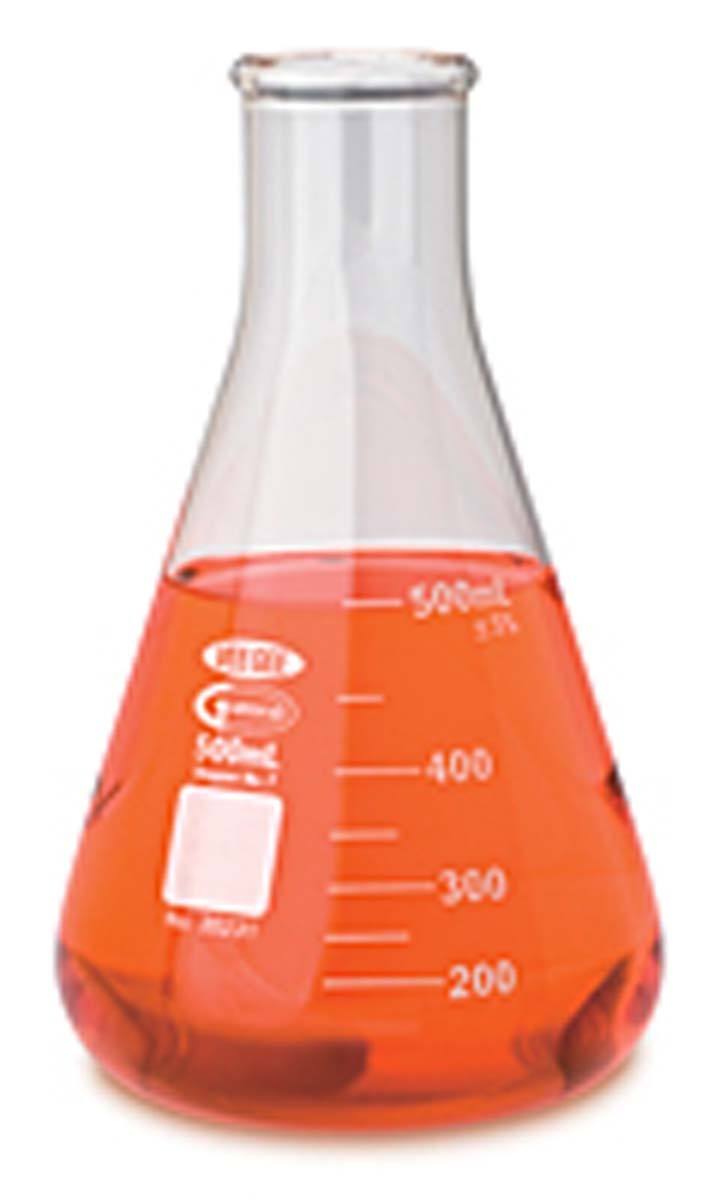
What is used to store or heat chemicals?
a)
Beaker
b)
Flask
c)
Test Tube
d)
Graduated Cylinder
81.

What is used to measure the volume of liquids more precisely in milliliters?
a)
Beaker
b)
Flask
c)
Graduated Cylinder
d)
Test tubes
82.

Used to measure length and distance in the metric system
a)
Graduated cylinder
b)
Triple beam balance
c)
Thermometer
d)
Meter stick
83.

What is used to measure and mix large amounts of liquids?
a)
Beaker
b)
Flask
c)
Test Tube
d)
Graduated Cylinder
84.
What tool would a student use to find out if a toy car traveled faster down a metal ramp or a wood ramp?
a)
graduated cylinder
b)
pan balance
c)
stopwatch
d)
thermometer
85.

Identify this element.
a)
Neon
b)
Colbalt
c)
Hydrogen
d)
Nitrogen
86.

Identify this element.
a)
Neon
b)
Cobalt
c)
Hydrogen
d)
Nitrogen
87.

Identify this element.
a)
Neon
b)
Cobalt
c)
Hydrogen
d)
Nitrogen
88.

Identify this element.
a)
Neon
b)
Cobalt
c)
Hydrogen
d)
Nitrogen
89.
An object at rest stays at rest and an object in motion stays in motion with the same speed and in the same direction unless acted upon by an unbalanced force. (Law of Inertia)
a)
1st Law
b)
2nd Law
c)
3rd Law
d)
4th Law
90.

The acceleration of an object as produced by a net force is directly proportional to the magnitude of the net force, in the same direction as the net force, and inversely proportional to the mass of the object.
a)
Newton's 1st Law
b)
Newton's 2nd Law
c)
Newton's 3rd Law
d)
Newton's 4th Law
91.
"For every action, there is an equal and opposite reaction."
a)
Newton's 1st Law
b)
Newton's 2nd Law
c)
Newton's 3rd Law
d)
Newton's 4th Law
100 %

