
 Worksheets
Music 5&6 Summative Test 3
Total questions: 95
Worksheet time: 1hrs 2mins
What scale do these pitches in this order represent? C D E F G A B C
It is defined as the sequence of pitches in a melody that creates a distinct shape when visually represented on a musical staff.
It makes use of notes far away from each other.
Single notes
Melodic patterns
Wide melodic range
Close melodic range
A melodic range that makes use of notes near each other.
Narrow melodic range
Wide melodic range
This scale is made out of five notes only. This scale has been around for a long time and is used in ancient music.
Chromatic scale
Pentatonic scale
A set of notes arranged in order of pitch, either ascending or descending.
A type of interval that sounds farther from one note to the other. It has a key between two pitches.
Wide Interval
Whole Step
Half Step
A type of interval that sounds nearer from one note to the other. It has no key between two pitches.
wide interval
whole step
Half step
octave
What does penta means in Greek?
What are the pitches involved in C Major Pentatonic Scale?
C, D, E, G, A
B, C, D, E, F
What is the home tone or root of C Major Scale?
What is the pattern of whole step and half step in major scale?
The order of pitches in G major scale.

What pitch has a sharp accidental based on the picture below?
D#
F#
How are melodic contours visualized?
Melodic contours are visualized by plotting note durations on a graph.
Melodic contours are mapped by drawing the emotional reactions to a melody.
Melodic contours are visualized using simple graphs showing pitch movements.
Melodic contours are represented by detailed musical scores showing dynamics.
People tend to hear major scales as sounding...
"happy" or "bright"
"windy" or "cold"
“dark" or "gloomy"
"scared" or "worried"
By what interval do sharp signs "#" and flat signs "b" raise or lower pitches?
half step
c major
whole step
g major
What scale do these letters in this order represent?
A# major
Ab major
A major
C# major
What major scale is this?
C major
D major
A major
C# major
What is the melodic contour of the picture below?
Ascending
Descending
Repeated
The interval of these 2 notes is_________.
5th
6th
7th
Octave
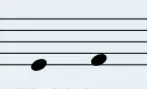
Identify whether the interval is a whole step or half step.
Whole Step
Half Step
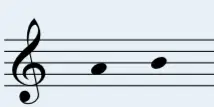
Identify whether a whole step or a half step.
Whole Step
Half Step
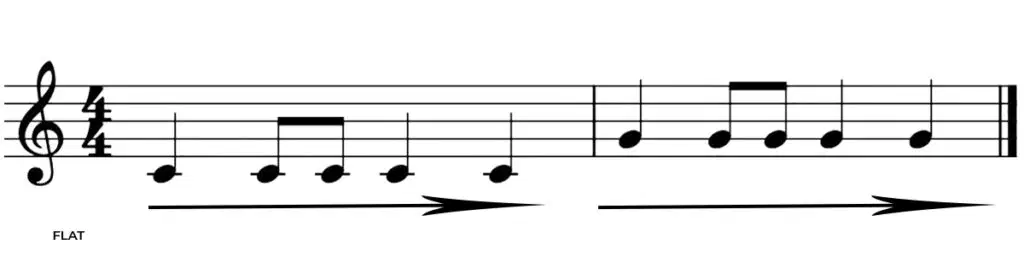
What melodic contour is shown?
Repeated
Where you can find the first note on the staff in C Major Scale?
First ledger line below the staff
First space
2nd line
2nd space
The most common diatonic scale is the MAJOR scale. This scale follows the pattern of _________.
WS-WS-WS-HS-WS-WS-HS
WS-WS-HS-WS-WS-HS-WS
WS-WS-HS-WS-WS-WS-HS
WS-WS-HS-WS-WS-HS-HS
A minor melody sounds ________ , while a major melody sounds _________.
confident; confused
triumphant; serious
sad; happy
happy; sad
A descending melody moves ___________ , while an ascending melody moves ___________.
slowly; quickly
upward; downward
quickly; slowly
downward; upward
It is used as the framework to create melodies. It suggest different emotions, scenes, and seasons.
How do you get the melodic range of the notes?
What is the interval between the notes C and E?
Perfect fifth
Perfect fourth
Minor third
Major third
What is the Latin term for scale?
scale
scala
scaled
It is a musical symbol that raises the pitch of a note by a half step.
clef
sharp
flat
It is a musical symbol that lowers the pitch of a note by a half step.
clef
sharp
flat
How many notes in a scale arranged in an ascending and descending order?
5 notes
8 notes
10 notes
It is the only key without flats or sharps.
Key of C Major
Key of G Major
Key of F Major
It has one sharp on the fifth line of the staff.
Key of C Major
Key of G Major
Key of F Major
It has one flat on the third line of the staff.
Key of C Major
Key of G Major
Key of F Major
What type of scale is used in most of the pop music you hear on Top 40 radio?
Diatonic scale
Pentatonic scale
Chromatic scale
Dialectic scale
What can you conclude about the F major scale from its name?
Its root is F
Its interval is F
Its major third is F
Its minor triad is F
If the root of a scale is D flat, the eighth note in the scale is:
E
D natural
D natural
D flat
"Fa" represents the ______ tone in an eight-note scale.
First
Second
Third
Fourth
Which of the following describes an interval of one half-step?
F to F sharp
A to C
B flat to C sharp
F major to F minor
A song in a minor key is most likely to be:
A football fight song
A sad ballad
A popular dance track
A fun sing-along
Which of the following statements is true?
In a C major scale, C has a higher pitch than D
In a C minor scale, C has a higher pitch than F
In a C major scale, F has a higher pitch than C
In a C minor scale, C has a higher pitch than D
If a song is written in the key of E minor:
Most of the notes in the song will be taken from the E Minor scale
All of the notes in the song must be taken from the E Minor scale
Only notes from the E Minor and E Major scales can be used
Notes from the E major scale cannot be used
The relative minor key follows the same home tone do as its parallel major key.
TRUE
FALSE
The home tone is the beginning note of a minor scale.
TRUE
FALSE
The parallel minor keys follow the same pattern of whole tones and half tones.
TRUE
FALSE
Minor scales follow the interval pattern: WS-HS-HS-WS-WS-HS-WS.
TRUE
FALSE
An interval is ___________________.
the distance between notes.
the highest and lowest notes in a melody
how loud or quiet a note is
the shape of a melody
It tells the mid-range to low-range pitches.
Bass clef
Major clef
Treble clef
Baritone Clef
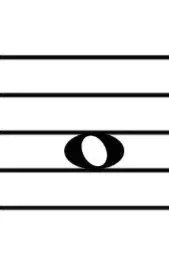
What pitch is this?
A
C
B
D
Why is the bass clef also called an F-clef?
Because its curl encircles the note G on the second line of the staff.
Because the second line from the top is the line for the pitch F, where the two dots are placed on the spaces above and below the line.
Because the pitch starts in F.
It is a short extra line used for pitches that are outside of the staff. Middle C also distinguishes other Cs in a higher or lower pitch.
Musical line
Extended line
Extra line
Ledger line
How do you call an interval between C and D?
2nd
3rd
4th
unison
How many notes make an octave?
7
8
5
4
It merges when a sequence of intervals is used over and over again in a song
Melodic Pattern
Melodic Direction
Melodic Interval
This symbol cancels out any accidental applied to a pitch. It signifies the return to the original pitch.
Flat
Sharp
Natural
Clef
The melody can either go up, down, or repeat.
Melodic Pattern
Melodic Direction
Melodic Interval

Tukuyin ang mga pitch names. Anong salita ang nabuo sa larawan?
FADED
FACADE
FEED
CABBAGE

Isulat ang mga pitch names para makabuo ng salita
(a)

Isulat ang mga pitch names para makabuo ng salita
(a)
There are three steps between two notes.
Unison
Third interval
Octave
Half step
The smallest interval used in music.
Seventh interval
Octave
Half step
Unison
Two notes are written on the same line or space and have the same pitch.
Second interval
Octave
Unison
Half step

What pitch is this?
A
B
C
D
These are the syllable names of each pitch which are used in singing?
letter names
syllable names
lyrics
sol-fa syllables
These are the notes found on the lines of the staff G-clef?
A, C, E, G
A, B, C, D,
E, G, B, D, F
G, B, D, F,A
Which refers to steady even pulse?
Beat
Rhythm
Pitch

What are the syllables for this pattern?
Ti Re
Do So
Do Mi
Re Sol
What is this musical element that is considered the most expressive and meaningful?
Pitch
Interval
Tonal Movement
Melody
It is the alter pitch of the notes.
scale
interval
staff
accidentals

What is the scale of the given staff above?
whole step
half step

What is the scale of the given staff above?
whole step
half step

What is the scale of the given staff above?
whole step
half step

What is the scale of the given staff above?
whole step
half step

Study and analyze the given staff above. Identify the numeric interval of the two notes.
(a)
It is an element of music that makes a sound unique and distinct.
Rhythm
Timbre
Dynamics
Tempo
An orchestra is a group of musicians playing a symphony with different instruments. What are the group or families of instruments that compose an orchestra?
brass, wind, percussion
brasswind, string, woodwind, percussion
string, percussion, brasswind
woodwind, string, percussion
This symbol (>) is...
fortissimo
pianissimo
crescendo
decrescendo
It gives emphasis to each part that goes soft and loud.
Dynamics
Volume
Scale
Tempo
Mezzo Forte means...
very loud
very soft
moderately soft
moderately loud
This refers to the rate of speed in a composition. What is it called?
harmony
tempo
melody
texture
It is a tempo change from a slow gradual change to a faster tempo.
Accelerando (accel.)
Lento
Ritardando (rit.)
Presto
This comes from Italian word for “quickly.” Officially, this is the second-quickest speed that music can be played after prestissimo.
Andante
Largo
Presto
Vivace
What is the value of a dot if placed beside a note or rest?
The same value as the note or rest beside it.
A quarter of the note or rest it follows.
Half of the value of a note or rest it follows.
1/8 of the value of the note or rest beside it.
Which of the following dotted notes receives 1 ½ beats?
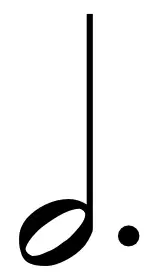


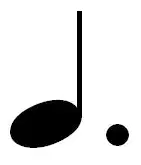
Its usual beat pattern has a strong first beat, and weak second and third beat.
Triple Meter
Duple Meter
Quadruple Meter
What does the number at the bottom of the time signature mean?
The number of beats per measure.
What kind of note gets one beat or the beat unit.
The number of measures in the song.

What type of note gets one beat with this time signature?
eighth note
quarter note
half note

How many beats would be in each measure with this time signature?
2
4
3

What do you call this device?
Metre Tone
Tuner
Metronome
Stethoscope

thunder
forte (f)
piano (p)

1.We use notes and rests to create a composition, Identify the encircled note in this musical composition.
A. whole note
B. half note
C. quarter note
D. eighth note

