
Font size
S
M
L
XL
 Worksheets
Mid Term Review
Total questions: 86
Worksheet time: 2hrs 13mins
Name
Class
Date
1.
A runner races in the 100 meter dash. It takes her 10 seconds to finish. What is her average speed?
a)
10 m/s
b)
1000 m/s
c)
100 seconds
d)
10 seconds
2.
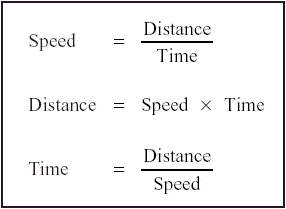
What is the formula to calculate speed?
a)
Speed = time/distance
b)
Speed = distance/time
c)
Speed = distance x time
d)
Speed = time x distance
3.
What is speed?
a)
how far you go
b)
how much distance is covered over a period of time
c)
how fast you accelerate
d)
the change in the location of a object
4.

What is the person doing from 5 seconds to 10 seconds?
a)
Walking
b)
Running
c)
Standing Still
d)
Walking Fast
5.

At 60 seconds, how far had this object traveled?
a)
0 m
b)
10 m
c)
20 m
d)
40 m
6.
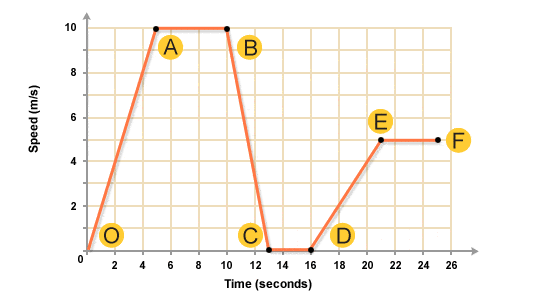
What is happening in this graph from point B to C?
a)
The object is going down a hill.
b)
The object is returning to its starting location.
c)
The object is slowing down.
d)
The object is staying still.
7.

What does this graph represent?
a)
Constant speed
b)
Acceleration
c)
Not moving
8.

What does this graph represent?
a)
Constant Speed
b)
Acceleration
c)
Not moving
9.
What is velocity?
a)
the quickness of an object
b)
the location of an object
c)
acceleration
d)
speed in a specific direction
10.
Calculate the average speed (in meter/sec) if a cheetah runs 180 meters in 10 seconds.
a)
198 m/sec
b)
170 m/sec
c)
12 m/sec
d)
18 m/sec
11.
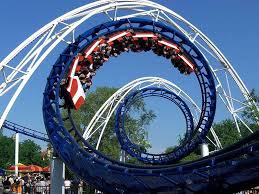
A roller coasters accelerates from an initial velocity of 6.0 m/s to a final velocity of 70 m/s over 4 seconds. What's the acceleration?
a)
24 m/s2
b)
18 m/s2
c)
16 m/s2
d)
16 m/s
12.
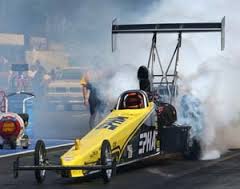
A drag racer accelerated from 0 m/s to 200 m/s in 5 s. What was the acceleration?
a)
0 m/s
b)
40 m/s2
c)
-40 m/s2
d)
40 m/s
13.
A dog runs with an initial speed of 7.5 m/s on a waxed floor. It slides to a stop in 15 seconds. What is the acceleration?
a)
-7.5 m/s
b)
-7.5 m/s2
c)
-0.5 m/s2
d)
7.5 mi//hr
14.
Acceleration can be classified as _______________
a)
Speeding up
b)
Slowing Down
c)
Changing directions
d)
All of the above
15.
The SI unit for acceleration is
a)
mph
b)
ft/sec2
c)
m/s2
16.
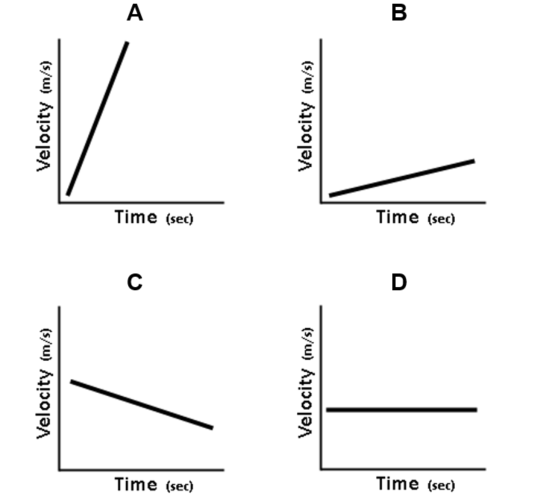
Which graph represents zero acceleration (constant velocity)?
a)
A
b)
B
c)
C
d)
D
17.
In each of the following cases, determine where the car has no acceleration ?
a)
A car shortly after a stoplight turns green.
b)
A car approaching a red light
c)
A car with the cruise control set at 80 km/h
d)
A car turning a curve at a constant speed
18.
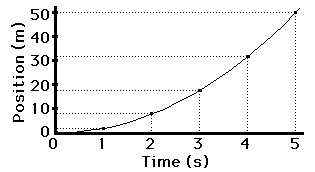
The picture of the position vs. time graph shows an object that is...
a)
accelerating/speeding up
b)
moving at a constant speed
c)
not moving
d)
accelerating/slowing down.
19.
How far will a person go if they jog for 2 hours at a speed of 12 km/hr?
a)
6 km
b)
0.5 km
c)
10 km
d)
24 km
20.
Eggs cooking in a frying pan.
a)
Conduction
b)
Convection
c)
Radiation
21.

Which of the following is not a good insulator?
a)
Copper
b)
Glass
c)
Rubber
d)
Wool
22.

At which point is potential energy greatest?
a)
W
b)
X
c)
Y
d)
Z
23.
According to the Law of Conservation of energy, the amount of energy before and after a reaction must be the same. Which statement below is true?
a)
Energy cannot be created or destroyed! Just transferred
b)
The total amount of energy is less after a reaction
c)
The total amount of energy is more after a reaction
24.

As a pendulum swings from its highest to lowest position, what happens to its kinetic and potential energy?
a)
The PE and KE increase and decrease together
b)
The PE decreases while the KE increases
c)
Impossible to know without knowing the mass
25.
The highest point on a wave is:
a)
the crest
b)
the trough
c)
the top
d)
the coast
26.
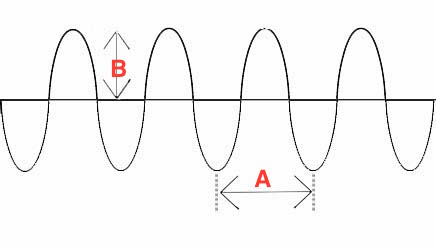
What property of the wave is represented by the letter "B"?
a)
amplitude
b)
crest
c)
trough
d)
wavelength
27.
When a wave strikes and object and bounces off. (example echo)
a)
medium
b)
refraction
c)
reflection
d)
interference
28.
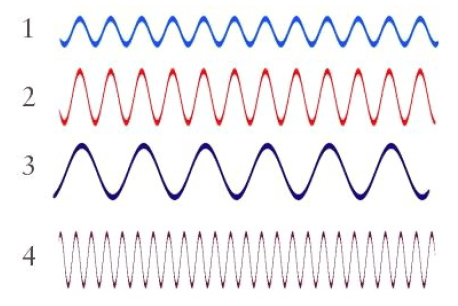
Which wave in the diagram has the greatest frequency?
a)
1
b)
2
c)
3
d)
4
29.

When a wave bends as it passes through at an angle from one medium to another.(example: pencil in a glass of water-)
a)
medium
b)
refraction
c)
reflection
d)
interference
30.
When the frequency of a wave increases, what happens to the wavelength?
a)
The wavelength is not directly affected by the frequency of a wave.
b)
The wavelength increases.
c)
The wavelength decreases.
d)
More specific information is needed to form a conclusion about the wavelength.
31.
Electromagnetic waves can transfer energy without a(n)
a)
electric field
b)
medium
c)
polarizing filter
d)
magnetic field
32.

_____________ wave particles move left to right.
a)
Transverse
b)
Electromagnetic
c)
Longitudinal
d)
Ocean
33.
All longitudinal waves travel as a series of ________________ and ________________.
a)
compressions & rarefactions
b)
compressions & reflections
c)
expansions & rarefactions
d)
expansions & reflections
34.

What kind of wave is this?
a)
Transverse
b)
Longitudinal
35.
If a material does not allow charges to move through it easily, what is it called?
a)
electrical insulator
b)
electrical conductor
c)
reistor
d)
capacitor
36.

This image represents what kind of wave behavior?
a)
Diffraction
b)
Reflection
c)
Refraction
d)
Resonance
37.
What does it mean to refract?
a)
bounce off
b)
to bend
c)
curve outward
d)
reflect
38.

Which energy transformation occurred?
a)
chemical energy transformed into light and heat energy.
b)
Electrical energy transformed into light and heat energy.
c)
Heat energy transformed into light and electrical energy.
d)
Light energy transformed into heat and chemical energy.
39.
Which activity best demonstrates the transfer of heat energy through radiation?
a)
An egg is frying in a heated pan.
b)
A marshmallow is burning when held above a campfire.
c)
A hamburger is cooking on a hot grill.
d)
A metal in a cup of hot tea.
40.
Jerome rubs a balloon against his hair. Then he puts the balloon on the wall. It stays there. Why did the balloon stick to the wall?
a)
static electricity
b)
magnetism
c)
heat energy
d)
power
41.

Rube Goldberg is a name associated with energy transformations. He was a ...
a)
cartoonist
b)
architect
c)
engineer
d)
scientist
42.

What variables directly affect the PE of an object?
a)
height, weight, velocity
b)
velocity, mass, distance
c)
mass, gravity, height
d)
weight, gravity, distance
43.

What 2 quantities are always conserved in any physical or chemical process?
a)
light and mechanical energy
b)
density and thermal energy
c)
gravity and potential energy
d)
matter and energy
44.

Which variable directly affects the KE of an object?
a)
distance the object moves
b)
the object's mass
c)
the gravitational pull on the object
d)
the height the object is at
45.

A sealed container holds 100mL of ice. The mass of the container and its contents are is 100g.What will happen to the mass of the container and its contents when the ice melts?
a)
its mass will increase
b)
its mass will decrease
c)
its mass will remain the same
46.
A beaker full of water is set upon a hot plate turned on to its highest setting. The water begins to boil. A pinwheel (turbine) begins to rotate when it is placed above the beaker of boiling water.
What transfer is occurring between the bottom of the beaker and the hotplate?
What transfer is occurring between the bottom of the beaker and the hotplate?
a)
conduction
b)
convection
c)
radiation
47.

The law of conservation of mass states that
a)
mass can't be created nor destroyed, only rearranged
b)
energy can't be created nor destroyed, only transformed or transferred
c)
mass can't be created nor destroyed, only transformed or transferred
d)
energy can't be created nor destroyed, only rearranged
48.

The law of conservation of energy states that
a)
energy can't be created nor destroyed, only transformed or transferred
b)
mass can't be created nor destroyed, only transformed or transferred
c)
energy can't be created nor destroyed, only rearranged
d)
mass can't be created nor destroyed, only rearranged
49.

A pendulum is pulled back and released. What will eventually happen and why?
a)
the pendulum will stop swinging because energy leaves the system as thermal energy due to friction
b)
the pendulum won't stop swinging because energy is always conserved
c)
the pendulum will stop swinging because gravity is pushing down with a greater force with each swing
d)
the pendulum won't stop swinging because its kinetic energy and potential energy will always be equal to one another
50.
Which of the energy forms listed are classified as potential energy?
a)
gravitational, nuclear, elastic, chemical
b)
gravitational, mechanical, thermal, nuclear
c)
sound, electromagnetic, mechanical, electrical
d)
sound, elastic, electromagnetic, gravitational
51.
Which are the energy forms classified as kinetic?
a)
thermal, sound, mechanical, electrical, electromagnetic
b)
thermal, nuclear, elastic, sound
c)
chemical, nuclear, elastic, gravitational
d)
thermal, electrical, elastic, electromagnetic, sound
52.
An element that is a good conductor of heat and electricity is a ___.
a)
metal
b)
non-metal
c)
metalloid
d)
noble gas
53.
A material that heat or electricity cannot easily pass through is called a(n) ___.
a)
conductor
b)
resistor
c)
insulator
d)
locator
54.
A worker drops his hammer off the roof of a house. If the hammer weighs 88.2 newtons and gravity accelerates it at 9.8 m/s2, What is the mass of the hammer? (force = mass x acceleration)
a)
864.36 grams
b)
9 grams
c)
about 0.1 grams
d)
there is not enough information to answer this question
55.
Which term refers to an object's tendency to resist a change in motion?
a)
stubbornness
b)
friction
c)
inertia
d)
acceleration
56.
The transfer of thermal energy is called ___.
a)
heat
b)
specific heat
c)
viscosity
d)
Avada Kedavra
57.
When Wyle E. Coyote is waiting for the Road Runner with a huge boulder at the top of a cliff, which type of energy is being demonstrated?
a)
mechanical
b)
kinetic
c)
potential
d)
cartoon
58.
A material a wave travels through is called a ___.
a)
vaccuum
b)
medium
c)
frequency
d)
crest
59.
True or False:
The particles in both a solution and a colloid can scatter light.
The particles in both a solution and a colloid can scatter light.
a)
True
b)
False
60.
The frequency of violet light is ____ that of yellow light.
a)
higher than
b)
lower than
c)
the same as
d)
faster than
61.
Temperature is the average amount of _____.
a)
chemical energy
b)
kinetic energy
c)
thermometer energy
d)
potential energy
62.

The picture above shows a large box being pushed by two men. The box did not change its position in the room because…
a)
A. The opposing forces were balanced
b)
B. The smooth floor created no friction
c)
C. The man on the left side applied more force than the man on the right side.
d)
D. The man on the right side applied more force than the man on the left side.
63.
When you walk on the sidewalk and roll your bike, the force you use is a
a)
pull
b)
pulley
c)
push
d)
lever
64.
When a ball is thrown into the air, it falls back to the ground. What causes this to happen?
a)
the round shape of the ball
b)
the way the ball is thrown
c)
the force of the air against the ball
d)
the force of gravity on the ball
65.
Why can astronauts jump higher on the Moon than on Earth?
a)
There is more oxygen on the Moon.
b)
Their pressurized suits help them.
c)
The Moon's gravity is weaker than Earth's.
d)
The warm temperature on the Moon gives the astronauts more energy.
66.
Energy can neither be created nor destroyed, it just changes form.
a)
Law of Matter
b)
Law of Conservation of Energy
c)
Law of Light Energy
d)
Law of Solar Energy
67.
Which of the following increases when the force applied to an object increases?
a)
A. The acceleration of the object.
b)
B. The force of gravity on the object.
c)
C. The effects of inertia on the object.
d)
D. The velocity of the object.
68.

The line graph show that a car is ...
a)
A. Not moving.
b)
B.Moving at a constant speed.
c)
C. Speeding up and then slowing down.
d)
D. None of the above are correct.
69.
As a sample of matter is heated, its particles ____.
a)
are unaffected
b)
move more quickly
c)
move more slowly
d)
stop moving
70.
An object at rest stays at rest and an object in motion stays in motion unless acted on by an unbalanced force states which of Newton's laws of motion?
a)
Newton's 1st Law
b)
Newton's 2nd Law
c)
Newton's 3rd Law
d)
Newton's 5th Law
71.
Which term refers to an object's tendency to resist a change in it's motion?
a)
resistance
b)
stubborn
c)
inertia
d)
acceleration
72.
In any change, chemical or physical, the mass of the starting stuff is _________ the mass of the ending stuff.
a)
the same
b)
different
c)
less than
d)
more than
73.

How fast is the car traveling at 30 seconds?
a)
5m/s
b)
10m/s
c)
20m/s
d)
30m/s
74.
The pull of gravity on an object
a)
mass
b)
weight
c)
volume
75.
The process that allows you to hear the sound of a drum around the corner is:
a)
Refraction
b)
Diffraction
c)
Polarization
d)
Absorption
76.
What must be true if an object is accelerating?
a)
Friction is not acting on the object.
b)
The object no longer has inertia.
c)
Unbalanced forces act on the object.
d)
Balanced forces act on the object.
77.
Which example describes kinetic energy being converted into potential energy?
a)
A ball being lifted to a shelf
b)
An acorn falling from a tree
c)
A car rolling down a hill
d)
A baseball being thrown to a batter
78.
You produce a wave on a rope by moving the end of the rope up and down repeatedly. How can you increase the amplitude of the wave?
a)
Move your hand in a circular pattern.
b)
Move your hand a greater distance.
c)
Move your hand up and down more quickly.
d)
Move your hand from side to side instead.
79.
How does heat generally travel from a stove to the teapot on the stove?
a)
Radiation
b)
Convection
c)
Conduction
d)
Sublimation
80.
Whenever you use a Class 3 lever, the force you apply must always be greater than the load. What then is the advantage of using this type of lever?
a)
The amount of work done is increased.
b)
The effort force can be exerted over a shorter distance.
c)
The direction of the force is reversed.
d)
The amount of work required is reduced.
81.
In the engine of a car, chemical energy in gasoline is converted into mechanical energy to move the car. However, the amount of chemical energy used does not equal the amount of mechanical energy produced. You know that the law of conservation of energy states that energy cannot be created nor destroyed. What happened to the majority of the remaining energy?
a)
It was changed to light energy for the spark plugs.
b)
It was changed to electrical energy and stored in the battery.
c)
Most of it was changed to heat energy and released into the environment.
d)
Most of it was changed to sound energy and released into the environment.
82.
Sound travels MOST quickly through
a)
Gases
b)
Liquids
c)
Solids
83.
Which description relates to light but NOT to sound?
a)
It consists of waves.
b)
It does not disturb the particles of a medium.
c)
It carries energy from one place to another.
d)
It is produced by vibration.
84.
Which of these describes an object with the LARGEST acceleration?
a)
An object with a small change in velocity over a small change in time.
b)
An object with a small change in velocity over a large change in time.
c)
An object with a large change in velocity over a small change in time.
d)
An object with a large change in velocity over a large change in time.
85.
Ms. Lee heats a pot of water on her stove. Water heated at the bottom of the pot flows to the top of the pot. The colder water at the top sinks. As the water moves, heat flows from the hotter water to the colder water.
Which of these statements describes this method of heat transfer?
Which of these statements describes this method of heat transfer?
a)
Conduction
b)
Convection
c)
Emission
d)
Radiation
86.
A student has an aquarium filled with water. Light shines through the window and into the aquarium.
Which of these describes how the light wave will MOST LIKELY change as it moves from air to water?
Which of these describes how the light wave will MOST LIKELY change as it moves from air to water?
a)
The light wave will be absorbed.
b)
The light wave will be diffracted.
c)
The light wave will be reflected.
d)
The light wave will be refracted.
Reset

