wayground logo

Free Printable Worksheets

Font size

S
M
L
XL
Worksheets

Honors Chemistry Pre-Test

Total questions: 88

Worksheet time: 3hrs 37mins

Name
Class
Date
1.

Before you leave the science room, you should

a)

wash your hands with soap and water.

b)

return all equipmernt to the proper storage area.

c)

clean your work area and equipment.

d)

all of the above.

2.

You have been injured in the laboratory (cut, burn, etc.). First you should

a)

apply first aid yourself

b)

tell your science teacher immediately

c)

see a doctor after school

d)

visit the school nurse after class

3.

Goggles are worn in the lab...

a)

any time chemicals are used

b)

any time heat is used

c)

any time glassware is used

d)

all of the above

e)

none of the above

4.

What is the center of an atom called?

a)

Neutron

b)

Proton

c)

Nucleus

d)

Electron

5.

What is a particle with one negative charge called?

a)

electron

b)

proton

c)

quark

d)

neutron

6.
Where are electrons of an atom found?
a)
Nucleus
b)
Electron Cloud
c)
Some are in the nucleus and some in the electron cloud.
d)
They are moving everywhere.
7.

What does the nucleus of an atom contain?

a)

Electrons and neutrons

b)

Protons and neutrons

c)

Neutrinos and positrons

d)

DNA and RNA

8.
If an atom has more protons that electrons, it will have a ___ charge?
a)
Positive
b)
Negative
c)
Neutral
d)
No charge, it would just disappear
9.
An experiment is performed on plants to see how different liquids affect plant growth. Each plant in the experiment is given a different liquid; water, apple juice, or milk. Each plant has the same amount of soil, sunlight, and listens to the same music. In this investigation, the independent variable is ...
a)
The type of plant
b)
The amount of sunlight
c)
The type of music
d)
The type of liquid
10.
If you increase the amount of spinach you eat, then you will increase the iron in your blood. 
What's the dependent variable?
a)
increase the amount of iron in your blood
b)
spinach you eat
11.
What are the building blocks of MATTER?
a)
Atoms
b)
Cells
c)
Protons
d)
Neutrons
12.
What are the positively charged particles in an atom?
a)
Protons
b)
Neutrons
c)
Electrons
13.

States of Matter: Solid turning into a gas is called...

a)

melting

b)

freezing

c)

evaporation

d)

condensation

e)

sublimation

14.

States of Matter: Gas turning into a liquid is called...

a)

melting

b)

freezing

c)

evaporation

d)

condensation

e)

sublimation

15.

States of Matter: Which of the following has a tightly packed structure?

a)

solid

b)

liquid

c)

gas

16.

Atoms of the same element that have different numbers of neutrons.

a)

Isotope

b)

Covalent Bond

c)

Enzymes

d)

Ionic Bonds

17.

Which of these is an example of a Heterogeneous mixture:

a)

Tea with sugar

b)

oil and water

c)

NaCl

d)

H2O

18.

Which of these is an example of a Compound:

a)

Tea with sugar

b)

oil and water

c)

Gold

d)

H2O

19.
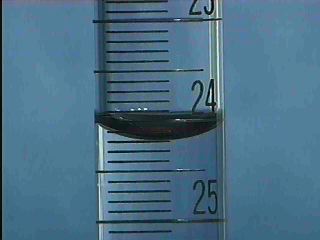
What is the volume in this buret?
a)
24.1mL
b)
24.3mL
c)
24.2L
d)
24.2mL
20.
Two basic properties of the gas phase are 
a)
a. a definite shape and definite volume
b)
b. a definite shape but no definite volume
c)
c. no definite shape but a definite volume
d)
d. no definite shape and no definite volume
21.

What are the states of matter?

a)

solid, liquid, gas, and plasma

b)

solid, water, gas, and plasma

c)

wood, liquid, gas, and water

d)

solid, liquid, helium, and wood

22.

Two or more substances that are together but NOT chemically combined is a(n)

a)

element

b)

compound

c)

mixture

d)

all of the above

23.

What describes how much matter is in an object?

a)

volume

b)

density

c)

mass

d)

weight

24.
________________ is anything that has mass and takes up space.
a)
volume
b)
matter
c)
mass
d)
weight
25.

Which lab tool should you use to measure the volume of a liquid?

a)

beaker

b)

electric balance

c)

test tube

d)

graduated cylinder

26.
Why do ice cubes float in a  glass of water?
a)
the ice cubes are more dense than the water
b)
the water is more dense than the ice cubes
c)
the water is more dense than the glass
d)
the ice is more dense than the glass
27.
A slower particle has a lower energy than an identical, faster particle.
a)
True
b)
False
28.

Write 7.113 x 10⁷ in standard form.

a)

71,130,000

b)

7,113,000

c)

0.0000007113

d)

7,113

29.
Write 0.00000707 in scientific notation.
a)
7.07 x 10⁻⁶
b)
7.07 x 10⁶
c)
707 x 108
d)
707 x 10-8
30.
Which of the following is correct scientific notation?
a)
20.35 x 10⁴
b)
.2035 x 104
c)
2035 4
d)
2.035 x10⁴
31.
Which is the smallest?
1.3 x 10²⁰
2.9 x 10²¹
9.5 x 1032
8.4 x 10¹⁹
a)
1.3 x 10²⁰
b)
2.9 x 10²¹
c)
9.5 x 1032
d)
8.4 x 10¹⁹
32.

987 mm = _____ cm

a)

98.7 cm

b)

9,870 cm

c)

9.87 cm

d)

0.987 cm

33.

2.7 L = _____ mL

a)

0.27 mL

b)

270 mL

c)

2,700 mL

d)

27 mL

34.

10 m = _____ mm

a)

10,000 mm

b)

100 mm

c)

1 mm

d)

1,000 mm

35.

Which item has the highest density #?

a)

honey

b)

dish soap

c)

water

d)

vegetable oil

36.
A cube has a  volume od 8.0 cm3 and a mass of 21.6 grams.  The density of the cube, in grams per cubic centimeter, is best expressed as
a)
a. 2.7
b)
b. 2.70
c)
c. 0.37
d)
d. 0.370
37.
The atomic number of an atom is always equal to the total number of 
a)
a. neutrons in the nucleus
b)
b. protons in the nucleus
c)
c. neutrons plus protons in the atom
d)
d. protons plus electrons in the atom
38.
All the atoms of argon have the same
a)
a. mass number
b)
b. atomic number
c)
c. number of neutrons
d)
d. number of nucleons
39.
a)
a. A
b)
b. B
c)
c. C
d)
d. D
40.
What is the mass number of an atom which contains 21 electrons, 21 protons, and 24 neutrons?
a)
a. 21
b)
b. 42
c)
c. 45
d)
d. 66
41.
What is the total number of neutrons in an atom of 7Li3?
a)
a. 7
b)
b. 10
c)
c. 3
d)
d. 4
42.
What is the total number of electrons in a Mg2+ ion?
a)
a. 10
b)
b. 2
c)
c. 12
d)
d. 24
43.
A K atom differs from a K+ ion in that the K atom has one
a)
a. more electron
b)
b. less electron
c)
c. more proton
d)
d. less proton
44.

The ___ constitutes most of the volume of an atom.

a)

Neutrons

b)

Electron Cloud

c)

Nucleus

d)

Protons

45.
How many electrons can the first energy level hold?
a)
1
b)
2
c)
8
d)
0
46.

What is the oxidation number for Carbon?

a)

+4 and -4

b)

-3

c)

+1

47.

Is this the correct lewis dot for Chlorine?

a)

yes

b)

no

48.

An ionic bond is between

a)

metal and metal

b)

metal and nonmetal

c)

nonmetal and nonmetal

49.

1s22s22p63s23p63d104s24p3

Which element does this configuration belong to?

a)

Arsenic

b)

Calcium

c)

Lithium

d)

Aluminum

50.

A covalent bond is formed as a result of

a)

transferring electrons

b)

sharing electrons

c)

transferring protons

d)

sharing protons

51.
The elements in the modern Periodic Table are arranged according to their
a)
a. atomic number
b)
b. oxidation number
c)
c. atomic mass
d)
d. nuclear mass
52.
Which element has chemical properties that are most similar to the chemical properties of sodium?
a)
a. Mg
b)
b. K
c)
c. Se
d)
d. Cl
53.
Which element is a noble gas?
a)
a. krypton
b)
b. chlorine
c)
c. antimony
d)
d. manganese
54.

Which of the following is a nonmetal?

a)

calcium

b)

iron

c)

hydrogen

d)

potassium

55.

Which element is in period 5 group 3?

a)

F

b)

B

c)

E

d)

A

56.
Is silicon a metal, nonmetal or metalloid?
a)
Metal
b)
NonMetal
c)
Metalloid
57.

Which of these are considered properties of metals? (choose ALL that apply)

a)

brittleness

b)

low melting point

c)

luster (shininess)

d)

malleability

e)

ductility

58.
Which of these would be covalently bonded
a)
Fr and K
b)
Sc and O 
c)
F and Cl
d)
He and Pt
59.

What is the ionic formula for a bond between Calcium and Phosphorus?

a)

Ca2P3

b)

Ca3P2

c)

Ca2P5

d)

P5Ca2

60.
How many Al atoms are in this compound?         4Al2O3
a)
2
b)
8
c)
6
d)
4
61.
What atom matches this electron configuration?
1s22s22p63s23p64s23d10
a)
Zinc
b)
Copper
c)
Nickel
d)
Germanium
62.

Name the compound Na2O

a)

Sodium Oxide

b)

Sodium Dioxide

c)

Sodium Oxygen

d)

Sodium (I) Oxide

63.
Give the formula for oxygen dichloride
a)
OCl2
b)

O2Cl2

c)
OCl
d)
O2Cl
64.
Heat flows from _______ to ______ objects
a)
cooler to warmer
b)
warmer to warmer
c)
warmer to cooler
d)
cooler to cooler
65.
A slower particle has a lower energy than an identical, faster particle.
a)
True
b)
False
66.
How do nuclear power-plants work?
a)
Fusion
b)
Half-life
c)
Fission
d)
Fusion or fission
67.

A process that absorbs heat is a(n) _________.

a)

Exothermic process

b)

Polythermic process

c)

Endothermic process

d)

Ectothermic process

68.

Why does a collision with an airbag (a gas-filled bag) hurt less than a collision with a steering wheel (a solid)?

a)

Particles of a gas have less mass than particles of a solid

b)

Particles of a gas are smaller than particles of a solid

c)

Gases are more chemically reactive than solids

d)

Particles of a gas are spread apart and compressible, while particles of a solid are held firmly in one position

69.

Which of the following statements is NOT true about what happens in all chemical reactions?

a)

The ways in which atoms are joined together change

b)

New atoms are formed as products

c)

The starting substances are called reactants

d)

The bonds of reactants are broken and new bonds of products are formed

70.

What are the coefficients that will balance the skeleton equation below?

AlCl3 + NaOH → Al(OH)3 + NaCl

a)

1,3,1,3

b)

3,1,3,1

c)

1,1,1,3

d)

1,3,3,1

71.

Identify the products in this reaction: 6H2O + 6CO2 → C6H12O6 + 6O2.

a)

6H2 and 6CO2

b)

6CO2 and C6H12O6

c)

6H2O, C6H12O6, and 6O2

d)

C6H12O6 and 6O2

72.

Three 10 g samples of sugar are represented below.


Sample A dissolves in water more slowly than sample B.

Sample B dissolves more slowly than sample C.

Which of the following best explains why sample A dissolves more slowly than the other two?

a)

It has the most volume.

b)

It has the smallest surface area.

c)

It has the largest number of sugar molecules.

d)

It has the fewest bonds between sugar modules.

73.

The solubility graph below shows the amounts of four substances that will dissolve in 100 grams of water at various water temperatures.


Which substance has 80 grams of solute dissolved in 100 grams of water at 50 C?

a)

Potassium Bromide

b)

Ammonium Chloride

c)

Potassium Chloride

d)

Lithium Hydroxide

74.
If the pH of a solution is 7 the solution is said to be
a)
Acidic
b)
Basic
c)
Neutral
d)
Tasty
75.
Heat flows from _______ to ______ objects
a)
cooler to warmer
b)
warmer to warmer
c)
warmer to cooler
d)
cooler to cooler
76.
Which pH value indicates the most basic solution?
a)
a. 7
b)
b. 8
c)
c. 3
d)
d. 11
77.
Which is the most likely pH for a solution of a weak acid?
a)
a. 1
b)
b. 5
c)
c. 11
d)
d. 14
78.

How many moles of aluminum are needed to react completely with 1.2 mol of FeO?

2Al(s) + 3FeO(s) → 3Fe(s) + Al2O3(s)

a)

1.2 mol

b)

0.8 mol

c)

1.6 mol

d)

2.4 mol

79.

The equation 2C3H7OH + 9O2 → 6CO2 + 8H2O is an example of which type of reaction?

a)

Combustion reaction

b)

Single replacement reaction

c)

Double replacement reaction

d)

Decomposition reaction

80.

Which answer is an example of a chemical change?

a)

Boiling water

b)

rusting iron

c)

dissolving powder

d)

freezing water

81.

How many atoms are there in one mole of any element?

a)

6.02x10⁻²³

b)

6.02x10²³

c)

22.4

d)

2.06x10⁻²

82.
Which of the following colors of visible light has the longest wavelength?
a)
orange
b)
blue
c)
red
d)
green
83.
High frequency waves have _________ wavelength.
a)
varying
b)
high
c)
the same
d)
low
84.
What is the molar mass of one molecule of Nitrogen N2?
a)
14.01 amu
b)
14.01 g
c)
28.02 g
d)
28.02 amu
85.
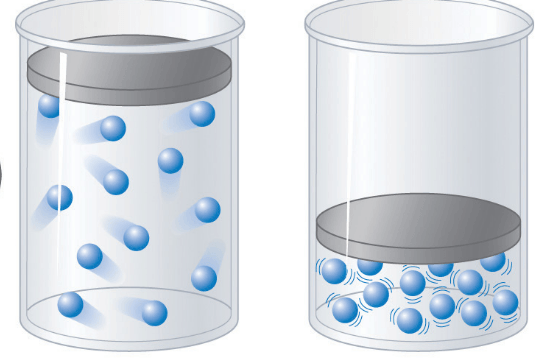
Which container will have a lower pressure?
a)
left
b)
right
c)
they both have the same pressure
d)
I don't know
86.
What is the scale on this graduated cylinder?
a)
.1 mL per line
b)
.2 mL per line
c)
.5 mL per line
d)
1 mL per line
87.
What is the volume of the liquid in this graduated cylinder?
a)
8.2 mL 
b)
8.02 mL 
c)
82 mL 
d)
9.8 mL
88.

What is the volume displacement of the robot?

a)

1.4

b)

1.6

c)

1.8

d)

2