
 Worksheets
Weather Test #2 Review
Total questions: 35
Worksheet time: 46mins
Name
Class
Date
1.

What does symbol # 4 mean?
a)
Stationary Front
b)
Occluded Front
c)
Warm Front
d)
Cold Front
2.

What type of storm front if this?
a)
Warm Front
b)
Cold Front
c)
Stationary Front
d)
Occluded Front
3.

What type of storm front is this?
a)
Warm Front
b)
Cold Front
c)
Occluded Front
d)
Stationary Front
4.
What type of cloud does thunderstorms and tornadoes form in?
a)
cumulus
b)
cumulonimbus
c)
stratus
d)
nimbus
5.

Which of these would you NOT expect from a thunderstorm?
a)
lightning
b)
strong wind
c)
storm surge
d)
heavy rain
6.
A severe storm that involves high winds and forms over water is:
a)
tornado
b)
thunderstorm
c)
hurricane
d)
blizzard
7.
These can be produced by thunderstorms
a)
stationary fronts
b)
tornadoes
c)
volcanoes
d)
tsunamis
8.
What do hurricanes feed on?
a)
warm tropical water
b)
hot water
c)
cold artic water
d)
rain
9.
An air that can be described as continental polar is defined as?
a)
dry and cold
b)
dry and warm
c)
humid and warm
d)
humid and cold
10.
When discussing air masses in locations like Florida and California, what type of air mass is present?
a)
Continental Arctic
b)
Continental Polar
c)
Maritime Tropical
d)
Maritime Polar
11.
What causes a hurricane to lose energy when it moves onto land?
a)
Heating below land
b)
lack of warm, moist air
c)
lack of cold, dry air
d)
none of the above
12.
When a cold front or a warm front stays in place for several days without invading another front, it is called a ______.
a)
stationary front
b)
cold front
c)
occluded front
d)
warm front
13.
_______ pressure systems are characterized by cloudy, rainy weather.
a)
High
b)
Low
14.
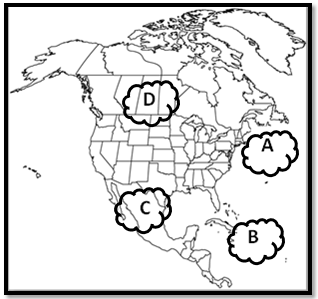
Which type of air would you find at air mass B?
a)
cold, dry
b)
warm, humid
c)
warm, dry
d)
cold, humid
15.
What type of weather would you expect to see after a cold front has passed through an area?
a)
cool and clear skies
b)
warm and humid
c)
thunderstorms
d)
foggy
16.

This is the large electrical discharge during a thunderstorm, caused by static electricity.
a)
thunder
b)
lightning
c)
storm surge
d)
The Flash
17.
Where does the initial source of energy come from that creates winds?
a)
the moon
b)
the Sun
c)
the Earth's surface
d)
the rotation of the Earth
18.
The Coriolis effect causes ___________.
a)
the Earth to rotate on its axis
b)
continental deflection
c)
global winds and surface currents to move in a curved path instead of a straight line
d)
global winds and deep ocean currents to move in a curved path instead of a straight line.
19.
The jet stream usually moves from
a)
north to south
b)
west to east
c)
east to west
d)
south to north
20.
Which two properties characterize an air mass?
a)
temperature and location
b)
temperature and pressure
c)
temperature and moisture
d)
moisture and pressure
21.
A cT air mass is...
a)
cold and dry
b)
cold and wet
c)
hot and dry
d)
hot and wet
22.
The boundary that separates different air masses is called a(n)..
a)
front
b)
cyclone
c)
anticyclone
d)
storm
23.
On a weather map, which type of front is shown by a line with semicircles extending from one side?
a)
warm
b)
cold
c)
stationary
d)
occluded
24.
Along which type of front is the intensity of precipitation generally heavy, but short-lived?
a)
warm front
b)
cold front
c)
stationary front
d)
occluded front
25.
Which statement correctly defines wind?
a)
Wind is the movement of air from an area of low pressure to an area of high pressure
b)
Wind is the movement of air to a colder area in the atmosphere.
c)
Wind is the movement of air from an area of high pressure to an area of low pressure.
d)
Wind is the movement of air pushed around and bouncing off Earth's surface.
26.
Why do sea breezes occur during the day?
a)
Water heats up faster than land, so the air above water is warmer.
b)
Water cools off faster than land, so the air above land is cooler.
c)
Land heats up slower than water, so the air stays cooler during the day.
d)
Land heats up faster than water, so the air above land is warmer.
27.
Warm, rising air at the Equator forms a calm, weak wind called the:
a)
Doldrums
b)
Trade Winds
c)
Polar Easterlies
d)
Westerlies
28.

What is found at letter E?
a)
Polar Easterlies
b)
Prevailing Westerlies
c)
Doldrums
d)
Tradewinds
29.
Which is true about sea breezes?
a)
They form when both the land and the ocean have cooler temperatures
b)
They form when both the land and the ocean have warmer temperatures
c)
They form because the land warms up more quickly than the cooler ocean waters
d)
They form because the ocean warms up more quickly than the land
30.
Which of these actions causes wind?
a)
the rotation of the Earth on it's axis
b)
movement of air from water to land
c)
uneven heating of the earth's surface
d)
air passing earth as it revolves around the sun
31.
You are sitting in a pocket of high air pressure. The weather would probably be...
a)
Rainy and cloudy
b)
Sunny and warm
32.
What is a barometer used for?
a)
To help you measure temperature
b)
To help you measure wind speed
c)
To help you measure air pressure
33.

Which diagram shows the formation of a sea breeze?
a)
diagram Y
b)
diagram X
c)
neither
d)
both
34.
Ohio often has the weather that Indiana recently had because weather in the United States tends to move from
a)
north to south
b)
south to north
c)
west to east
d)
east to west
35.

Why does warm air rise?
a)
Warm air is more dense than cooler air.
b)
Warm air has more pressure than cooler air.
c)
Warm air is less dense than cooler air.
d)
Warm air has a higher dew point than cooler air.
100 %

